|
| |||
|
ANNOUNCEMENTS &
NEW ITEMS:
Meanwhile, mankind’s enslavement continues. It
works like this: In order to get people to accept a fully-surveilled, open
prison, cashless society, social credit system, ... a gradual wearing down
process is implemented. “First you wear people down. Poison them with drugs,
vaccines, fluoride, and chemical assaults so they become fat and dumb. Put
addictive devices in their hands and bombard them with propagandized movies,
TV, and Masonically-controlled actors and musicians. Destroy the food
supply, poison the water and the air, manufacture fake climate change while
blaming it all on the people, and tax them to death for it.” Push
‘sustainability’ according to the UN-2030 Agenda and the
World-Economic-Forum Cult. Work towards the implementation of “15-minute
SMART-city enslavement camps.” At the same time “give them all sorts of
distractions, from the two-party political charade (with the illusion of
choice when it is a totally rigged game), manufacture social disharmony, and
grow up controlled opposition to divide and conquer any truth movement that
appears to be gaining any momentum.”
Meanwhile: We stand at a crisis—the supreme crisis of the ages. For unnumbered millenniums man has toiled upward from the dank jungles of savagery toward glorious heights which his mental and spiritual potentialities give promise that he shall attain. His path has been slow and wavering. Time and again he has lost his way and plunged into deep valleys. Man’s trail is littered with the wrecks of dead civilizations and dotted with the graves of promising peoples stricken by an untimely end. –Lothrop Stoddard’s dire warning of the dangers of the practice of dysgenics (1921 !)
The World Conquerors, The Real War Criminals by Louis Marschalko
Meanwhile: Reflect on the mega-crime of the last century —Dresden
Hellstorm (February 13-15, 1945). It is appalling to think its
perpetrators were actually hailed as war heroes!
| |||
|
“Laws of Physics Twentieth-Century Scientists
Overlooked”
Available on AMAZON.com
The Nature of Gravitational Collapse
Guide to the Construction of the Natural Universe
Participate in a unique exploration of the Cosmos: venture into the
sub-atomic realm, even into the sub-quantum realm where the roots of reality
reside, and into the domain of cosmic-scale cell-structure and beyond to
infinity. Along the way, discover the cause of mass, the cause of
gravitation, and rediscover Einstein’s “nonponderable” aether and Heraclitus’
harmony-of-opposites principle. … The book represents the ultimate
vindication for all the skeptics who resisted the "preposterous" Big Bang
mythology and who refused to join the exploding-cosmos religion. POPULAR RESEARCH PAPERS:
| |||
|
Glossary of Terms
used in Cosmology and Astrophysics with particular emphasis on DSSU theory. |
|||
|
GENERAL INTEREST ARTICLES: | |||
|
COSMOLOGY ARTICLES, etc:
Large-Scale Structure of the Dynamic Steady State Universe published in
the American Journal of Astronomy and Astrophysics, Vol.4, No.6,
2016, pp.65-77.
Astract and Links. Galaxy Morphology:
Ellipticity, Its Origin & Progression in Comoving Galaxies, American Journal of Astronomy & Astrophysics,
AJAA, Vol.3, No.2, 2015.
EXTERNAL LINKS:
| |||
|
DSSU Theory:
The Fundamental Process of Energy —A Qualitative Unification of
Energy, Mass, and Gravity. (Abstract
& Reviews & Links) … This article reveals
the secret behind photon confinement. (Contains only a bare minimum of mathematics
and mainly in one of the 14 sections.)
Headlined as:
| |||
|
ARTICLES on AETHER: |
|||
|
DSSU RESEARCH PAPERS: |
|||
|
GRAVITY:
|
|||
|
RELATIVITY ARTICLES: |
|||
|
An Open Letter to the Scientific Community "The big bang today relies on a growing number of hypothetical entities, things that we have never observed-- inflation, dark matter and dark energy are the most prominent examples. Without them, there would be a fatal contradiction between the observations made by astronomers and the predictions of the big bang theory. In no other field of physics would this continual recourse to new hypothetical objects be accepted as a way of bridging the gap between theory and observation. It would, at the least, raise serious questions about the validity of the underlying theory. ..." continues ... A devastating Declaration of opposition to Big Bang cosmology signed by more than 400 Researchers.
|
|||
|
INTELLECTUAL FREEDOM:
|
|||
|
DEDICATION: This website is solemnly dedicated to those
individuals who have conducted research in their chosen field and have
informed others of their inquiries and suffered the consequences when
subpoenaed by the Inquisition or some variant thereof. The dedication
extends to those individuals currently imprisoned, and those facing
trial and persecution simply for exercising their basic human right of
freedom of expression supposedly granted to them under the UN Charter of
Human Rights. "Every year, hundreds of writers and other literary professionals around the world are imprisoned, prosecuted, persecuted, attacked, threatened, forced into exile or even murdered as a result of their work." ALSO: Be aware of the continuing threat to our precious freedom of expression on the Internet. The threat is serious and relentless. It is described as “… the formal effort to mimic Communist China’s system of Internet censorship.” – www.InfoWars.com More information on threats to internet freedom: https://battleforthenet.com/ End of free speech in Britain:
A publisher of history books in Britain has reported that “due to new laws
in the UK all their books will have to be censored moving forward” to avoid
criminal penalties for “inciting racial hatred.” –The Barnes Review (2020 March/April)
p77 In repressive Germany:
Ursula Haverbeck,
89, Sentenced to 14 Months in Jail for Heresy! –2017 November George Orwell Free Speech Awards:
The Supreme Irony:
□ The Continuing Struggle for Freedom A ray of hope in the ongoing struggle for freedom. Populist and nationalist movements around the world are gaining ascendancy over the New World Order’s effort to establish global governance and impose tyrannical control over every last square meter of the Earth’s surface. –The Barnes Review Vol.23 No.1 (2017 Jan p70)
The ongoing fight for freedom and truth. –Just Right Media (2020, Sept 18, program)
● Pro-Freedom NEWS:
Vanguard News
For more on Freedom (and Objectivism), |
|||
|
... about the author ...
D S S U Research,
Niagara Falls, Canada Visits since mid-2010 :
2026-10-9 |

.jpg)

.jpg)
The
Aether
Experiments
| ||||||||||||||||||||||||||||||||||||||||||||||||||||||||||||||||||||||||||||||||||||||||||||||||||||||||||||||||||||||
|
|
|

Although Michelson never did carry out the recommendations contained in his concluding remarks, others did and it is their experiments (performed during the 20th century) that accumulated definitive evidence and confirmed the existence of aether.
And the most extraordinary of these is the series of experiments carried out over a 30 year period by Dayton Miller, from 1904 to the mid 1930s, using far more sensitive apparatus than the one used by Michelson and Morley, and which clearly and consistently showed an aether drift effect. His measurements taken in the years 1925 and 1926 atop Mt. Wilson in California were particularly significant, and again detected the anisotropy of the speed of light —the signature of aether and absolute motion. As Professor Cahill explains, “Had Michelson and Morley been as astute as their younger colleague [Dayton] Miller, and had been more careful in reporting their non-null data, the history of physics over the last 100 years would have been totally different.” [12] And in particular our understanding of space and gravitation would now be totally different. Unfortunately the Miller experiments came too late, took too long, and contained a calculation error. And since the results contradicted Einstein and Relativity, they were at first ignored. By the time Miller had sorted out the M-M misinterpretation, the world of physics (and cosmology) had adopted the four-dimensional ontology[13] —in which all motion is relative and absolute motion is meaningless.
The experiments of Michelson and Morley and of Dayton Miller, have been repeated and analyzed in modern times by French engineer Maurice Allais (Nobel Prize recipient for Economic Science in 1988). It is primarily due to the work of Allais that Miller's discoveries have been brought to a modern audience. For further details see the Allais website: http://allais.maurice.free.fr/English/Science.htm . The story of Dayton Miller and what happened to his findings has also been researched and told in considerable detail by Dr. James De Meo, Director of the Orgone Biophysical Research Lab. His research paper can be found here: www.orgonelab.org/miller.htm .
4. Michelson and Morley and the Aether Theory
British researcher Richard Milton has prepared a historical analysis of the Michelson and Morley Experiments and the Aether Theory. It is an investigative tale that traces the source and the flow of the alleged null result; and details the relentless misrepresentation, bias and cover-up that hampered the Aether theory. See R. Milton’s article entitled Michelson-Morley and the Story of the Aether Theory: www.CellularUniverse.org/AA2MM&Aether.htm .
Clearly the amplitude of the fringe shift, in all the successful aether experiments, did not match prediction —but there is no question about the fact of the presence of the shift. But what is most amazing —and Richard Milton fails to mention this— is that the sinusoidal pattern of the fringe shifts versus the angle of apparatus rotation did approximate the prediction, particularly for the Miller data! Furthermore, the aether flow readings produced a minimum-and-maximum cyclical pattern over a nominal 24-hour period; somewhat analogous to the way the waxing and waning of the ocean tides will produce a sinusoidal rise-and-fall pattern.
Albert A. Michelson died in 1931, on the 9th of May. Albert Einstein publicly paid tribute to Michelson's extensive contributions to science (having received the Nobel award for his measurements of the speed of light); Michelson's leading role in changing physics; and again acknowledged the influence which the famous experiment's 'null' interpretation had on his own work:
My honored Dr. Michelson, it was you who led the physicists into new paths, and through your marvelous experimental work paved the way for the development of the theory of relativity.[14]
5. Other Aether Experiments
Various other experiments have succeeded in detecting absolute motion relative to space. Most notable are the experiments by Illingworth, Jaseja et al, Torr and Kolen, and by DeWitte. The Roland DeWitte data (as well as those of Dayton Miller) also reveal an in-flow of aether into matter; an in-flow which manifests as gravity. The in-flow also manifests turbulence and the experimental data confirms this as well, which amounts to the observation of a gravitational wave phenomenon.[15]
In 1991 Roland De Witte carried out an experiment in Brussels in which variations in the one-way speed of radio-frequency waves through a coaxial cable were recorded over 178 days. The data from this experiment show that De Witte had detected absolute motion of the earth through space. His results are in excellent agreement with the extensive data from the Miller 1925/26 detection of absolute motion using a gas-mode Michelson interferometer atop Mt. Wilson, California. The De Witte data reveal turbulence in the flow which amounted to the detection of gravitational waves. Similar effects were also seen by Miller, and by Torr and Kolen in their coaxial cable experiment.[16]
These experiments, with their extensive data, add further support to the conclusion: The Einstein assumptions leading to the Special and General Theory of Relativity are thus shown to be false. Contrary to the Einstein assumptions, absolute motion is consistent with relativistic effects, which are caused by actual dynamical effects of absolute motion through the quantum foam, so that it is Lorentzian relativity that is seen to be essentially correct.[17]
There are also aether experiments which support aether theory in another way. It is important to note that when the M-M interferometer is enclosed in a vacuum chamber, or even a near-vacuum chamber (or if placed in outer space), it serves as an instrument to confirm the Fitzgerald-Lorentzian length-contraction resulting from the absolute motion through aether. Regardless of orientation the instrument will give a near zero reading —it gives virtually no fringe shift. For instance, H. P. Kennedy and E. M. Thorndike obtained null results with a vacuum-mode apparatus. This is predicted by the modern aether theory and supported by experimental evidence. But the vast majority of physicists having rejected the concept of aether, came to a very different conclusion.
So as better and better vacuum interferometers were developed over the last
70 years the rotation-induced fringe shift signature of absolute motion
became smaller and smaller. But what went unnoticed until 2002 was that the
gas in the interferometer was a key component of this instrument when used
as an “absolute motion detector”, and over time the experimental physicists
were using instruments with less and less sensitivity; and in recent years
they had finally perfected a totally dud instrument. [Conclusions] from such
experiments claim that absolute motion is not observable, as Einstein had
postulated, ... –R. Cahill[18]
Summary of Experiments for the Detection of Aether
|
Date & |
|
|
Original |
Original |
Original |
Cahill's |
|
1881 |
Albert |
Michelson-Interferometer (air) |
null |
Fringe shifts too small |
none |
none |
|
1887 |
Michelson & Morley |
Michelson-Interferometer (air) |
null |
Fringe shifts observed |
5 -7 km/s |
330 km/s |
|
1925-26 Mt.Wilson |
Dayton C. Miller |
Michelson-Interferometer (air) |
Not null |
Fringe shifts observed |
8 -10 km/s |
430 km/s absolute motion |
|
1927 |
K. Illingworth |
Michelson-Interferometer (Helium) |
null |
Fringe shifts observed |
1 km/s |
368 km/s absolute motion |
|
1930 |
Georg Joos |
Michelson-Interferometer (vacuum) |
null |
Fringe shifts observed |
1 km/s |
Aether consistent to data |
|
1958 Saint-Germain France |
Maurice Allais |
Paraconical pendulum, solar eclipse |
Not null |
See papers |
See papers |
Aether consistent |
|
1963 |
New Bedford |
2 He-Neon Masers (= M-Interferometer) |
null |
Small effect observed |
none |
Aether consistent to data |
|
1981 |
Torr & Kolen |
E-W Coaxial (2 Rb clocks) |
Not Null |
Effect observed |
See paper |
Aether consistent to data |
|
1991 |
Roland DeWitte |
N-S Coaxial (using atomic clocks) |
Not null |
See papers |
See papers |
Aether consistent. “stunning experiment” |
|
1999 |
Yu Galaev |
Radiowave interferometer |
Not null |
See papers |
See papers |
Aether consistent |
|
2001 |
Yu Galaev |
Optical interferometer |
Not null |
See papers |
See papers |
Aether consistent |
| 2007 & 2008 | R.T. Cahill & Finn Stokes | Optical-fiber interferometer |
Aether speed of 420±30km/s; RA = 5.5±2hr; DEC = 70±10°S Detection of large wave turbulence effects (i.e., aether gravity waves) |
|||
· Absolute-motion effects are not observed with vacuum interferometers; a gas must be present in the Michelson-type interferometers. This is entirely consistent with aether theory.
· For detailed references associated with R. Cahill's re-analysis of these experiments, see the Process Physics index. See also the index resource based on the Aether Hypothesis
· References for 2007 and 2008 experiments:
R.T. Cahill, Optical-Fiber Gravitational Wave Detector: Dynamical 3-Space
Turbulence Detected, Progress in Physics, Vol.3, Issue 4,
pp63-68 (2007). [Posted at: http://www.ptep-online.com/]
R.T. Cahill and Finn Stokes, Correlated Detection of sub-mHz
Gravitational Waves by Two Optical-Fiber Interferometers, Progress in
Physics, Vol.4, Issue 2, pp103-110 (2008).
[Posted at:
http://www.ptep-online.com/]
6. The M-M and Miller Experiments Revisited in 2002
Methods and Data Re-analyzed
Approximately 115 years after the historical aether experiment Reginald T. Cahill joined the search. He, as others before him, found that the M-M results had been misreported. Motivated by the explanatory power of the new Process Physics, which he had been instrumental in developing, Professor Cahill undertook the tedious task of re-analyzing the considerable data from the M-M and the Miller experiments. But more importantly he questioned the interferometer's mode of calibration and quickly came to the conclusion that it was flawed. The true nature of its operation was found and the calibration was eventually quantified. The understanding of the operation of the Michelson interferometer in gas-mode was only achieved in 2002 and involved 1) the refractive index of the gas in the light paths; it was essential to have the light travel through a gas and to have the value of its index of refraction; and 2) Special Relativity effects; the Fitzgerald-Lorentz contraction had to be considered.
Cahill was thus able to recalculate the aether velocities from the M-M and the Miller experiments. Once the various vector components were separated it was determined that the absolute speed of the Solar System through space is some 430 kilometers per second in an almost North-South direction (in agreement with the six other experiments listed above).[19]
Furthermore, the results demonstrate the reality of the Fitzgerald-Lorentz length contraction as an observer-independent relativistic effect. The apparatus arm parallel to the aether flow is physically shortened in relationship to the speed. Contrary to the Einstein assumptions, absolute motion is entirely consistent with the usual relativistic effects (clocks slow down, lengths contract), which are caused by actual dynamical effects of absolute motion through the aether. It is Lorentzian relativity that is seen to be essentially correct, while the Einstein assumptions leading to the Special and General Theory of Relativity are wholly unnecessary.[20]
But most remarkably Cahill's re-analysis provided the observational confirmation of the most startling prediction of Process Physics about the dynamics of space: Aether is, to use Cahill’s term, a quantum foam system in which gravity is an inhomogeneous flow of the quantum foam into matter. Aether contracts by dissipation as it flows towards and into matter. By attributing to aether an absoluteness quality —a real and measurable and dynamic quality— the science of physics has acquired the long sought causal mechanism of gravitation. ... As much as I would enjoy dwelling on this truly great achievement, I must turn to the second essential feature of our Universe.
One thing is clear; these developments will completely change fundamental physics and our understanding of reality. Prevailing paradigms in current physics are being overturned. And the science of cosmology? ... For cosmology the change would more accurately be described as a total revolution.
Academic Censorship
As mentioned earlier the first of the two essential aspects of our universe, the absolute nature of space, is actively being suppressed. During the previous century there was a systematic bias against absolute motion and the aether concept as detailed in several articles mentioned earlier; but now in the new millennium, bias has turned ugly. Revisionist physicists and cosmologists are now faced with suppression-by-censorship. (At least it's not as bad as it is for historians who in some parts of the Western world face censorship-by-threat-of-imprisonment —suppression by the laws of their own respective countries.) Are these the signs of a pending revolution?
To this day absolute motion is a banned concept in physics, editors of 'mainstream' physics journals will reject any paper claiming the reality and observability of absolute motion, internet archives censor their submissions and remove the offending papers, and conference bans are placed on any persons who report experimental evidence for absolute motion.[21]
So why is absolute motion and aether still a banned concept in physics? The answer appears to be that Einstein's ideas resulted in essentially a cult following within the physics community. Its members ruthlessly attack any evidence that is not in agreement with their belief system. The deplorable result: progress in understanding space and gravitation has stalled for the last 100 years or so.[22] The result has been the failure of cosmology throughout the 20th century.
7. The Evolution of the Aether Concept
For the sake of brevity let us skip the views on aether held by the Ancients and the historical practitioners of the Ptolemaic cosmology, and just mention, in passing, Descartes’ vortices of aether, or cosmic whirlpools, that moved the planets, and proceed to consider Newton's view of the aether.
Newton turned to the aether concept as a way of addressing the "immediate action at a distance" problem and as a way of providing the causal mechanism for his universal gravity theory. He came up with two ideas. Newton thought of the aether as either consisting of particles and by the impulses of a stream of these particles bombarding an object the force of gravity is conveyed; or alternatively, as an all-pervading fluid possessing some unknown variable property. Unsubstantiated as they were, he did not advance either of these notions in the Principia.[23]
During the 19th century, aether tended to be viewed as being elastically solid ("infinite in elasticity" as Faraday would say), being without weight or any other measurable property, and being the medium through which light waves are transmitted. As an invisible but real fluid that fills the universe, “The aether is assumed as pervading all bodies as well as space.” [24]
Aether theories were divided on details and on fundamentals. Some maintained that aether consists of particles with "infinite elasticity ... belonging to the particles of the aether." [25] Other theories considered aether to be a continuum —an incompressible medium, very rigid and very dense, and yet elastic in the sense that objects could pass through unhindered. It was the observed polarization of light, establishing the fact that light consisted of transverse waves, that demanded that aether be a quasi-solid —a fluid would not suffice since only a solid could convey transverse waves. This rigid-aether argument only holds if light is a wave of the aether continuum itself. But what if light is not a simple vibrational wave of aether? ... There were also force-field theories which suggested that the aether may not be necessary and some even denied its very existence. (The force-field theories eventually led to Einstein's relativity.)
Augustin Cauchy (1789-1857), presumably searching for that "variable property" of space that had eluded Newton, developed three aether theories: 1) Aether changes in density; 2) Aether changes in elasticity; 3) Then in a 1839 theory, aether was contractile, "possessing a negative compressibility." [26] Today we would call this a negative Lambda effect or a simplified gravity effect.
Physicist George Green (1793-1841) pointed out that Cauchy's contractile aether would be unstable, tending to contract all the time.[27]
George Stokes (1819-1903) hypothesized in 1845 that aether was rigid enough to transmit light waves, but could not be compressed or expanded and simply yielded to permit the movement of objects within it.[28]
Many other aether models were proposed during the latter half of the 19th century.
With the rival field theory gaining popularity, and the fallout from the M-M misinterpretation, and finally the paradigm shift towards the 4-dimensional geometrization of space-time, the aether idea suffered crippling setbacks.
During the 20th century there was practically no further development in the aether model. For the dwindling number of adherents, aether was still viewed as the medium for the propagation of electromagnetic waves, but was also viewed as the seat of the 'zero-point' fluctuations of electric charge and current. And of course, being a fluid, aether could flow —and the experimental evidence repeatedly proved it.
Then, in 2002, aether underwent a fundamental change —aether became dynamic. Researchers in Australia had performed a meticulous re-analysis of the M-M measurements and the Miller data and applied new and powerful concepts of Process Physics. As described earlier, aether was once more rediscovered, but this time it was recognized as having specific dynamic properties.
In the very same year, and in another part of the world, a new cosmology model was being developed. Newton's "variations in an all-pervading aether" was identified. The gravity-manifesting distortions of the aether were finally found. The new cosmology's two key postulates spelled out the dynamic properties (or processes) of aether.
Now, to proclaim that space is dynamic should not, and does not, raise any eyebrows. Einstein assures us, space is dynamic. It is a fact often repeated. So when DSSU theory postulates that aether (aether as the space medium) is dynamic we should feel reasonably secure in the validity of the assertion.
We are on a safe theoretical footing. Space, whether of the aether type or the non-aether type, is predicted to be dynamic. Never overlook the fact that the relativity theories do not disprove the existence of aether but merely consider it to be superfluous. Einstein may have been wrong when he denied the absoluteness of space, but he was brilliant with respect to its dynamic qualities. His theory allows space to expand as well as to contract.
We are also on secure observational footing. Regions of space are actually observed to be dynamic. Astronomers, for instance, 'observe' the expansion of space when they measure the cosmic redshift imprinted onto the light from distant galaxies. In fact the experts are so convinced of the ubiquity and extent of the space-expansion that they believe the whole visible universe is expanding! It is also why they make space expansion the main pillar of cosmology —and rightly so. ... And the contraction of space? Astronomers 'observe' the contraction of space in the phenomenon called gravitational lensing. Astronomers and non-astronomers alike observe the contraction of space in the gravitational freefall of objects such as the ones that were supposedly dropped from that famous Pisa Tower long ago —hence giving meaning to the science term contractile gravitation.
Einstein's vision of dynamical space was in the sense of curvature and changes in the curvature of space. Now, curvature of space may be an elegant mathematical concept involving x, y, z, and t (for time) coordinates; but what does it mean? What does it mean when the equations show that the intervals between coordinates expand (or contract)? What is the connection with reality without the prior existence of some kind of space fluid? There is no answer, it is the conundrum of relativity. True enough, the coordinates represent lengths, distances, and intervals; but 'through' or 'in' or 'of' what? Nothingness, the nothingness of empty space? ...
In contrast to Einstein's geometrized view, the expansion and contraction of aether is a very real property —a very real dynamic action of a universal medium. This is a new kind of aether theory. One could say that for the first time in history there is a dual-dynamic aether theory.
The consequences for cosmology are without precedence.
8. Dynamic Aether Leads to a Cellular Universe
Here is what we have so far: There is a dual dynamic process taking place in a fluid (aether) having some degree of absoluteness. This process is occurring in a universe that is isotropic and homogeneous on the largest scale (in compliance with the cosmological principle). And we particularly note that there is a regional division between one dynamic process expansion and the other dynamic process contraction. And what happens when there are two opposing dynamic effects in a homogeneous substance? ... Looking at the evidence presented by Nature we find, for example, that a ‘hot-cold’ fluid produces thermal convection cells; gas pressure versus surface tension forms soap bubbles; freeze-thaw cycles result in a polygon Tundra-terrain; atomic forces versus macro stresses transform amorphous ice into crystalline candled ice. All of these diverse examples have one thing in common —the formation of cells.
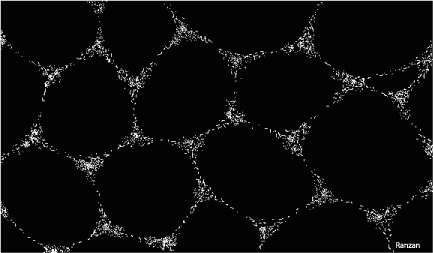
We should therefore expect that the dual dynamic processes of expansion and contraction will likewise be responsible for cell structure. We should expect the Universe to be divided into cells (see Fig. 1).
And thus the first 'overlooked' aspect leads naturally to the second. The existence of the pervasive aether fluid, endowed with the ability to dynamically expand and contract, leads naturally to the cellular cosmic structure. And this too is observed. Numerous reports from astronomers tell of vast empty regions, the voids, separated by webs and sheets of linked galaxy clusters. The many voids and their surrounding galaxy clusters are the manifestations of cosmic cells.
|
|
|
|
|
|
Fig. 1. Conceptional view of the cellular universe. The Dynamic Steady State Universe consists of the simultaneous, but spatially-separated, expansion and contraction of the universal medium. These balanced dynamic processes produce a quasi-static polyhedral pattern. According to DSSU theory and astronomical observations, our Universe is cellularly structured. Although the medium expands in the interior (the Void) of the cells, in general, the cells themselves do not increase in size. At the boundaries of the cells, where gravity dominates, the medium is contracting. The cells maintain equilibrium; consequently the universe does not expand. |
|
We saw earlier that the nineteenth century witnessed several unsuccessful attempts, namely the Cauchy versions, to model possible dynamic properties of aether. Since there are different ways of achieving expansion and contraction (which, when you think about it, is really the only dynamic activity permitted of a nonmaterial fluid), it is important to clarify what is meant by such dynamical distortions of aether as postulated under the new theory. The dynamic properties of DSSU’s aether are unlike those of Cauchy’s aether, which is postulated to achieve contraction and expansion by means of a change in density or alternatively a change in elasticity.[29] DSSU aether is not expanded by stretching and contracted by compression. It is not contractile in the sense of a change in density induced by compression. And the expansion is not associated with any elastic property of aether. In the Dynamic Steady State Universe model space expansion represents, on the macro-scale, a real growth in the 3-dimensional quantity of aether —and a growth in the number of discrete units on the micro-scale. While in like manner, space contraction is a reduction in the quantity of aether. It follows that DSSU's universal space medium is not a continuum, but rather, it is quantized or micro-cellularized.
When we apply this dual-dynamic aether to the Universe, we come to the other essential cosmological aspect. If the first essential feature of the Universe is the existence of aether, or more specifically dynamic aether, then the second essential feature is that the Cosmos is cellularly structured. What is truly astounding, and was only recognized two years after the initial discovery, is that there are three distinct cellular structural levels. (For the present we are only concerned with the most obvious level.) Thus, it is for good reason we refer to the cellular universe.
The cellular universe is modeled by the Dynamic Steady State Universe theory. This theory corresponds to what we experience and observe, incorporating the known repertoire of reality, an invariant order that is independent of our representation of it. And the key part of the repertoire of reality includes expanding, as well as contracting, aether medium.
However, expansion and contraction in themselves do not ensure the manifestation of cells. The mode of expansion determines whether a universe is cellular or not.
Most important is the requirement that on the large scale there be a regional separation between the process of expansion and the process of contraction.
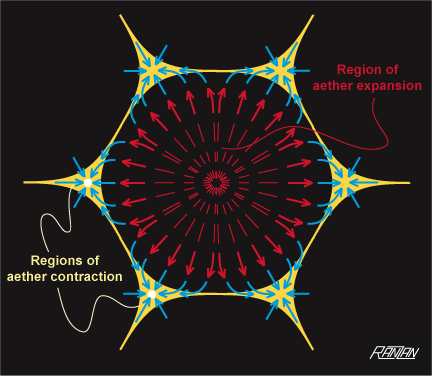
If the expansion is contained within cosmic sized ‘bubbles’, then aether expands within, but the structures themselves do not expand (see Fig. 2). While aether in the interior of the cosmic cells expands, the boundaries between cells limit the expansion. In fact the boundaries reverse the expansion by absorbing the medium flow —by contracting the aether that constitutes the flow. The effects of expansion (technically known as Lambda, Λ) and its dynamic opposite, contraction (familiarly known as gravitation), together, produce an endless flow of aether along with comoving mass.
The dual-dynamic cosmic cells are somewhat like thermal convection cells except that aether does not circulate; rather it flows in a one-way pattern. The medium flows radially, then ‘sinks’ into what are called Voronoi cell boundaries. And since the cells with their dual-dynamic aether do not expand, then neither does the Universe.
We can now address the question of why Official Cosmology insists on claiming that the universe IS expanding. The answer is not so much that it fails to recognize the significance of the cellular structure but more because it is missing the phenomenon of space contraction. And why is it missing? ... Because the BB theory of gravity is incomplete.
The Dynamic Steady State Universe consists of cosmic cells —each approximately 300 million lightyears in diameter— within which Lambda is distinctly positive. Although the space medium expands in the interior (the Void) of the cells, the cells themselves do not increase in size. At the boundaries of the cells, where contractile gravity dominates, space-medium expansion is reversed. The cells maintain ‘flow’ equilibrium; consequently the Universe does not expand. The cellular universe may be thought of as having a Euclidean 3-dimensional background space in which real structured space performs its dual dynamics —aether expansion and aether contraction.
|
|
|
|
|
|
Fig. 2. Dual-dynamic aether in a cosmic cell. Schematic cross-section reveals the balanced flow of dynamically expanding aether and dynamically (and simultaneously) contracting aether. In conventional terminology, the void region where Lambda dominates (red arrows) is in equilibrium with the surrounding galaxy clusters (yellow) where contractile gravity dominates (blue arrows). |
|
From a deeper exploration than the brief excursion undertaken here, one finds that DSSU theory embraces a simple and elegant fact: The wonderful match between observation and theory is best achieved when one’s theory holds that the universe is more or less statically cellular and that the universe is correspondingly nonexpanding.
By applying Nature's preferred mode of organizing itself, the numerous unresolved, and poorly resolved, problems of twentieth-century cosmology simply vanish.
Official Truth and More Academic Censorship
The DSSU cellular universe is uncompromisingly a nonexpanding universe and is contrary to the Official Cosmology, which decrees that the universe is expanding. Consequently the relevant journals refuse to publish. In the same way that aether and absolute motion are banned concepts in physics, the nonexpanding universe is a banned concept in astrophysics. The self-correcting mechanism seems to be failing. While Mainstream Cosmology is safeguarding the official truth irrespective of its validity, the DSSU theory of the dynamic equilibrium-universe is not reaching those who would benefit the most from its dissemination.
Theories and “Even observations are now interpreted [and] judged right or wrong depending on whether or not they support the big bang. ... This reflects a growing dogmatic mindset that is alien to the spirit of free scientific inquiry. ...”
“... All the peer-review committees that control [funding and publication] are dominated by supporters of the big bang. As a result, the dominance of the big bang within the field has become self-sustaining, irrespective of the scientific validity of the theory.” –Halton Arp, and others, from An Open Letter to the Scientific Community (Published in New Scientist, May 22, 2004, by E. Lerner)
In 1616 the Roman Catholic Church banned all books that maintain that the Earth moves. It was a desperate act to uphold the Christian religion's long held view that the Earth was stationary and the Heavens moved. The official doctrine that restrained the Earth’s motion was eventually rescinded. However, the doctrine that dictates the motion of the Heavens was not; it is still adhered to —but with a change of mode. Instead of declaring the divinely-perfect rotational-motion of the Heavens (manifest as concentric spheres), the doctrine now holds that the motion is a radial expansion of the Heavens. Yes, strange as it may seem, this represents the official position of the Church. In 1951 Pope Pius XII, who reigned during the period 1939-1958, presented to the Pontifical Academy a Paper, supported by the obligatory Scriptural evidence, in which the expanding universe popularly known as the Big Bang was decreed the blessed theory —the chosen theory of cosmology.[30]
By the late 1960s, most astronomers considered the debate closed. The big bang [the expanding universe] was the official creation mythology of sci/religion, and its details were inscribed in the pages of the Astrophysical Journal. –Corey Powell[31]
Over the centuries the universities have replaced the former role of the churches as centers of higher learning. Sadly, restrictive codes defining the official truth still rule and often restrict the search for knowledge and suppress all deviations.
In cosmology today, doubt and dissent are not tolerated, and young scientists learn to remain silent if they succumb to any unpure thoughts about the standard big bang model.
Official religion at one time denied that the Earth moves; today the Official religion and its Big Bang believers deny that the aether moves. And worse, there are believers who deny the existence of the aether altogether.
9. Summary and Conclusion
Nevertheless, the evidence is undeniable, space has a certain absoluteness quality; and furthermore, this space-fluid —the aether— has dynamic qualities.
The science of cosmology during the last two centuries suffered truly devastating setbacks. The science of cosmology, due to the "ghastly errors" described herein, failed to reach maturity status. With the beginning of the third millennium came the rediscovery of the aether and the discovery of the causative mechanism of gravitation. Simultaneously, the theory of the nonexpanding cellular universe was developed. These three discoveries, when combined, constitute the New Cosmology.
The science of cosmology is only now (in the 21st century), with tentative steps, transitioning into its modern form. The old pillar of space-medium expansion remains unaltered; the new pillars being added are the ubiquitous existence of aether, the mechanism of gravitation, and cosmic cellular structure.
In the “impact of aether” flowchart (below) the left side outlines the well-known conventional story of the Michelson-Morley experiment and its impact on 20th-century cosmology. It is primarily a story of mathematical constructions. Note the unjustified extrapolation of Einstein’s highly accurate local theory of space-time. In contrast, the right side of the flowchart highlights the reality-based story of M-M and aether. The impact of the aether experiments involves not only forcing changes in the 20th-century concept of space and absolute motion but also the dramatic transforming of that century’s cosmology. The phenomenon of aether flow must now be recognized; space and motion have absoluteness qualities; space has structure. In physics, long-standing theories are being modified and subsumed. In cosmology, however, the full impact is nothing less than revolutionary and is yet to be realized. The aether experiments, having led to the true nature of space, and further, having led to the true nature of gravity, have now led to the true nature of the Cosmos. The Universe is a cellular steady-state universe —not an expansionary big-bang world.
|
|
|
|
|
|
Flowchart: The impact of the aether experiments on physics and cosmology |
|

The considerable evidence is conclusive —we live in a nonexpanding cellular universe.
The New Cosmology, the cosmology of the 21st century, represents a glorious simplification of the universe since it can now be understood as an infinite Euclidean expanse arranged into non-Euclidean regions. The new picture reveals a non-dynamic framework of regions of dual-dynamic aether.
In closing, it is worth noting an interesting exemplar from history. Modern biology began with the discovery that every individual animal and plant is composed of tiny living units, the cells. The New Cosmology begins with the recognition that the Universe is composed of dynamic-aether units —the cosmic cells.
This article is an open-access article distributed under the terms and conditions of the Creative Commons Attribution License which permits unrestricted use, distribution, and reproduction in any medium, provided the original work is properly cited.
2007-11 rev2011-1 Copyright © by Conrad Ranzan www.CellularUniverse.org
[1] R.T. Cahill, Space and Gravitation,
Magister Botanicus, Vol.2 (Jan 2004).
Posted at: www.mountainman.com.au/process_physics/index_of_papers.htm
[2] John von Neumann, “The Mathematician,” in The World of Mathematics, Vol.4, pp2053-2063
[3] R.T. Cahill, Space and Gravitation, Magister Botanicus, Vol.2 (Jan 2004)
[4] Ibid.
[5] Ibid.
[6] R.S. Shankland, Michelson-Morley Experiment, in The Encyclopedia of Physics, 3rd Ed., Editor Robert M. Besancon (Van Nostrand Reinhold Co., N.Y.) p747
[7] A. Einstein. 1916. Relativity, the Special and General Theory, (1961 edition, Random House) p59
[8] R.S. Shankland, Michelson-Morley Experiment, in The Encyclopedia of Physics, 3rd Ed., p748
[9] R.T. Cahill, Space and Gravitation, Magister Botanicus, Vol.2 (Jan 2004)
[10] R.T. Cahill, The Michelson and Morley 1887 Experiment and the Discovery of Absolute Motion, Progress in Physics, Vol.1, Issue 3, pp25-29 (2005). Posted at: http://www.ptep-online.com/
[11] A.A. Michelson and E.W. Morley, On
the Relative Motion of the Earth and the Luminiferous Ether, The
American Journal of Science, Vol.34, No.203 (Nov 1887).
Posted at: http://www.mountainman.com.au/process_physics/index_of_papers.htm
[12] R.T. Cahill, The Michelson and Morley 1887 Experiment and the Discovery of Absolute Motion, Progress in Physics, Vol.1, Issue 3, pp25-29 (2005). Posted at: http://www.ptep-online.com/
[13] Ibid.
[14] Web article: Science in Poland - Albert
Michelson
(http://www.sciences.univ-nantes.fr/sites/jacques_charrier/tp/michelson/aam.html)
[15] R.T. Cahill, Absolute Motion and
Gravitational Effects, Apeiron, Vol.11, No.1, pp53-111 (2004).
Posted at: http://redshift.vif.com/journal_archives.htm
[16] The Roland De Witte 1991 Detection of Absolute Motion and Gravitational Waves. Published: Progress in Physics, Vol.2, Issue 3, p60-65 (2006). Posted at: http://www.ptep-online.com/
[17] R.T. Cahill, Absolute Motion and
Gravitational Effects, Apeiron, Vol.11, No.1, pp53-111 (2004)
Posted at Apeiron website:
http://redshift.vif.com/journal_archives.htm
[18] R.T. Cahill, The Michelson and Morley 1887 Experiment and the Discovery of Absolute Motion, Progress in Physics, Vol.1, Issue 3, pp25-29 (2005). P25
[19] R.T. Cahill, Space and Gravitation, Magister Botanicus, Vol.2 (Jan 2004)
[20] R.T. Cahill, Absolute Motion and Gravitational Effects, Apeiron, Vol.11, No.1, pp53-111 (2004)
[21] R.T. Cahill, Space and Gravitation, Magister Botanicus, Vol.2 (Jan 2004)
[22] Ibid.
[23] I.B. Cohen, Revolution in Science (The Belknap Press of Harvard University Press, Cambridge, Massachusetts, 1985) p170
[24] Faraday, as in Brian S. Baigrie, Scientific Revolutions (Pearson Prentice Hall) p278
[25] Ibid. p276
[26] Stephen F. Mason, A History of the Sciences (Collier Books, N.Y., 1962) p472
[27] Ibid.
[28] Ibid.
[29] Ibid.
[30] Helge Kragh, Steady State Theory, in Encyclopedia of cosmology (Garland Publishing Inc N.Y., 1993) p633
[31] Corey S. Powell, God in the Equation (The Free Press, New York, 2002) p178
|