|
| |||
|
ANNOUNCEMENTS &
NEW ITEMS:
Meanwhile, mankind’s enslavement continues. It
works like this: In order to get people to accept a fully-surveilled, open
prison, cashless society, social credit system, ... a gradual wearing down
process is implemented. “First you wear people down. Poison them with drugs,
vaccines, fluoride, and chemical assaults so they become fat and dumb. Put
addictive devices in their hands and bombard them with propagandized movies,
TV, and Masonically-controlled actors and musicians. Destroy the food
supply, poison the water and the air, manufacture fake climate change while
blaming it all on the people, and tax them to death for it.” Push
‘sustainability’ according to the UN-2030 Agenda and the
World-Economic-Forum Cult. Work towards the implementation of “15-minute
SMART-city enslavement camps.” At the same time “give them all sorts of
distractions, from the two-party political charade (with the illusion of
choice when it is a totally rigged game), manufacture social disharmony, and
grow up controlled opposition to divide and conquer any truth movement that
appears to be gaining any momentum.”
Meanwhile: We stand at a crisis—the supreme crisis of the ages. For unnumbered millenniums man has toiled upward from the dank jungles of savagery toward glorious heights which his mental and spiritual potentialities give promise that he shall attain. His path has been slow and wavering. Time and again he has lost his way and plunged into deep valleys. Man’s trail is littered with the wrecks of dead civilizations and dotted with the graves of promising peoples stricken by an untimely end. –Lothrop Stoddard’s dire warning of the dangers of the practice of dysgenics (1921 !)
The World Conquerors, The Real War Criminals by Louis Marschalko
Meanwhile: Reflect on the mega-crime of the last century —Dresden
Hellstorm (February 13-15, 1945). It is appalling to think its
perpetrators were actually hailed as war heroes!
| |||
|
“Laws of Physics Twentieth-Century Scientists
Overlooked”
Available on AMAZON.com
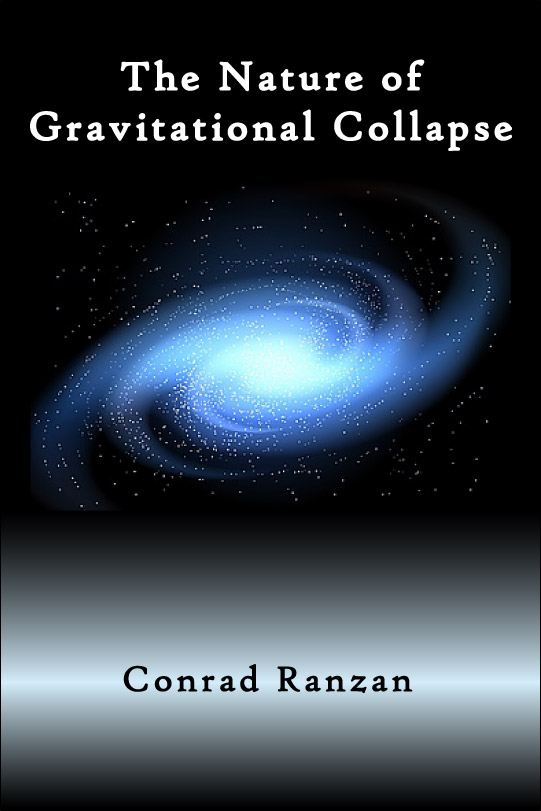
The Nature of Gravitational Collapse
Guide to the Construction of the Natural Universe
Participate in a unique exploration of the Cosmos: venture into the
sub-atomic realm, even into the sub-quantum realm where the roots of reality
reside, and into the domain of cosmic-scale cell-structure and beyond to
infinity. Along the way, discover the cause of mass, the cause of
gravitation, and rediscover Einstein’s “nonponderable” aether and Heraclitus’
harmony-of-opposites principle. … The book represents the ultimate
vindication for all the skeptics who resisted the "preposterous" Big Bang
mythology and who refused to join the exploding-cosmos religion. POPULAR RESEARCH PAPERS:
| |||
|
Glossary of Terms
used in Cosmology and Astrophysics with particular emphasis on DSSU theory. |
|||
|
GENERAL INTEREST ARTICLES: | |||
|
COSMOLOGY ARTICLES, etc:
Large-Scale Structure of the Dynamic Steady State Universe published in
the American Journal of Astronomy and Astrophysics, Vol.4, No.6,
2016, pp.65-77.
Astract and Links. Galaxy Morphology:
Ellipticity, Its Origin & Progression in Comoving Galaxies, American Journal of Astronomy & Astrophysics,
AJAA, Vol.3, No.2, 2015.
EXTERNAL LINKS:
| |||
|
DSSU Theory:
The Fundamental Process of Energy —A Qualitative Unification of
Energy, Mass, and Gravity. (Abstract
& Reviews & Links) … This article reveals
the secret behind photon confinement. (Contains only a bare minimum of mathematics
and mainly in one of the 14 sections.)
Headlined as:
| |||
|
ARTICLES on AETHER: |
|||
|
DSSU RESEARCH PAPERS: |
|||
|
GRAVITY:
|
|||
|
RELATIVITY ARTICLES: |
|||
|
An Open Letter to the Scientific Community "The big bang today relies on a growing number of hypothetical entities, things that we have never observed-- inflation, dark matter and dark energy are the most prominent examples. Without them, there would be a fatal contradiction between the observations made by astronomers and the predictions of the big bang theory. In no other field of physics would this continual recourse to new hypothetical objects be accepted as a way of bridging the gap between theory and observation. It would, at the least, raise serious questions about the validity of the underlying theory. ..." continues ... A devastating Declaration of opposition to Big Bang cosmology signed by more than 400 Researchers.
|
|||
|
INTELLECTUAL FREEDOM:
|
|||
|
DEDICATION: This website is solemnly dedicated to those
individuals who have conducted research in their chosen field and have
informed others of their inquiries and suffered the consequences when
subpoenaed by the Inquisition or some variant thereof. The dedication
extends to those individuals currently imprisoned, and those facing
trial and persecution simply for exercising their basic human right of
freedom of expression supposedly granted to them under the UN Charter of
Human Rights. "Every year, hundreds of writers and other literary professionals around the world are imprisoned, prosecuted, persecuted, attacked, threatened, forced into exile or even murdered as a result of their work." ALSO: Be aware of the continuing threat to our precious freedom of expression on the Internet. The threat is serious and relentless. It is described as “… the formal effort to mimic Communist China’s system of Internet censorship.” – www.InfoWars.com More information on threats to internet freedom: https://battleforthenet.com/ End of free speech in Britain:
A publisher of history books in Britain has reported that “due to new laws
in the UK all their books will have to be censored moving forward” to avoid
criminal penalties for “inciting racial hatred.” –The Barnes Review (2020 March/April)
p77 In repressive Germany:
Ursula Haverbeck,
89, Sentenced to 14 Months in Jail for Heresy! –2017 November George Orwell Free Speech Awards:
The Supreme Irony:
□ The Continuing Struggle for Freedom A ray of hope in the ongoing struggle for freedom. Populist and nationalist movements around the world are gaining ascendancy over the New World Order’s effort to establish global governance and impose tyrannical control over every last square meter of the Earth’s surface. –The Barnes Review Vol.23 No.1 (2017 Jan p70)
The ongoing fight for freedom and truth. –Just Right Media (2020, Sept 18, program)
● Pro-Freedom NEWS:
Vanguard News
For more on Freedom (and Objectivism), |
|||
|
... about the author ...
D S S U Research,
Niagara Falls, Canada Visits since mid-2010 :
2026-7-24 |

.jpg)

.jpg)
| |||||||||||||||||||||||
Homepage Items
| |||||||||||||||||||||||
The Cellular Universe website:"Making the Universe understandable with
compelling concepts, sound theories, ■ presenting articles and research papers relating to all aspects of what is known as DSSU Theory* for the professional and amateur explorers of our Universe —and for the interested spectators; ■ presenting the continuing research resulting from the discovery (in August 2001) of the four fundamental processes that constitute the Universe and manifest all that is observable; ■ presenting the on-going exploration into a new realm of cosmology, astrophysics, and fundamental physics; ■ the real Universe explained without employing advanced mathematics, without invoking fanciful speculations, and without resorting to faith-based revelations.
The extensive research into Dynamic-Steady-State-Universe Theory is presented as * The Dynamic Steady State Universe theory ---the definitive model of our Universe based on the premise that all things are processes. | |||||||||||||||||||||||
Y E S ! I T I S T R U E
!
| |||||||||||||||||||||||
How do we know that the DSSU is the Real Universe?We know on the basis of several recent discoveries and the overwhelming convergence of the evidence.
We know on the basis of unambiguous evidence convergence. | |||||||||||||||||||||||
Press Release (2015 Oct 15):
|
.png)
|
“We have
now completed our review of your manuscript, and I regret to tell you
that we are not able to undertake further consideration of your
submission for publication in The Astrophysical Journal. |
What!? What about the obvious evidence presented with quality images? What’s going on here?
The problems are so serious that Lee Smolin, a physicist at the Perimeter Institute in Canada, has written a book in which he makes it clear “The problems are rooted in the way the career and funding structures of the academy reward me-too science, lack of courage, entrenchment of failed research programs, legacy building, empire building, narrowness, defensive strategies and groupthink.”
Meanwhile, this website
remains steadfastly dedicated to presenting
truth in cosmology.
"Gateway" webpage to the game-changing evidence
—incontrovertible and devastating evidence:
DSSU Validated by Redshift Theory and
Structural Evidence ●Abstract ●Links ●Highlights ●Reviews
–C. Ranzan (2015-10-15)
The World is changing. Witness the on-going social revolution, succinctly described as a full-blown orchestrated decline of Western nations. The devious and highly effective divide-and-conquer strategy of the New World Order continues to be implemented; and the predictable nightmare of Marxist multiculturalism continues to unfold.
Press Release (2017 December 30):
The Sacks-Wolfe Effect has been disproved!
While society, sadly, is suffering through a regressive revolution, positive and pronounced changes are happening within the ages-long Quest of our species. Astrophysics and cosmology are undergoing the greatest, most profound, revolution in the history of science as Mankind progresses towards a breathtaking new understanding of the way the Universe works.
The latest development: It has been revealed that the Sacks-Wolfe effect is founded on a false assumption. A straightforward argument has shown that the Sacks-Wolfe effect is invalid. This means it can no longer be used to explain the patchiness of the Cosmic Microwave Background Radiation —it cannot be used to explain temperature variation of cosmic regions. Most important of all, the Sacks-Wolfe effect can no longer be used to support the Big Bang hypothesis!
The newly published research paper “Sachs-Wolfe Effect Disproof” [Ref.#1] presents
a foolproof argument based on three unambiguous facts, as follows:
1. The particle of light, the photon, is an extended entity —it has a wavelength.
2. The space of the Universe, by which is meant space-as-a-container or the background space of three dimensions, is NOT a region of nothingness.
3. The closer an object is to a massive body, the stronger is the “pull” of gravity, and the greater is the gravitational acceleration. (This gravitational influence, of course, also applies to photons.)
These facts negate the viability of the Sacks-Wolfe Effect. Any sort of counterargument, advanced in an attempt to defend the Effect, requires a rejection of one or more of those three foundational conditions. No reputable physicist, no rational person, is willing to do that.
None will deny the photon, or a wave packet, is an extended entity —that it has a wavelength.
No one would dare claim that “space” is an empty nothingness!
And it is inconceivable that anyone would reject the reality of the gravity
premise.
And so, the argument against the Sacks-Wolfe Effect is foolproof. It collapses the last Pillar of the Big Bang hypothesis. This is the Pillar acting as the supposed explanation of CMBR temperature variation. It now joins the other fallen Pillars.
The “Pillar of receding galaxies” was previously debunked. See the article, Cosmic Redshift in the Nonexpanding Cellular Universe [Ref.#2].
The “Pillar of CMBR” turned out to be nothing more than the unchanging background temperature of the Universe.
The “Pillar of universe expansion” required, as it was believed, by Olbers’ paradox was overturned in 2016 (in conjunction with the discovery of the velocity-differential cosmic redshift). See the article, Olbers’ Paradox Resolved for the Nonexpanding Infinite Universe [Ref.#3].
There are no other remaining pillars, only makeshift braces and portable props.
The Emperor of 20th-century Cosmology has been exposed. The Big Bang has turned out to be a mega-myth! —an embarrassing concoction of misinterpretations!
|
“Physics desperately needs not new ideas but new facts. Discoveries, not inventions. Ideally, physicists will stumble on something so startling that they abandon their pursuit of multiverses, strings and other fantasies and return to reality.” –John Horgan, teacher and science writer. [Source] |
Exactly. Facts are needed to return us to reality. And the new fact is that the Sachs-Wolfe effect has no foundation —it is not real.
The Sacks-Wolfe Effect has been disproved!
The last Pillar of the Big Bang has collapsed.
The Expanding-universe cosmology has no valid scientific support.
Here is the link to the Sacks-Wolfe-disproof article. ... This is simple enough for the layperson. So don’t let the math discourage you. Some of it is merely basic algebraic addition and subtraction. Most of the math is not even necessary; it merely gives the presentation a scholarly flavor. Just know that the underlying logic is simple —a foolproof and compelling argument presented with the aid of various figures (14 in all).
Supplementary: A good description and illustration of the Sachs-Wolfe effect
may be found in the cover story of Scientific American (the 2016 August issue),
“The Emptiest Place in Space” by István Szapudi.
–C. Ranzan (2017- December)
Ref.#1. C. Ranzan, Sachs-Wolfe Effect Disproof –The fundamental
flaw in the spectral analysis of gravity wells, International Journal of
Astrophysics and Space Science,
Vol.6, No.1, 2018, pp.1-17 (Abstract
& links.)
(Doi: http://dx.doi.org/10.11648/j.ijass.20180601.11 )
Ref.#2. C. Ranzan, Cosmic Redshift in the Nonexpanding Cellular Universe, American Journal of Astronomy & Astrophysics, Vol.2, No.5, 2014, pp.47-60. (Doi: http://dx.doi.org/10.11648/j.ajaa.20140205.11)
Ref.#3. C. Ranzan, Olbers’ Paradox Resolved for the Nonexpanding Infinite Universe, American Journal of Astronomy and Astrophysics Vol.4, No.1, 2016, pp1-14. (Doi: http://dx.doi.org/10.11648/j.ajaa.20160401.11)
Press Release (2018 August)
The Mechanism driving astrophysical jets has been discovered
The mystery behind the source of ultra-energy particles
has been resolved
Approved for journal publication, a new DSSU research paper addresses some long-standing questions:
What drives astrophysical jets? What process or mechanism generates the stupendous power of those spectacular emission jets associated with certain compact stars? Even the energies of the individual particles are mind-blowing. The emissions include gamma photons and neutrinos with energy equivalent to a million hydrogen atoms!! Imagine that much energy contained in a single gamma photon or a solitary neutrino!
-Wiki(2016-1).png) The causal driver has been one of the biggest mysteries of the universe
—one that has baffled the academic cognoscenti for decades.
The causal driver has been one of the biggest mysteries of the universe
—one that has baffled the academic cognoscenti for decades.
The DSSU paradigm now brings to astrophysics a new mechanism by which a gravitationally collapsed body produces energy —the energy that feeds emission beams and then drives polar jets.
Traditionally, energy-extraction theories fall into two categories:
First category. The energy is extracted from external magnetic fields —generated by the rotation of an accretion disk diffused with charged particles. An example is something called the Blandford–Znajek process. Its major weakness is its inability to explain the presence of jets for objects that have no accreting mass.
Second category. The energy is extracted from the rotation of the collapsed body itself. The logic here is that the angular momentum (the energy of the rotation) of the black hole’s mass is conveyed to the external world by way of frame dragging. Then the external environment responds by somehow producing jets. An example is the Penrose mechanism. The fatal weakness of this hypothesis is its inability to explain the presence of jets for objects that have negligible rotation.
Both extraction methods fail to explain the truly extreme energy, the ultra-energy particles.
Now there is a third way. While the traditional methods all require that radiant energy be generated in the external environment, the DSSU approach has radiant energy emanating from within!
| Table 1. There are only three basic ways to explain the energy source for the jets associated with critically-collapsed stars (commonly called stellar black holes). |
|
Explanatory Theory |
Source of Energy |
Mechanism |
|
Traditional view requiring an ACCRETION DISK: |
Magnetic fields associated with the dynamics of an accretion disk surrounding a stellar black hole. |
Various complex relativistic and electromagnetic effects involving the rotating disk and its charged particles. Problem: FAILS to explain the jets of disk-free objects. |
|
Traditional view requiring significant ROTATION: |
Energy is derived from the rotation of a black hole. This would have to be the energy of the mass’s angular momentum. The rotation causes frame dragging, which then somehow causes jets. |
The frame dragging is caused by the rotation of the singular mass; but there is no plausible explanation of how a singularity —a point mass of zero dimensions— can possess angular momentum or rotational kinetic energy! |
|
Superneutron Star (DSSU theory): |
Processes WITHIN the Superneutron Star; inside the “event horizon.” |
Generation mechanism: Velocity differential blueshift acting on photons and neutrinos. Escape mechanism: via bipolar magnetic portals. |
Most profoundly, the new approach is a mechanism whereby energy is released from INSIDE a totally collapsed gravitating body (misleadingly called a stellar black hole). The result of recent research into the DSSU, it is the only such mechanism ever devised without violating the laws of physics and without incurring infinities. DSSU theory offers the first and only method for powering jets that does not require rotation or an accretion disk.
The latest research paper under the DSSU paradigm delivers another devastating blow to conventional physics and astro-science.
Highlights
■ First compelling explanation of the mechanism powering astrophysical jets.
■ First reality-based explanation of the energy source when there is no spin, no accretion, no disk —when conventional theories fail.
■ Details the mechanism for the generation of ultra-energy gamma particles and Peta-eV-energy neutrinos (neutrinos having 1,000,000,000,000,000 electron volts of energy!).
■ The first and only theory for the emission of energy from the inside of a totally collapsed (gravitationally collapsed) structure.
■ And as the followers of DSSU theory have come to expect, the explanations are perfectly natural; the concepts are straightforward, the arguments logical, the conclusions compelling, the implications profound.
The details are contained in the revolutionary article* —Natural Mechanism for the Generation and Emission of Extreme Energy Particles by C. Ranzan— published in Physics Essays Journal in the 2018 September issue. According to the PE Reviewer: “This is a scholarly and erudite article that deserves to be published in recognition of its tutorial nature and … the validity of the author’s proposals.”
DOI link: http://dx.doi.org/10.4006/0836-1398-31.3.358
FREE Reprint: Download PDF *
* Reprinted by permission of Physics Essays Publication, from Physics Essays, Vol.31, No.3, p358-376 (2018).
–C. Ranzan (2018-8) Back to Top
Press Release (2018 December 28)
Unprecedented Unification of Gravity Theory
For the first time in history, the diverse manifestations of gravity are brought together by one surprisingly simple process.
The new research paper, entitled The Nature of Gravity –How One Factor Unifies Gravity’s Convergent, Divergent, Vortex, and Wave Effects, details the unification of the various aspects of gravity. It also presents a remarkable new development in the theoretical nature of gravity waves and proves the existence of a strict limit on the centrifugal effect.
Ongoing research into DSSU Theory has uncovered a way, a perfectly natural way, to bring all four (five if the primary cause is included) manifestations of gravity together under the “aether” umbrella —under the distinct aether that serves as the foundation of DSSU theory and DSSU cosmology.* Unified by a simple factor (a two-sided process) are, two primary manifestations, and two secondary effects, and acoustic-like gravity waves.
Here is a brief description of the gravity effects:
(1) Convergence gravity. This is your normal everyday gravity. It includes Primary gravity associated directly with mass AND Secondary gravity associated only with the convergent gravity field.
(2) Divergence gravity. This is what Einstein called Lambda (the cosmological constant) and popularly known as cosmic antigravity.
(3) Vortex effect. This is best described as a spiral-motion amplification of gravity. It manifests in the region around significant rotating structures.
(4) Gravity waves. These are acoustic-like effects conducted by the universal space medium.
In each and every case, the energy involved can be linked to aether.*
Yes! Linked to the universal space medium —but not in the way that others have been attempting for centuries.
The Vortex effect, it turns out, has profound implications for understanding spiral galaxies —for making sense of their rotation curves. As noted in (3), the effect acts as a booster of gravity; this, in turn, makes it appear as if there is significantly more mass present than what astronomers actually observe, or estimate to be there. It is quite elementary to see how this gravity amplification makes the invoking of “dark matter” entirely redundant.
However, the strangest implication to emerge from the research into the Vortex effect must surely be the diminishment of the centrifugal effect. Here was yet another gravity-amplifying mechanism. Following the carefully constructed logic and taking the Vortex effect (often called the frame-dragging effect) to its ultimate conclusion, it was found that the centrifugal effect totally vanishes! It was a stunning conclusion. Under the given conditions, the rotation rate of a gravitating body has no upper limit!
--- The research reveals how, in the real world, the centrifugal “force” depends on the rotation speed through aether —and how Nature has a way of reducing that speed (via the mechanism of aether drag), even to the extent of entirely cancelling all centrifugal manifestation.
Last on the list is gravity’s acoustic aspect. And here again the investigation revealed something unexpected but unavoidable. In a surprising development, it was found that gravity waves fall into two categories of waves —only one of which carries defined energy.
Summary Table of the major stresses to which the universal medium is subjected.
|
Primary stress |
Secondary stress |
Tertiary stress |
Torsion stress |
|
↓↓ |
↓↓ |
↓↓ |
↓↓ |
|
Manifests as MASS (& energy particles) —the PRIMARY ABSORBER of aether |
Manifests as negative aether strain: SELF-DISSIPATION |
Manifests as positive aether strain: SELF-EMERGENCE |
Manifests as negative aether strain: More SELF-DISSIPATION |
|
↓↓ |
↓↓ |
↓↓ |
↓↓ |
|
PRIMARY CAUSE of GRAVITY |
CONVERGENT GRAVITY |
DIVERGENT GRAVITY |
GRAVITY INTENSIFIER |
A unique aether theory of gravity —based on DSSU’s dynamic aether— has been developed to explain the several guises of gravity. The convergent, divergent, vortex, and wave effects all have one thing in common: They all result from the stress-induced change in quantity of aether.
The opportunity this presents is nothing less than revolutionary. It opens the door to a new level of understanding our Universe.
And, for the benefit of all the spectators and participants in the ongoing search for truth and reality …
For the benefit of all those still struggling with the preposterous big-bang hypothesis …
For the benefit of physicist Janna Levin who has been optimistically searching, since at least 2001, for an answer to the most pressing question dealing with gravity,
|
“Is there a theory beyond Einstein’s that will avoid the ugliness of infinite singularities; a theory that can handle … black holes without becoming singular? … We’re inspired by the predictions of relativity to look for an even greater theory, a theory that looks like Newtonian gravity when gravity is weak and looks like general relativity when gravity is strong, but may look entirely different when gravity is strongest.”** |
For the benefit of all those seeking to expose the foundationless big-bang hypothesis and other unscientific cosmologies …
… here is the icing on the cake:
DSSU gravity, based on a subquantum medium, encompasses a full range of manifestations —from autonomous cosmic-scale gravity domains, down to the maximum compaction and intensity of terminal-state neutron stars— without ever becoming singular. In other words, there is no black-hole paradox.
LINKS to the abstract and the full Article at the International Journal
of Astrophysics and Space Science:
The Nature of Gravity –How One Factor Unifies Gravity’s Convergent,
Divergent, Vortex, and Wave Effects.
DOWNLOAD Reprint of Article: PDF file.
* Unfamiliar with DSSU aether? Here is a quick overview:
DSSU aether is a nonmaterial substrate consisting of discrete subquantum entities (pulsations). It possesses no energy when in a static state. Yet its presence is essential for manifesting energy —any and all forms of intrinsic energy. The energies associated with gravity are the most immediate examples in the context of this article.
** J. Levin, How
the Universe Got Its Spots (Weidenfeld & Nicolson, London, U.K., 2002)
–C. Ranzan (2018-12) Back to Top
Press Release (2019 March)
How Nature Extracts Energy from Aether
Awesome astrophysical mechanism for the amplification of energy has been uncovered.
Following several years of research, it is now understood how Nature is able to extract energy from the universal space medium (aether). What has been uncovered is a fundamental mechanism whereby limitless energy is extracted from nonmaterial aether. Sounds bizarre, but is supported unambiguously by the science. What is so remarkable about this process is the fact that it does not require the universal space medium to possess energy. Let me make this absolutely clear, energy is extracted from the aether, yet the aether itself contains NO energy! It is a stunning finding.
The process can be easily understood. Based on the spectral shift caused by a velocity differential of aether flow, it is as straightforward as changing the wavelength of light. It is just the opposite of what is familiarly known as redshift.
|
.jpg)
The process is enormously powerful. The profusion of the energy that emerges staggers the imagination … 1000 times more powerful than anything (mass or energy particles) produced by CERN or any other particle accelerator.
Then there is the considerable breadth of applicability: The process plays a crucial role in resolving five of the greatest mysteries in astrophysics.
■ The great mystery of stellar black holes. The energy-extraction Mechanism exposes the black hole singularity as an obsolete and untenable concept.
■ The mystery of electromagnetic radiation bursts. The Mechanism explains how energy extracted from aether contributes to the cosmic source of electromagnetic radiation bursts (ranging from radio to gamma frequencies).
■ The mystery of the ultra-energy neutrinos. This is resolved by revealing how ordinary neutrinos undergo a vast amplification, thereby generating the most potent energy particles in the universe.
■ The mystery behind astrophysical jets. This is resolved by providing the veritable source of the driving energy.
■ The greatest mystery of them all. The energy-extraction Mechanism solves the mystery of how Nature transfers energy from the interior of an end-state collapsed star —from the forbidden side of the lightspeed boundary (conventionally called the event horizon).
For the record, a totally revolutionary
feature: The energy is extracted from the space medium (aether) yet this
space medium itself has NO MASS and NO ENERGY! … Furthermore, the amount
of energy that can be extracted is limitless!
|
.jpg)
Published in Infinite Energy Magazine (2019 March/April) is the fascinating story [1] of how a totally collapsed (gravitationally collapsed) body —a type of neutron star best described as a terminal-state star— takes in comparatively low energy radiation particles and spews out high-energy and ultra-energy radiation particles, namely photons and neutrinos.
It is the story of the universe’s most powerful, most prodigious, energy amplifier. The published article reveals how aether is able to generate and amplify energy. Described is a process whereby low-energy CBMR energy is converted to gamma radiation and ultra-energy photons —and neutrinos with energy far beyond anything ever produced by Man’s particle accelerators.
Take a moment and reflect on the profound implications, both scientific and philosophical, of what has been uncovered [1] [2]: We are now able to recognize, at a fundamental level, what regenerates the energy of the Universe. We are now able to comprehend the mechanism by which the Universe perpetually regenerates its energy! —even to fathom how the Universe perpetually regenerates itself !
–C. Ranzan (2019-3)
Ref [1]: C. Ranzan, Nature’s Supreme Mechanism for Energy
Extraction from Nonmaterial Aether,
............. Infinite Energy Vol.25,
Issue#144 (2019
March/April). Reprint PDF
Also see the related article:
Ref [2]: C. Ranzan, Natural Mechanism for the Generation and Emission
of Extreme Energy Particles,
.............
Physics Essays
Vol.31, No.3, pp.358-376 (2018). (Doi: http://dx.doi.org/10.4006/0836-1398-31.3.358)
Reprint
PDF
Back to Top
Press Release (2019
May)
Simple extension of Einstein’s relativity theory
radically
changes black-hole physics
The latest DSSU research extends Einstein’s relativity theory in a way that makes possible the 100-percent conversion of mass to energy WITHOUT involving matter and antimatter annihilation.
Moreover, the easy-to-understand new (and more inclusive) interpretation of mass and motion resolves paradoxes associated with conventional black holes.
Essentially, this article† shows: How to use basic relativity equations to explain mass-to-energy conversion. It provides the mathematical support for the recently discovered astrophysical mechanism that powers Terminal-star jets (popularly called “black hole” jets). More specifically, it details the theoretical foundation of the total conversion of mass to energy without invoking matter-antimatter annihilation.
The proof: If you like mathematical arguments, a basic algebra proof is presented in step-by-step detail. If averse to mathematical reasoning, no problem; a straightforward graphic/diagrammatic sequence works just as well. Either way the logic is foolproof; the conclusions compelling. What this means is that we now have the theoretical underpinnings for the recently discovered mechanisms detailed in two previous articles:
■ Natural Mechanism for the Generation and Emission of Extreme Energy Particles, Physics Essays Vol.31, No.3, pp.358-376 (2018). [Reprint]
■ Nature’s
Supreme Mechanism for Energy Extraction from Nonmaterial Aether, Infinite
Energy Vol.25, Issue#144 (2019 March/April). [Link to Issue#144]
A precedent for DSSU theory. For the first time, it is being published in a journal dedicated to high-energy physics. The periodical is the Journal of High Energy Physics, Gravitation and Cosmology. The article title is “Mass-to-Energy Conversion, the Astrophysical Mechanism.”†
.jpg)
Highlights of the article detailing the new interpretation:
■ The presentation uses relativistic motion and mechanical energy equations, combined to form a simple energy triangle; and then the triangle is manipulated to explain mass-to-energy conversion. It’s as simple as that. With a child’s play manipulation of triangles the standard and new interpretations are clarified and compared.
■ Exploited is the enormously important distinction between apparent and intrinsic aspects: including motion, momentum, kinetic energy, and total energy.
■ Recalled is Sir James Jeans prescient insight from the 1920’s into how the process of mass conversion (to energy) is merely that of “unbottling” imprisoned wave-energy and setting it free to travel through space.
■ Implemented is a three-part strategy to accomplished TOTAL
mass-to-energy conversion:
1. Make the motion relative to the universal
space medium. This allows the introduction of the concept of intrinsic
energy (total, kinetic, and mass energies) as counterpart to the apparent
version.
2. Recognize that a particle’s mass property diminishes with
increase in speed. This means introducing the concept of intrinsic mass
(which varies with intrinsic speed).
3. Impose a change in the particle’s
gravitational environment. Instead of applying an electromagnetic
accelerating force/energy in order to alter the particle’s total energy,
there is simply an environmental change.
■ Explored is the remarkable consequence of this mass-to-energy conversion and the associated limitless energy-amplification process. When combined, the two processes lead to a compelling explanation of the mechanism driving astrophysical jets.
■ Followed is a conceptual trail that starts with “unorthodox”
relativity and “bottled” energy, takes the reader along a natural course
through to limitless power, and finally leads to stellar astrophysical
jets. All in all, another great success for DSSU theory.
And so, the revolution in cosmology continues …
–C. Ranzan (2019-4)
† C. Ranzan, Mass-to-Energy Conversion, the Astrophysical Mechanism,
Journal of High Energy Physics, Gravitation and Cosmology Vol.5,
No.2, pp.520-551 (2019). [Reprint]
Back to Top
Press Release (2019
June)
Remarkable Paradoxical Aspect of Length Contraction has been Uncovered
First, some background into what led to a remarkable new feature of special relativity —a feature dealing with the nature of intrinsic-motion length contraction. It relates to a previous research paper, into DSSU theory, entitled Mass-to-Energy Conversion, the Astrophysical Mechanism (revolutionary in its own right). In the conclusions section of that work, it was stated,
|
“Unexpected implication. After completion of the main body of this article and the write-up of the various, mostly self-evident, implications, there emerged an additional ramification. At first it was just something incidental, then it became an annoyance. However, it could not be ignored. What it revealed was so unexpected, so logically inevitable, and so deeply profound, that a simple assertion of this implication would fail to do it justice and, in the absence of full and proper context, may risk sounding scarcely credible. Decidedly, it demands a proper exposition. It will be the subject of the next DSSU research documentation.” |
It turns out that while atoms undergo physical length contraction (as detailed in the Part 1 article from 2013) the subatomic particles, the electrons, protons, and neutrons actually undergo elongation! This is the stunning conclusion of the newly-published “Part 2” article. While the electron’s atomic orbit contracts (as expected when there is significant motion), the electron itself elongates!
The new interpretation —the aether-referenced elongation of fundamental particles— provides a remarkable fit to the reality. (i) It facilitates the conservation of intrinsic energy. (ii) It incorporates the decrease of mass (intrinsic mass) with increased motion (with respect to aether). (iii) And provides the key element in the mechanism of mass-to-energy conversion. A noninteraction-hundred-percent conversion (i.e., no particle-antiparticle annihilations involved). (iv) Furthermore, it precludes the formation of singularity-type black holes.
The new interpretation solves the paradox inherent in black hole physics —the paradox of having infinitely dense mass inside an infinitely small domain.
The following Table summarizes the main points and the benefits to physics
of incorporating the concept of elongation.
|
Arguments in support of elongation (of fundamental particles) |
Why it is important |
|
1. If elemental particles did not elongate and contracted instead, it would lead to a major problem —their mass (by definition) must increase. But such increase is contrary to the evidence. |
■ Avoids the mass-increase pitfall (as detailed in Natural Mechanism for the Generation and Emission of Extreme Energy Particles, Physics Essays Vol.31, No.3, 2018; page 372). ■ Conformance to physical reality —mass simply does not increase with motion. |
|
2. Conservation of total energy (mass + aether-referenced kinetic energy) requires elongation. |
Conformance to the total intrinsic energy equation (for total mechanical energy). |
|
3. Facilitates mass-to-energy conversion. (Total conversion rooted in aether-referenced motion.) |
■ Solves the paradox of stellar black holes. ■ Provides the driving energy/force behind astrophysical jets. |
The new understanding of intrinsic motion resolves the textbook problem involving the energy of a particle or object undergoing extreme length contraction (due to extreme motion). … The problem can be expressed this way: Where within the orthodox picture does the energy go, if the particle, atom, or object becomes a cross-section of itself? Where does the mass-energy go when the thing has no volume, when it exists only as a cross-sectional area and no thickness dimension? Where indeed!
Under the traditional view combining unrestricted length contraction and energy conservation has always been problematic. Because of this, the long-standing rule has been that a mass particle/object can never attain lightspeed. And that rule, in turn, has led to a failure to understand the nature of the strangest objects of the Cosmos —Terminal neutron stars.
But now, by understanding the nature of aether-referenced motion, the conflict between mass energy and mass contraction vanishes. The problem of energy being squeezed within a “cross-section” simply does not arise.
The article also addresses this question: What happens to mass particles during a gravitational collapse and these same particles end-up within a no-escape zone —within the most extreme gravitational environment Nature has to offer? Within this extreme environment particles are subjected to the ultimate speed of aether flow.
The discussion focuses on the electron. The standard
argument is that “for an electron, it is theoretically impossible to
obtain the speed of light.” But there is a situation where an electron
finds itself being placed into a lightspeed environment —of a
gravitational kind. So, what happens? An electron, of course, cannot
travel at lightspeed; so therefore it must transform into a massless
particle —it must transform into a pure energy state. … The new
interpretation of length “contraction” explains how this comes about.
□.gif)
Publication details and links:
C. Ranzan, Physical Nature of Length Contraction (Part 2) How the Electron Elongates While Its Orbit Contracts, International Journal of High Energy Physics Vol.6, No.1, pp.1-12 (2019).
Abstract & link to PDF document.
Link to Journal (IJHEP): http://www.sciencepublishinggroup.com/j/ijhep
–C. Ranzan (2019-6)
Press Release (2020 May)
The Definitive Cause of Galaxy Rotation
First
ever, cogent cause of galaxy rotation and the concomitant explanation of the
relationship
between galaxy morphology and spatial distribution.
Pinwheel Galaxy. What produces such grand-scale rotation? |
-462x360.jpg)
The adventure into 21st-century cosmology continues. For the first time in the history of modern cosmology and astrophysics, the cause of galaxy rotation has been worked out. We now have a remarkably compelling explanation of what drives some galaxies to come together as participants in a spiral dance. And as a bonus, the research includes the resolution of the galaxy-distribution mystery and the dark-matter mystery. However, a major astrophysics journal was not interested in promoting awareness of any of this! The research article was rejected outright; no reason given; no reply to a polite enquiry for some explanation. Strange as it may seem —or maybe not— the elitist Astrophysics Journal does not want its readership (mostly front-line researchers) to gain awareness of the natural cause of galaxy rotation!
Could it be that the theory is a threat to the “professional” view? It certainly looks that way. Another over-rated journal rejected on the basis, get this, that anyone can make-up a theory for how the universe works. Here was an accredited astrophysicist who actually claimed “Anyone can make up a description to explain the Universe.” Does this person not realizing that the professionals have tried and failed throughout the 20th century with their preposterous expanding-universe fantasies? And what about the rotation mystery they tried to solve over the many decades since astronomers first discovered rotating spiral galaxies? … Researcher and author, Conrad Ranzan, had this reaction: “I was immediately reminded of the words of warning by the brilliant physicist Richard Feynman, words aimed at any would-be theorists or anyone who thinks the process of original reality-based ideation is easy:"
|
“In physics there
are so many accumulated observations that it is almost impossible to
think of a new idea which is different from all the ideas that have
been thought of before and yet agree with all the observations that
have already been made.” –R.P. Feynman, The Meaning of it All,
p22 |
Speaking from his own experience, the author of the Cause of Galaxy Rotation says that to construct a theory to explain the Universe to agree with “so many accumulated observations … is almost impossible.” Difficult but not impossible. With the detailed explanation of the cause of galaxy rotation, the success of DSSU Theory continues. This is why the DSSU model stands peerless and unrivalled; and why no meaningful response has ever been forthcoming to the routinely-asked reasonable question: “Regarding the assessment of the Paper’s scientific merits: Did the reviewer(s) or the editor find any errors in the reasoning used in the presentation, any lack of clarity of the ideas, or any ambiguity of the supporting evidence?”
Presenting what was long missing from the field of cosmology and astrophysics, a completely natural cause of galaxy rotation, this is the paper many DSSU followers have been waiting for. It presents aspects of galactic motions that astronomers and astro-theorists need; and it exposes the total redundancy of so-called Dark Matter.
Article: Natural Cause of Galaxy
Rotation,
Abstract & Link to article
Journal: American Journal of Astronomy and Astrophysics,
Vol.8, No.2, pp19-29 (June 2020).
High-resolution Reprint: PDF download
In the year 2019, the man who many believe to be the greatest living cosmologist was awarded the Nobel Prize for Physics. The Nobel Committee stated that its motivation for so honoring astrophysicist James Peebles was “for theoretical discoveries in physical cosmology.” What, may you ask, were these great “theoretical discoveries”? … It is generally acknowledged that Canadian-born James Peebles’s research concentrated mainly on (1) constructing an account of the evolution of an expanding universe and the formation of cosmological structure culminating in galaxy clusters; (2) developing theories for the formation of galaxies; and (3) in order to give some degree of credibility to the first two, inventing and developing dark matter physics.
The problems here are staggering. Contrary to Peebles’ strange beliefs and mathematical models, the Universe does not evolve and does not expand. The problem regarding his work on galaxies will be explained in a moment. Then there is the utter irrelevancy of his "dark matter" physics. There is no dark matter mystery; such matter has never been found; it does not exist; and it is completely unnecessary.
These problems are evidently of no concern to the Awards Selection Committee as it continues to promote the failed cosmology of the last century. With the awarding of the 2019 Physics Award to James Peebles, the Nobel Foundation, in its considerable prestigious capacity, was endorsing his life-long theoretical speculations on the Big Bang fantasy. It was effectively reaffirming its commitment to supporting the Religio-Cosmology founded in the last century.
Turning to the problem of galaxy evolution, James Pebbles is widely credited for having developed “the theoretical framework … of how galaxies have formed and evolved.” As expressed in an editorial in Nature Physics dated November 2019: “Peebles shaped our current understanding of how galaxies and galaxy clusters form.” But take a closer look.
The most iconic characteristic of a large percentage of galaxies is large-scale rotation. In the case of face-on spiral galaxies, this rotation is revealed most spectacularly. Yet Peebles’ theoretical framework fails to identify the basic cause of the rotation. It is an omission comparable to having a theory of blood transmission through the arteries and veins of the body and failing to include the beating heart!
And worse, Peebles’ theory of the evolution of galaxies is flat out contrary to reality.
Within the framework of Peebles’ Big Bang cosmology, extremely distant galaxies are now routinely discovered that are supposedly not much older than one-half billion years —yet appear fully mature. But Peebles, expert that he is, knows full well that galaxies cannot possibly form in such a short time span. On the cosmic scale, 500 million years is just a coffee break —barely time enough for two rotations of our Milky Way Galaxy.
Surely, an appropriate reaction here is to shake one’s head in disbelief —disbelief in that there are people who actually believe such nonsense.
One can understand big bangers nominating Professor Pebbles for the Physics Award, but how does one fathom the gullibility of the Nobel Selection Committee? It’s hard to believe they failed to notice the obvious contradictions. Did the Committee bother to ask these simple questions? —Where is the cause of rotation? —What miracle produces pre-prepared galaxies? —And why is there no evidence for Dark Matter?
To the credit of the Nobel people, one notices something interesting in their citation literature relating to Peebles’ work. Conspicuously, they did NOT capitalize the word “universe”; while they did capitalize “Earth.” Could it be that the decision-makers recognized that Peebles is strictly a practitioner of mathematical cosmology (the domain of fanciful possible worlds, speculative universes) quite unrelated to the real capitalized Universe? The real Universe is always capitalized, a hypothetical universe is not. (Incidentally, it seems they expressed this same subtle message before, namely in awarding Arno Penzias and Robert Wilson for the background radiation.)
As for Professor Pebbles, he constructed a mathematical world able to imitate some observed values but founded on false assumptions. Instead of advancing cosmology, he did much to lead it down the wrong path and help widen the disconnect between officially approved cosmology and reality. The divergence between the two can be quite embarrassing, as it is so easily shown to be wrong and it increasingly tends towards fake science.
In any case, it was this gaping deficiency in the awareness of acclaimed experts and award bestowers that motivated Ranzan to present this latest DSSU exploration.
–C.R. (2020-5-20)
Press Release (2021
July)
The Discovery of the Cosmic Law of Energy Conservation
Armed with a powerful definition of the fundamental process of energy, DSSU theory solves one of the deepest mysteries of cosmology.
In standard textbook physics, the claim has long been that the conservation of energy law does not apply to the cosmic system. In the normal everyday world, energy (including the energy of mass) can neither be created nor destroyed —it can only be transformed. That’s the strict rule. However, supposedly, it does not apply to the universe as a whole. Why not? Why does Mainstream Physics reject what is undoubtedly the most important law of nature?
The answer is simple. Mainstream Physics champions the belief in a Created universe —one created from nothing. Mass, energy, space and time, all emerge from nothingness —or in the jargon of the Believers, from some BIG out-of-control quantum fluctuation. See the dilemma here? The choice was between a Created universe, on the one hand, and a no-free-lunch energy conservation law on the other. As it happened, the Believers demoted the conservation law and as a result textbooks and professors teach that the universe itself is the law-breaking exception. Accept it, for that’s just the way it has been ordained.
Physics and astrophysics are said to be in crisis (a common theme in Scientific American, for instance). Evidently there is a stagnation of ever more bizarre and unworkable ideas promoted by the usual big players.
However, advances are being made. Fortunately, there are a growing number of non-believers, dissident scientists, and real truth-seekers.
Thanks to several recent breakthroughs in physics, we have gained ever deeper insights into the nature of reality and our Universe.
Most notably, the highly-successful unified theory of gravity[*], based on DSSU aether, has been instrumental in the development of the cosmic conservation of energy mechanism. The latter simply emerges as a logical extension. But the consequences are far-reaching.
The discovery of the energy conservation mechanism is unprecedented in the long history of cosmology. For the first time ever, we have a cosmology that complies with the paramount law of nature. More specifically, it makes the DSSU the first true scientific theory of the Universe.
The short title of the Article detailing the mechanism is the “Cosmic-Scale Conservation of Energy”. After having undergone extensive peer review, over a period of almost six months, the work has now been published.
.jpg)
“Cosmic-Scale Conservation of Energy,” Physics Essays Vol.34, No.3, pp.331-339 (2021). [** See links below]
Highlights
■ Revealed is the conservation of energy mechanism pertaining to the universe system —our Universe. Overturns the long-held belief that the energy conservation law does not apply to the Universe.
■ This conservation mechanism makes the DSSU the first true scientific theory of the Universe —one that complies with the nature’s most important law.
■ Yet no radical physics was required, rather, the conservation of energy mechanism emerged as a logical extension of the highly-successful unified theory of gravity based on DSSU aether.
■ The mechanism is pleasingly straightforward —everything fits together in a self-evident way.
■ Reveals the secret of how cosmic-scale energy conservation is maintained within the physical realm and within the sub-physical realm; and how physical existence is entirely dependent on the aether medium.
■ Arrives at the profound conclusion that we live in a two-particle Universe.
That last item was an unexpected bonus: All existence is
based on only two elementary particles.
–C.R. (2021-7)
[*] C. Ranzan, “The Nature of Gravity –How one factor unifies gravity’s
convergent, divergent, vortex, and wave effects,” International
Journal of Astrophysics and Space Science, Vol.6, No.5, pp.73-92 (2018).
Abstract & Links.
Doi:
http://dx.doi.org/10.11648/j.ijass.20180605.11
[**] C. Ranzan, “Law of Physics 20th-Century Scientists Overlooked
(Part 6): Cosmic-Scale Conservation of Energy,” Physics Essays
Vol.34,
No.3, pp.332-340 (September 2021).
Abstract.
Doi: http://dx.doi.org/10.4006/0836-1398-34.3.331
[PDF REPRINT] Reprinted by permission of PEP. (Journal website: http://physicsessays.org)
Press Release (2022
August)
The Ultimate Source of Energy has been Uncovered – the Mainspring of the Universe Resolved
Announcing a four-function mechanism —evidence-based and theory-consistent— that drives the Cosmos
The 20-year quest for the ultimate truth has paid off.
It is said that with a good scientific theory, you get more out of it than you put into it. At least that’s what theoretical physicist Max Tegmark said, in his 2014 book detailing his “Mathematical … Quest for the Ultimate Nature of Reality”. Although Tegmark found that his approach ran into major disappointments, the dictum certainly rang true for DSSU theory. Here is what happened. When the highly successful aether theory of gravity was combined with three recently discovered laws of physics, what emerged was the most unusual kind of object imaginable. … When these surprisingly simple theory components are brought together, what comes out is an object of unlimited energy-generating capacity. This is a stunning finding! It stands as the culmination of 20 years of research into the Dynamic Steady State Universe (DSSU). It revolutionizes modern cosmology.
The recently published article Mainspring of the Universe –The Mechanism Sustaining the Universe’s Steady State presents the remarkable story of how the energy of the Universe is continuously replenished. Discovered and pieced together over the past two decades, the elements of the “Mainspring mechanism” have now been assembled together in this very readable article. From an unprecedented and unique perspective, the research article delves into the Mainspring object and its four functional components:
|

(1) The raw input and conversion component. This consists of any radiation reaching the surface and any mass that has been gravitationally captured. (Some of the infalling mass transforms to pure energy.)
(2) The energy amplifying (Blueshifting) process —the key component of the system. Applicable to the Mainspring’s surface-trapped photons and neutrinos, this is the process of energy generation by the law of velocity differential propagation of radiation.
(3) The Primary radiation component. It is the ejection of amplified energy, and includes energy derived from mass infall.
(4) The extinction/annihilation of excess mass by aether deprivation —a heretofore unrecognized component. It follows logically from the straightforward way that mass is defined at the fundamental level. Since mass only exists as something continuously consuming aether, it stands to reason that when the supply of aether is cut off, the so-affected mass can no longer exist —it simply vanishes. Any excess mass acquired by the Mainspring object leads to mass extinction at the core.
It is these four components or processes, manifesting in the amazing Mainspring objects, that make it possible for the energy of the Universe to be continuously replenished. It is how our grand Cosmic system is perpetually sustained —now and forever.
The Fundamental Question. No matter what
theory of the universe one accepts or actively promotes, the fundamental
question has always been, where does, or where did, the energy come from?
Where indeed! It had to, or has to, come from somewhere. The foundation
principle of physics —the rule of cause and effect— demands it. The demand
for an answer extends into the depths of philosophy. This is what is known as
the First Cause dilemma —or paradox. The experts of the 20th
century never did find a plausible answer.
They never found the root cause, never detected the initiating spark. (As we all know, the Big Bang hypothesis is missing a realistic ignition factor.) The easy way out, of course, was to turn to a Divine "First Cause". In any case, here is what happened. Believing the dilemma irresolvable, scientists abandoned the search and focused on trying to understand, not the source of the energy, but rather its progressive dilution and final fate. The debate turned to the question of What happens to the universe as it "runs down"? —as the entropy-rule of thermodynamic law takes its toll? And so was born the popular myth of the gradual heat death of the cosmos —meaning that, as usable energy is dissipated, the universe dies of lack of heat.
Generating Energy. It is important to note,
energy is not created in the sense of getting something from nothing.
Nowhere, in the context of the Mainspring mechanism, is energy being
created from nothing. It is not as if an energy particle suddenly appears
without having some sort of pre-existence. … Rather than energy from
nothing, energy is being generated by amplifying the energy of already
existing particles (photons and neutrinos).
Theoretically, there are three ways to generate energy:
● From nothing. Ignore the law of energy conservation and extract energy from absolutely nothing —nothing whatsoever. Problem is no one knows how this can be done.
● From pre-existing energy via some form of transformation. This is the well-understood energy-conserving extraction of useful energy from mechanical, thermal, chemical, mass, and nuclear pre-existing forms of energy. Always from pre-existing energy.
● From pre-existing energy WITHOUT transformation. There is only one why to do this. It is by the unique energy amplification process based on the principle of the velocity differential propagation of radiation.
We now know where the Universe’s energy comes from. The ultimate source energy comes from the amplification of already existing energy particles —the photons and neutrinos fortuitously located within the surface layer of Terminal stars (the Mainspring objects). The process is a boosting of energy without actually adding any pre-existing energy to bring about the amplification.
This is revolutionary. □
Publication details: C. Ranzan, Mainspring of the Universe –The
Mechanism Sustaining the Universe’s Steady State, International
Journal of Cosmology, Astronomy & Astrophysics Vol.3, No.1, 130-142
(2021).
Link to DOI | Abstract | HTM version | PDF Reprint.
–C.R. (2022-8-20)
Back to Top
Press Release (2023 July)
Contrary to twentieth-century science, contrary to the big-bang
paradigm, our Universe is not running down
The Universe, rest assured, will not suffer a so-called “heat death.” A heat death has long been predicted by the conventional second law of thermodynamics. This is the physics principle governing the QUALITY of energy —the quality known as entropy.
Some background. Two of the most important laws of standard physics are the First law and Second law of thermodynamics. Both deal with energy. The First law governs the QUANTITY of energy —the quantity of energy must be conserved in any and all transformations/conversions (it cannot be created or destroyed). The Second law specifies the energy’s nature or QUALITY —a measurable aspect called entropy. In general, this principle describes heat and its loss during any energy conversion. For an isolated system, entropy is not conserved. In short, while the quantity of energy is always conserved, its quality is always deteriorating.
“Entropy” is just a fancy way of referring to the usefulness of energy in its various forms and states of concentration. … In a very real sense, it is a measure of disorder.
Consider the following typical sequence of energy conversions. Sunlight is converted to chemical energy (by, say, plants). Plants are converted to heat energy (by, say, combustion). The heat-energy of combustion is converted to mechanical energy (by, say, an internal combustion engine). The mechanical energy is then converted to kinetic energy (the energy of motion). At each stage there is a loss factor, a deterioration in the potency or usefulness of the original quantity of energy. The loss (in the form of heat) is due to the unavoidable inefficiency of the process of energy transformation itself.
… It has long been believed that this sort of running down of energy applies to the universe as a whole; and that the relentless trend would lead to the dissipation of all useful forms of energy … stars would all burn out; radiation would become redshift to ineffectuality. The result would be a dark, cold, dead cosmos.
However, the gloomy prognostication was unwarranted. It turns out that 20th-century Science had missed something crucially important. The experts failed to notice that our Universe has entropy-reversing processes.
The latest research in cosmology has found that the Universe actually has a way of reversing the ongoing entropy rise, a way of neutralizing disorder —a way of preventing the grand system from ever “running down”.
A newly published article explains how Nature circumvents the Second law of thermodynamics and maintains cosmic-scale entropy neutrality:
Nature’s
Entropy-Lowering Processes
How Nature circumvents the Second law of thermodynamics and maintains
cosmic-scale entropy neutrality[*]
|
Described are two entropy-lowering processes. But note carefully: The existence of these processes does not mean there is anything wrong with the Second law; it does not mean the Second law must be changed. No. The two ‘mechanisms’ explored in the research article are simply outside the domain of conventional thermodynamics.
Needless to say, there are profound implications.
● The Second law of thermodynamics does not apply beyond its proper domain. It becomes invalid when extrapolated to the cosmic realm —when extrapolated to the entire universe.
● There are two entropy-lowering mechanisms that operate independently of standard thermodynamics. This independence rests on the fundamental feature of there being no particle-to-particle interaction involved.
● Moreover, the two entropy-lowering mechanisms constitute one side of a self-balancing system —a system which, on the cosmic scale, maintains entropy neutrality.
The far-reaching conclusion:
The Dynamic Steady State Universe is perpetually sustained
in a thermodynamic steady state.
Our Universe will never ‘run down’ from lack of heat or energy.
It will never ‘die.’
|
The revolution in cosmology
continues.
* Publication details: C. Ranzan, Nature’s Entropy-Lowering Processes: How Nature circumvents the Second law of thermodynamics and maintains cosmic-scale entropy neutrality, International Astronomy and Astrophysics Research Journal Vol.5, No.1, Pages 128-149 (2023). https://journaliaarj.com/index.php/IAARJ/article/view/92 | PDF Reprint.
–C.R. (2023-7-20)
Back to Top
Press Release (2024 July)
Remarkable convergence of gravity theory and empirical evidence has
revealed the cosmic-scale geometry of the Universe
First comprehensive published article that focuses on the way our cellular Universe is structured. It reveals the interlocking nature of three key geometric shapes —three polyhedral cosmic-scale cells.
We have long known the Universe is cellularly structured, but the actual shapes of the cells have always eluded the experts.
Now, based on the comprehensive aether theory of gravity, and the mass-and-radiation recycling system, and entirely in accordance with DSSU cosmology: The Universe’s cosmic structure is revealed to be an interlocking geometry of dodecahedra, octahedra, and tetrahedra. There is even a ‘superoctahedron’ in the cell packing.
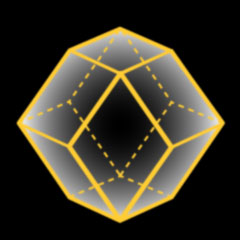
We now understand the geometric relationship between the structural cells and the gravity cells. The structural cells of the Universe are primarily rhombic dodecahedra, while the gravitation cells are octahedra, and tetrahedra. (In the technical jargon, when one has a dodecahedral array —a close-packing of dodecahedra— one also has an associated packing of dual shapes. For the dodecahedron these shapes are the octahedron and the tetrahedron; together they form a reciprocal or dual network.)
Structure cells interlocked with gravity cells, so much was known —but how did they all fit together? The solution lay in the evaluation of evidence and basic geometry.
The nodes of the dodecahedral structures are the sites of galaxy clusters —the regional centers of gravity. Significantly, there are two types of nodes. For an extended tessellation of such structural cells, there are twice as many Minor nodes as there are Major nodes. This ratio is a straightforward fact-of-geometry of ‘packed’ rhombic dodecahedra. It follows that the Universe should have twice as many tetrahedral gravity cells as octahedral gravity cells.
Furthermore, the existence of two node sizes, of Minor nodes and Major nodes, within the theoretical tessellation is a crucial link to real-world evidence. It turns out, the rhombic dodecahedron is the only close-packed shape that agrees with an amazing empirical fact —astronomers have found that galaxy clusters come in basically TWO SIZES.
Intrinsic order underlies apparent chaos
What is most remarkable (and most difficult for followers of the old paradigm to accept) is that cosmic cells never formed —never grew to be. They never evolved into a state of being. Rather, they have always existed. The revolutionary advancement in the understanding of cosmic geometry is that the cosmic cells (the structural units and the unified gravity domains) are perpetually SUSTAINED (meaning there was no initial formation origin).
The initial reaction of the scientific community was as expected, based on the author’s previous experience. Several cosmology/astrophysics journals declined publication, having foregone any formal review. One journal, however, did attempt to justify the rejection. First some perspective, it should be made clear: This present piece of research is an outstanding work, outstanding in the sense that the underlying theory agrees admirably with the empirical evidence —the abundant and incontrovertible astronomical observations. This is science of the highest standard. And yet, and yet, one reviewer flatly asserted, “It is completely unscientific,” and recommended rejecting the article (prompting the editor of the Journal of High Energy Physics, Gravitation and Cosmology to decline its publication). Who could have guessed!? Material backed by thirty-eight supporting references is not science!? And what about the text and diagrammatic content being as clear as a cloudless day? … But to that journal, and the others, truth and objective reality contained in the article was not something to be embraced … There was a recognition of a serious threat to their sacred never-to-be-challenged Worldview —a mytho-science view still stuck in the previous century.
One can only imagine the frustration and confusion of some astrophysicist/cosmologist encountering for the first time a theoretical framework that is far superior to what such individual had been taught and has long since been following. What other explanation can account for the irrational assessment of this latest DSSU work? No reasoned arguments, no specific criticism, just ridicule: The DSSU cosmology and the aether theory of gravity are merely ridiculous. The Paper is deemed not merely unscientific but “completely unscientific”! Yes, one can taste the exasperation.
Links to the article:
Natural Cosmic-Scale Geometry of Our Universe [High-resolution PDF Reprint]
… published in the International Journal of Cosmology, Astronomy and Astrophysics Vol.6, No.1, pp254-271 (2024). Doi: 10.18689/ijcaa-1000147
As always, the presentation is supported by sound theory, straightforward logic and irrefutable empirical evidence. This article’s insight into cosmic geometry represents another successful application of DSSU-defined aether. As a space-permeating dynamic medium, it bestows the property of mass, it manifests gravitation; its nature is responsible for the several guises of gravity. And gravity, of course, is what rules the Universe. It sustains the geometric shapes of the cosmic cellularity.
|
With the current revolution in cosmology, the situation seems somewhat ironic. Was it not Galileo back in the 17th century who had wisely pointed the way? —pointed to the conceptual tools for decoding the Universe? Consider his famous quote:
... this grand book of the universe which stands
continually open to our gaze ... is written in the language of
mathematics, and its characters are triangles, circles and other geometric
figures, without which it is impossible to understand a single word of it;
without these, one wanders in a dark labyrinth.
—Galileo Galilei,
1623, The Assayer
Unfortunately, 20th-century cosmologists used the cryptic geometry of an abstraction, the curvature of space, then they applied an outrageous extrapolation, and thus completely misread the nature of the universe.
* * *
Press Release (2025 July)
Nature’s maximal mass density has been determined,
The long-standing mystery surrounding neutron stars has been solved
After many decades, three major problems relating to neutron stars have been resolved.
● The question of their minimum size and maximum density;
● The reason why practically all of them have the same total mass;
● And the method by which they maintain this remarkable sameness.
It is difficult to overstate the significance of what has been discovered in the latest extension of DSSU theory.
The root of the difficulty goes back a long way. During the first half of the 20th century, the limits of gravity theory were being explored. On the largest scale, gravity theory was applied to the Universe as a whole. On the stellar scale, gravity theory was applied to the most massive contiguous objects conceivable —objects so massive and compact that no force (at least no force known at the time) could counter the certainty of total crushing collapse.
Two options were available, two ideas divided theorists into separate camps: One side decided that the answer would be found in a mathematical interpretation. The other side presciently recognized that the answer would be found in some yet-to-be-discovered mechanism of nature.
The purely mathematical interpretation, supported by contemporary leading figures such as J. Robert Oppenheimer (1904-1967) and Karl Schwarzschild (1873-1916) and Subrahmanyan Chandrasekhar (1910-1995), led to the concepts of stellar black holes and strange singularities and unrealistic infinities.
The cautionary realistic interpretation, supported by the iconic Albert Einstein (1879-1955) and the influential Sir Arthur Stanley Eddington (1882-1944); the furtherance of this interpretation, which held that behind the mathematical breakdown (the prediction of a singularity of great mass within an infinitely small volume) there is surely some still-to-be-deciphered law of nature, had to wait until the new century. As it happened, in the year 2015 the true nature of end-state gravitational collapse was discovered [Ref.1].
What was needed was a proper understanding of neutron stars, particularly in their final state —when the limits of conventional physics are reached. The old approach simply had not worked. For one thing, there was this insurmountable problem in obtaining the dimensional size of neutron stars: The basic diameters of neutron stars —dimensions absolutely vital for the determination of density— simply cannot be measured directly (astronomers have been trying since the 1960s). There are several reasons: neutron stars are just too small; they are too far away (even the nearest ones); with their black non-emitting surface they are quite ‘invisible’; and often they are surrounded by an obscuring mass-accretion disc. Another way had to be found.
Another problem was in thinking the answer would be found by focusing on extremely massive neutron stars. The expectation among theorists has always been to associate the maximal density with the largest most massive neutron star that can be found. Surprisingly, the successful determination of the maximal density did not use this conventional approach.
The successful interpretation of end-state gravitational collapse required the recognition of four ‘facts’ (as specified in the diagram below).
The solution turned out to be a matter of combining two empirical facts, one logically-derived fact, and a basic ontological fact:
● Empirical fact one: Practically all neutron stars have the same total mass, 1.4 solar masses.
● Empirical fact two: The speed limit inherent in special relativity determines the nature of the surface of the End-State neutron star.
● Logical fact: In order to avoid the logical contradictions intrinsic to stellar black holes, Nature places a strict limit on the density to which mass can be compressed.
● Ontological fact: All matter —all mass and energy
particles, anything physical, without exception— absorbs and consumes a
universal medium in order to sustain its existence. It ‘feeds’ on what
is best described as an all-permeating ethereal substrate. The very
existence of matter depends on a continuous absorption/consumption of this
sub-physical essence.
It has long been understood by space scientists that the
universal space medium (the vacuum or aether or whatever you
choose to call it) flows into gravitationally collapsed bodies. Our
ontological fact governing matter simply provides the explicit reason.
.gif) |
Concept map of how certain facts and a little-known law of physics came together to solve the mystery underlying neutron stars, namely their total-mass uniformity, their spherical size, and their crushing density. The fact regarding special relativity means the surface of an End-State neutron star must be a pure energy surface —that is, it must consist of photons and neutrinos. Note regarding the fourth fact: When astrophysicists say that ‘space’ flows into a black hole, they are in effect invoking the Ontological fact that matter/mass sustains its existence by a continuous process of absorption-consumption of the universal space medium (aether). |
A newly-published research paper documents the discovery. The Article brings those four ‘facts’ together, applies some basic math, and thus, defines the critical values of the End-State neutron star: Diameter equals 8.3 kilometers. Density equals 0.93×10¹⁹ kg/m3.
Bonus feature. The Article solves a double mystery: One is the question of what happens to any additional mass that inevitably falls onto, or merges with, an End-State neutron star. The other is the related question of how total-mass invariance is maintained. How do these 1.4-solar-mass objects remain absolutely unchanged (except for rotation rate)?
The answer is right there in our ontological fact. If mass can only exist conditionally provided there is a continuous supply of aether, then it logically follows that matter deprived of aether must vanish. It means such matter literally disappears from the Universe. The process, called mass extinction by aether deprivation, is the key element keeping the total mass unwaveringly constant. For the detailed story see the Article:
Nature’s Maximal Mass Density and the
Mechanism Keeping It Constant, by Conrad Ranzan, published in International Journal of
Astrophysics and Space Science,
(IJASS), Vol.13,
No.3, pp.94-105 (2025, September).
Abstract.
| High Resolution PDF
Complete online Article:
https://www.sciencepublishinggroup.com/article/10.11648/j.ijass.20251303.13
Doi: https://doi.org/10.11648/j.ijass.20251303.13
Also see the author's earlier Paper from 2021:
Law of Physics 20th-Century Scientists Overlooked (Part 4): Mass Extinction by Aether Deprivation, Journal of High Energy Physics, Gravitation and Cosmology Vol.7, No.1, pp.191-209 (2021). Doi: https://doi.org/10.4236/jhepgc.2021.71010
* * *
[Ref.1] C. Ranzan, The Nature of Gravitational Collapse, American Journal of Astronomy and Astrophysics Vol.4, No.2, pp.15-33 (2016). Doi: 10.11648/j.ajaa.20160402.11 http://dx.doi.org/10.11648/j.ajaa.20160402.11 | High-Resolution-Reprint
End of a Century-Long Experiment
The year 2015 marked the 100th Anniversary of the founding of the theory of gravity called General Relativity —the theory upon which Universal-Expansion cosmology is based. In 1915 was born the theory that became, in 1917, the mathematical foundation of single-cell cosmology. And it was later modified to serve as the bedrock of the Big Bang hypothesis —the speculative idea that the Universe exploded in the past and is currently expanding!
In the milestone year of 2015 the Old and the New cosmologies collided. The New exposed the fatal flaws of the Old. It was the year in which all whole-universe expansion models —this means all General Relativity Universe models— became untenable. They lost their validity. The century-long experiment of extending Einstein’s brilliant local-gravity theory to encompass the entire Cosmos had failed. … The unrestrained extrapolation of what was primarily a mathematical theory had flunked the test of reality.
With the publication of the definitive resolution of a long-standing mystery of our age —the greatest structural mystery in astronomy and astrophysics— the Expansion models have forever lost their scientific credibility.
Welcome to the nonexpanding Dynamic Steady State Universe!
–C. Ranzan (2015-12) Back to Top
The Case for a Cellular Universe
–the Story of a Baffling Omission in Modern Cosmology
Conrad Ranzan (2008)
“We have to return to this foundation and start
over again asking ancient but fundamental questions
hoping that today we are in a better position to answer them.” –Dr. Johan Masreliez
“Beneath the apparently haphazard motions ... may lie a formative tendency
toward simplicity of form, order and regularity.” –Lancelot Law Whyte
|
Finding that the case for cellularity is overwhelmingly convincing we are led to ponder why the astrophysicists and cosmologists of the 20th century failed to adopt the concept as a key feature of the Universe. Think about it: Intrinsic cellularity implies some sort of regularity, some sort of orderly arrangement; but if the opposite, chaos and randomness, is the guiding principle of one's cosmology then grand-scale order makes little sense. If the Big Bang is part of one's belief system, then entertaining the idea of systematic cosmic patterns is strictly heretical. The experts of the 20th century blundered —badly. They knew the World was a cosmos of dynamic space; they knew that, since "space" is not nothingness, it has to be "filled" with a dynamic space medium; they knew these things on the acknowledged authority of Albert Einstein. In fact, these essentials were known as early as 1839 when when the French polymath Augustin Cauchy (1789-1857) proposed the very first dynamic space medium, an aether-like medium that had the ability to contract. And whatever has the ability to contract surely has the countering ability to expand (this was later confirmed by Einstein's theory of gravity). In any case, the experts were faced with a basic choice: There were FIVE ways the space medium of the Universe could be dynamic. They extensively investigated four categories of "dynamics." In the end, they settled on one —the consensus was that there is a universal expansion of the space medium. And so, with the some extraordinary extrapolation the 20th century became the age of EXPANDING universe models. ... However, in making the choice, they missed the FIFTH way! Yes they did. Unbelievable as it may sound, they failed to see what they could easily have seen. In fact, they failed to see what they should have seen because it is well within the domain of the foundation principle of all modern cosmology! Now why does all this matter? Well, it turns out that the expanding-universe models don't work. The steady-state expanding models don't work; and explosive expanding models (think Big Bang) don't work. All are problem plagued constructs. It matters because the real Universe is cellular —it is innately, stably, provably, cellular. It matters because the consequences are revolutionary.
LINK to the complete essay:
There are five possible combinations of vacuum expansion and contraction. Each combination defines a category of universe models. ... Only one leads to a consistently problem-free cosmology.
2014 10 www.CellularUniverse.org |

NEW BOOK
Laws of Physics 20th-Century Scientists Overlooked
| |||
What they all missedIn the early years of this century, Oxford physicist Roger Penrose wrote a massive book entitled The Road to Reality (published in 2004). After following the scientific road to reality, detailing the history of theoretical physics, page after page, for more than 1000 pages, Penrose arrives at the somber conclusion that in spite of its magnificent achievements, modern science remains a flickering candle surrounded by inky mystery. As one reviewer put it, “With refreshing candor, Roger Penrose forcefully underscores the extent of our ignorance about the origin —and indeed the very nature— of the physical laws that govern the operation of our magnificent universe.”
“… we shall need powerful new ideas, which will take us in directions significantly different from those currently being pursued. Perhaps what we mainly need is some subtle change in perspective —something that we all have missed.” –Roger Penrose Yes, definitely, a change in perspective. Or better still, a new paradigm! But, what had they all missed?
Thousands of years! Sadly, the experts had missed something —something, as it turned out, embarrassingly straightforward. Consequently, they had failed to uncover the laws of physics that operate the Universe.
Understand those laws and you understand the deep nature of the Cosmos. This book is about that crucial something that all the scientists of the 20th century missed. |
|||
| |||
|
Book specifications:
Purchase online: ... Amazon.com ... Amazon.ca ... | |||
|
2022-12 |

|
Copyright © 2005-2025 All rights reserved. |
C. Ranzan |
Email: DSSUresearch@CellularUniverse.org |
Site updated: 25-02-07 |