|
| |||
|
ANNOUNCEMENTS &
NEW ITEMS:
Meanwhile, mankind’s enslavement continues. It
works like this: In order to get people to accept a fully-surveilled, open
prison, cashless society, social credit system, ... a gradual wearing down
process is implemented. “First you wear people down. Poison them with drugs,
vaccines, fluoride, and chemical assaults so they become fat and dumb. Put
addictive devices in their hands and bombard them with propagandized movies,
TV, and Masonically-controlled actors and musicians. Destroy the food
supply, poison the water and the air, manufacture fake climate change while
blaming it all on the people, and tax them to death for it.” Push
‘sustainability’ according to the UN-2030 Agenda and the
World-Economic-Forum Cult. Work towards the implementation of “15-minute
SMART-city enslavement camps.” At the same time “give them all sorts of
distractions, from the two-party political charade (with the illusion of
choice when it is a totally rigged game), manufacture social disharmony, and
grow up controlled opposition to divide and conquer any truth movement that
appears to be gaining any momentum.”
Meanwhile: We stand at a crisis—the supreme crisis of the ages. For unnumbered millenniums man has toiled upward from the dank jungles of savagery toward glorious heights which his mental and spiritual potentialities give promise that he shall attain. His path has been slow and wavering. Time and again he has lost his way and plunged into deep valleys. Man’s trail is littered with the wrecks of dead civilizations and dotted with the graves of promising peoples stricken by an untimely end. –Lothrop Stoddard’s dire warning of the dangers of the practice of dysgenics (1921 !)
The World Conquerors, The Real War Criminals by Louis Marschalko
Meanwhile: Reflect on the mega-crime of the last century —Dresden
Hellstorm (February 13-15, 1945). It is appalling to think its
perpetrators were actually hailed as war heroes!
| |||
|
“Laws of Physics Twentieth-Century Scientists
Overlooked”
Available on AMAZON.com
The Nature of Gravitational Collapse
Guide to the Construction of the Natural Universe
Participate in a unique exploration of the Cosmos: venture into the
sub-atomic realm, even into the sub-quantum realm where the roots of reality
reside, and into the domain of cosmic-scale cell-structure and beyond to
infinity. Along the way, discover the cause of mass, the cause of
gravitation, and rediscover Einstein’s “nonponderable” aether and Heraclitus’
harmony-of-opposites principle. … The book represents the ultimate
vindication for all the skeptics who resisted the "preposterous" Big Bang
mythology and who refused to join the exploding-cosmos religion. POPULAR RESEARCH PAPERS:
| |||
|
Glossary of Terms
used in Cosmology and Astrophysics with particular emphasis on DSSU theory. |
|||
|
GENERAL INTEREST ARTICLES: | |||
|
COSMOLOGY ARTICLES, etc:
Large-Scale Structure of the Dynamic Steady State Universe published in
the American Journal of Astronomy and Astrophysics, Vol.4, No.6,
2016, pp.65-77.
Astract and Links. Galaxy Morphology:
Ellipticity, Its Origin & Progression in Comoving Galaxies, American Journal of Astronomy & Astrophysics,
AJAA, Vol.3, No.2, 2015.
EXTERNAL LINKS:
| |||
|
DSSU Theory:
The Fundamental Process of Energy —A Qualitative Unification of
Energy, Mass, and Gravity. (Abstract
& Reviews & Links) … This article reveals
the secret behind photon confinement. (Contains only a bare minimum of mathematics
and mainly in one of the 14 sections.)
Headlined as:
| |||
|
ARTICLES on AETHER: |
|||
|
DSSU RESEARCH PAPERS: |
|||
|
GRAVITY:
|
|||
|
RELATIVITY ARTICLES: |
|||
|
An Open Letter to the Scientific Community "The big bang today relies on a growing number of hypothetical entities, things that we have never observed-- inflation, dark matter and dark energy are the most prominent examples. Without them, there would be a fatal contradiction between the observations made by astronomers and the predictions of the big bang theory. In no other field of physics would this continual recourse to new hypothetical objects be accepted as a way of bridging the gap between theory and observation. It would, at the least, raise serious questions about the validity of the underlying theory. ..." continues ... A devastating Declaration of opposition to Big Bang cosmology signed by more than 400 Researchers.
|
|||
|
INTELLECTUAL FREEDOM:
|
|||
|
DEDICATION: This website is solemnly dedicated to those
individuals who have conducted research in their chosen field and have
informed others of their inquiries and suffered the consequences when
subpoenaed by the Inquisition or some variant thereof. The dedication
extends to those individuals currently imprisoned, and those facing
trial and persecution simply for exercising their basic human right of
freedom of expression supposedly granted to them under the UN Charter of
Human Rights. "Every year, hundreds of writers and other literary professionals around the world are imprisoned, prosecuted, persecuted, attacked, threatened, forced into exile or even murdered as a result of their work." ALSO: Be aware of the continuing threat to our precious freedom of expression on the Internet. The threat is serious and relentless. It is described as “… the formal effort to mimic Communist China’s system of Internet censorship.” – www.InfoWars.com More information on threats to internet freedom: https://battleforthenet.com/ End of free speech in Britain:
A publisher of history books in Britain has reported that “due to new laws
in the UK all their books will have to be censored moving forward” to avoid
criminal penalties for “inciting racial hatred.” –The Barnes Review (2020 March/April)
p77 In repressive Germany:
Ursula Haverbeck,
89, Sentenced to 14 Months in Jail for Heresy! –2017 November George Orwell Free Speech Awards:
The Supreme Irony:
□ The Continuing Struggle for Freedom A ray of hope in the ongoing struggle for freedom. Populist and nationalist movements around the world are gaining ascendancy over the New World Order’s effort to establish global governance and impose tyrannical control over every last square meter of the Earth’s surface. –The Barnes Review Vol.23 No.1 (2017 Jan p70)
The ongoing fight for freedom and truth. –Just Right Media (2020, Sept 18, program)
● Pro-Freedom NEWS:
Vanguard News
For more on Freedom (and Objectivism), |
|||
|
... about the author ...
D S S U Research,
Niagara Falls, Canada Visits since mid-2010 :
2026-7-24 |

.jpg)

.jpg)
Gravity and Lambda
|
|
Unless you expect the unexpected you will never find truth, for it is hard to discover and hard to attain. –Heraclitus |
CONTENTS
1. GRAVITY
2. LAMBDA: THE GENERIC EXPANSION FACTOR
3. THE TRADITIONAL STORY OF GRAVITY AND LAMBDA: OPPOSITES IN CONFLICT
4. THE NEW COSMOLOGY STORY: OPPOSITES IN HARMONY
5. IMPLICATIONS OF GRAVITY AND LAMBDA IN HARMONY
6. REFLECTIONS
7. SUMMARY
Most believe in the superficial harmony of a universe that seems to be expanding —of a universe involved in a harmonious Hubble expansion. Others hold that the universe is not expanding and that a deeper, superior, harmony rules and accounts for not only its grand structure but also for the unity of the opposites of gravity and Lambda.
1. GRAVITY
THE RANGE OF GRAVITY. One of the key differences between the conventional cosmology of universe-wide expansion and the new cosmology of cosmic cellularity involves the range of gravity. Conventional cosmology, popularly called the Big Bang, permits the effect of gravity to have an unlimited range; the New Cosmology, in contrast, imposes a strict limit to gravity’s reach. In the Big Bang (BB) model of the universe every particle, every star, and every galaxy has a gravitational influence on every other particle, star, and galaxy. Everything “pulls” on everything else in accordance with the inverse-square law. For example, the gravitational pull of our Sun on a distant object decreases with the inverse of the square of the distance; as the distance to the object approaches infinity, the strength of the Sun’s pull on it approaches zero. But it never becomes zero. It means that conventional gravity’s reach has no limit. In terms of general relativity we would say that the Sun’s matter curves space (or spacetime) and contributes to the curvature of the entire universe.
However, this is not the case in our Cellular Universe. The reach of gravity of any particle, star, and galaxy has strict limits.
CAUSE OF GRAVITATION. There is another important difference. Often overlooked is the fact that neither Newton’s theory of gravity nor Einstein’s general relativity theory includes an all-important cause of gravitation. Newton’s gravity theory describes in mathematical terms the forces in a gravitational system —but not what causes the forces. The question, “What causes matter to grab a hold of other matter?” is left unanswered. As for Einstein’s gravity theory, although it uses a more advanced mathematical method (something called metric curvature) to describe the gravitational effect with admirable precision, the causative mechanism by which matter attracts other matter is, once again, absent. Remarkably, both of these famous gravity theories are incomplete! ... In the second year of the present millennium the cause of gravitation which had eluded theorists for centuries was discovered by an Australian physicist. This remarkable achievement may yet become known as the greatest astrophysics discovery of the present age encompassing the 20th and 21st centuries. (The cause was also found independently in that same year, 2002, during the development of the Dynamic Steady State Universe theory.) And here is the big difference: BB cosmology has not yet incorporated this key component. The New Cosmology makes full use of the cause of gravitation.
Before describing the mysterious Lambda effect, the key role of gravity must be emphasized. Gravity is, because of its cumulative nature, far the most powerful effect in all Nature. For an understanding of the Universe, there is nothing of greater importance than a comprehensive fully-functional theory of gravity. The description of gravity is critically important because, whatever it may be, it ends up at the very heart of the theory of the Cosmos. Consequently, if one’s theory of gravity lacks a causative mechanism then the associated universe model will be flawed, or incomplete at best.
2. LAMBDA: THE GENERIC EXPANSION FACTOR
GENERIC LAMBDA. The lack of a modus operandi for the gravitational force of Newton’s theory, or the lack of a physical meaning of positive curvature of space of Einstein’s theory, did not in any way prevent cosmologists and philosophers from constructing models of the Universe. But the problems were formidable. For one thing, ‘limitless’ gravity, it seemed, was too powerful. Almost invariably, theorists found that they needed to tame this universal and domineering ‘force’ tending to crush everything in the cosmos into some doomsday black hole. Such unrestricted gravity would preclude any sort of realistic functional universe. In the attempts to address this problem, theorists over the years have postulated various ways of counteracting the effect of gravity. They have, at one time or another, invoked: a new force, some mysterious energy, a dynamic effect, and more curved geometry —all with the express purpose of opposing gravity. And they all share a wonderfully simplifying commonality.
The variously proposed opposites of gravity all produce the same result as can be had with what is loosely referred to as space expansion. Each could be replaced by some appropriate degree of space-medium growth. Space, or space-medium, expansion is like a generic cosmological constant (the "cosmological constant" being the famous factor used in the first general-relativity model of the universe). In the light of "space" expansion the cosmological constant or Lambda loses much of its mysterious nature. It is equivalent to a straightforward concept.
Lambda, symbolized by the Greek letter Λ, is the generic name herein given to any cosmic phenomenon that opposes gravity. And as it is applied to the various posited opposites of gravity, it really doesn’t matter how "space" is defined. Generic Lambda simply means there is more and more of it. If we think of gravity as decreasing the space between cosmic objects, then Λ is the effect increasing the space.
HISTORIC EXAMPLES OF USE OF LAMBDA. Lambda made its first appearance in 1917 when Albert Einstein used it in a failed attempt to model a static universe. At that time in the history of the science of cosmology, the universe was believed to be static on the large scale. In his famous universe model, based on his recently developed theory of general relativity, the generic Lambda was called the cosmological constant. It functioned as a new kind of force —a cosmic repulsion effect. Since Einstein denied (or ignored) the existence of a space medium, he found it necessary to create this new effect. Nevertheless, his Λ force, as it tended to increase the distances between galaxies, behaved exactly as if space itself was expanding. The model had generic space expansion.
So why didn’t the model work? It didn’t work because it involved an unscientific extrapolation. General relativity, it must be understood, is a powerful mathematical theory of local dynamic space —not universal dynamic space. General relativity is not a theory of the universe and cannot serve as such. Whenever attempts are made to substitute general relativity for a theory of the greater universe, that is, whenever it is applied to the universe as a whole, serious problems arise. Thus, when Einstein used the relativity theory to formulate his 1917 model he needed some contrived component to give it stability. And so he introduced his cosmological constant as a precise counterbalance to all the gravity present in the universe. The picture that emerged was one of gravity and Lambda in opposition: Gravity struggles to pull everything in the universe together; Lambda strives to push everything in the universe apart. But the picture failed, stability was not to be had, and Einstein eventually abandoned the model.
Others followed the lead of Einstein and throughout this period and into the 1920s generic Λ became a central ingredient of various universe models. The Willem de Sitter universe (1917) used Λ as the expansion of flat (non-curved) space. Alexander Friedmann (1922 & 1924) had his own version of a generic Λ; he called it space curvature and used it to produce a “space curvature” expansion of his universe (and in another version he used Λ to produce a “space curvature” contraction). It did not represent space-medium expansion in the absolute sense, as it does in the Dynamic Steady State Universe (DSSU) theory, but rather, it modeled the expansion of the esoteric kind of space used in Einstein’s general relativity —a geometrically dynamic curved space, a purely mathematical space. But no matter, the results are the same as if the medium itself expands.
LAMBDA WAS USED TO MODEL A BIG BANG. Georges Lemaître, instead of aiming for harmonious stability in the universe, gave Lambda the upper hand. In his universe (1927-29) Λ overpowers its dynamic opposite. Lambda reigns, gravity submits. While gravity as usual pulls everything in the universe together, Λ works even harder pushing everything apart. By “everything” we are referring to the big stuff like galaxy clusters. Net result? ... A really big universal explosion.
LAMBDA WAS USED TO “CORRECT” MAJOR PROBLEMS WITH THE BIG BANG. As detailed in the historical records, the Lemaître big bang had big problems. Some of these were of the worst kind —outright paradoxes! And so, generic Λ was called upon “to save appearances” as it were. After considerable trial and error, several American cosmologists, including Alan Guth and Paul Steinhardt, and Russian experts, notably Andrei Linde, came up with a new and improved expansion mechanism —a reformulation of generic Λ which became known as inflation. They devised a supercharged Λ-effect with super-fast space expansion. Hypothetically, Inflation dominated the earliest epoch of the BB universe to such an extend that gravity’s role was practically negligible.
We now move ahead a few years. With the Crisis of 1998, Lambda took on the role of dark energy —the mysterious force causing an unexpected renewed phase of, you guessed it, space expansion.
LAMBDA’S MANY GUISES. A quick review of Lambda’s better-known manifestations. It appears as an anti-gravity force in the 1917 Einstein static universe. In the Friedmann models, Λ takes the guise of space curvature. It appears as a hyper-lightspeed explosion under the dictates of Inflation theory. And sometimes it appears in the equations describing a universe model just in case it is needed; the model might not actually need Λ (i.e., it is set to zero) but it is retained and serves to represent some unknown force that just might permeate the cosmos. In some theories Λ morphs into something called quintessence. And under the auspices of current orthodoxy in cosmology, Λ rules as a mysterious force appropriately called dark energy.
Cosmologists have enlisted Lambda in so many ways that it is sometimes called a “fudge factor” —a highly useful easily-adjusted term in the equations. It is this and much more:
|
It stands for the unknown, spiritual
element that the scientist desperately hopes will make each
cosmological model more beautiful, more complete, more true.
|
In some theories Lambda shares properties with vacuum energy. Then there are theories in which Λ is named according to its physical characteristics: negative pressure and, equivalently, tension. Not surprisingly, a region of space that is subjected to negative pressure EXPANDS. A region of space that is subjected to tension EXPANDS. In the end, whatever one may choose to label it, generic Λ is a necessary ingredient and serves as the counter-effect to gravity. And Λ in the DSSU is no exception.
WHAT CAUSES THE EXPANSION REPRESENTED BY LAMBDA? All expanding-space models implicitly or explicitly point to some sort of “energy in the vacuum” or energy in space itself. Does this mean that the vacuum energy is the cause of space expansion? Or is the action of "space," as it expands, the cause of the vacuum energy that permeates space? Is it even possible to determine the answer? ...
3. THE TRADITIONAL STORY OF GRAVITY AND LAMBDA: OPPOSITES IN CONFLICT
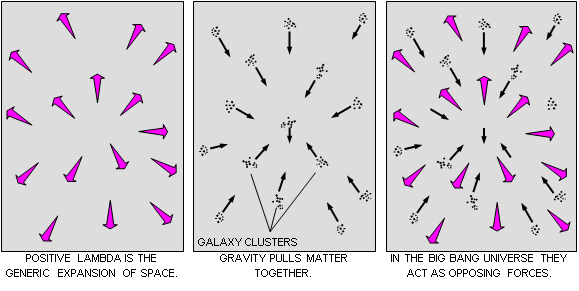
Throughout the 20th century and into the present, the conventional view on gravity and generic Λ has been two-fold: First, they were considered to be opposites with gravity tending to pull things together and Λ tending to push things apart. Secondly, they were seen to be in conflict with each other. The traditional view has been that of two opposite effects in conflict. This view is embodied in BB cosmology. It may seem an oversimplification, but this assessment is fundamentally sound; the Big Bang universe is a construction in which gravity pulls everything radially inward and Λ, as a cosmic repulsion, pushes radially outward.
Cosmologist Edward Harrison, in his textbook Cosmology, the Science of the Universe (p293), makes it clear that when Lambda is positive it acts as a cosmic repulsion —a force that opposes gravity. It “offsets the attraction of gravity.”
A schematic representation of this view is shown in Figure 1. Although the drawing suggests the presence of a center-point, one need not be presumed; with or without such a center, gravity and Λ are viewed as opposing each other.
 |
||
|
Figure 1. Gravity and Lambda are treated as forces in opposition by the 20th-century cosmology. |
As a representation of reality, the Big Bang view —to put it
bluntly— is wrong. Although it is true that positive-valued Lambda
behaves as a cosmic repulsion it does not follow that it also acts
in opposition to gravity. Astronomers and theorists, unaware of the non
sequitur, have long assumed that the two effects oppose each other.
Unfortunately their traditional view of opposites in conflict leads to an
unanticipated riddle.
Put yourself in the shoes of a physicist. The traditional view leads you to believe that Λ opposes gravitational clustering. But by failing to recognize the invalid premise and accepting it into your model you will have immediately burdened yourself with an artificial mystery. Allow me to explain. By placing gravity and Λ in conflict with each other you are in effect weakening the force of gravity; weakening the tendency of galaxies to cluster; weakening the cohesion that binds clusters and superclusters. Consequently, you will now be confronted with the task of explaining what in the world ... what in the name of heaven ... keeps any galaxy cluster together? Astronomers have accumulated abundant observations and theorists have the detailed calculations and together they have a sea of data that embodies the mystery: galaxy motions within a cluster are far too high; the cluster should be flying apart! Individual galaxies should be fleeing the cluster. But they are not. What is it then that holds the cluster together? The insurmountability of this problem is so enormous that should you manage to discover the cause of cohesion while retaining the above premise, then expect to receive a communiqué from the Nobel selection committee.
Evidently, something must be maintaining the integrity of the clusters and superclusters. Something is holding them together and their observable self-gravitation is insufficient for the task. Something mysterious is augmenting gravity. And what better way is there to solve a gravity mystery, at least within the traditional storyline, than with some kind of unseen mysterious material?
|
...[M]odels worked a lot better if they added
certain kinds of unseen material, or “dark matter,” into the mix. Dark
matter could provide the extra gravitational pull needed to build galaxies
and flatten out [i.e., reduce expansion of] the universe, and if its
properties were just right, it might not interfere with the [other aspects
of the BB model]. The mystery material was ... designed to amplify rather
than counteract the pull of gravity. |
Here is the insurmountable part of the problem: No
dark matter has ever been found. Although the search has been and continues
to be intensive, no lab experiment has ever produced a dark matter particle
and no detector has ever recorded one. The list of the possible candidates
for the elusive particles is perplexing and extensive: WIMPS, neutrinos, axions, photinos, neutralinos, ... . All have been more or less rejected.
Although the futility of the search is disheartening, in the long run it is
unimportant. As stated above the mystery is artificial. It actually does
not exist. Nevertheless ...
|
Nonetheless, the dark matter search goes on,
because without dark matter our picture of the universe makes no sense.
Visible matter alone cannot explain the gravitational dynamics of galaxies
and clusters of galaxies. |
As if to deny the BB model the plausibility it so desperately seeks,
Corey Powell then pens these discouraging words: ”Even the addition of
dark matter did not solve the essential mysteries of the big bang.”
If tragedy in a story appeals to you, this comes close. With or without dark matter, the BB model makes no sense. They (the astro-scientists) can’t seem to figure out how the space in the universe is expanding while all the material stuff is sticking together! ... What is going on? ...
Undoubtedly something is assisting gravity. ... It is not dark matter.
But wait. There is something more —something unexpected and sinister, in this sub-story of conflict. Standard cosmology has added a new dimension to the alleged conflict between gravity and Λ. With the Crisis of 1998 it was found that Λ does more than simply reduce the effect of gravity —it was determined, or so they claim, that Λ completely overpowers gravity. Λ now becomes the dominant force in the BB universe; and not just during the big bang genesis but forever after. This new enhanced Λ-effect is the reason that the revised model is often called the inflationary-BB-accelerating universe —with the new emphasis on accelerating.
The conventional view that gravity and Λ are opposites in conflict will now be challenged.
4. THE NEW-COSMOLOGY STORY: OPPOSITES IN HARMONY
One seldom sees what one is not looking for
—saying
If one is looking for conflict in opposites, one may miss seeing their
harmony.
A simple question: Can two opposite effects amplify each other? Consider an example for which the answer is obviously no: the two opposite parts of a propagating wave —crests and troughs. In the simple interference patterns of light or water waves, the crests and troughs just cancel each other; there is no amplification. Next, consider positive and negative electrical charges; they are obvious opposites. Depending on the configuration of their associated electric fields they may either cancel their combined effect or they may amplify the effect. For another example consider the opposite poles of a magnet. A pair of “U” shaped magnets, when aligned to demonstrate mutual attraction, represents a configuration of opposites acting in harmony.
Hidden in the configuration of our dynamic steady state universe lies the harmony between gravity and Lambda. These opposites do amplify each other. As we have seen, Lambda involves the dynamic expansion of "space" and ordinary gravity involves the dynamic contraction of "space." (These are basic Postulates #1 and #2 of DSSU theory.) They appear to be, and really are, opposite effects. And you will agree that in regions of expansion galaxies move apart and in regions of contraction galaxies move closer together. It certainly sounds like these "forces" are in conflict. And yet it can be shown —and this is about as magical as the story gets— that Lambda and gravity are actually oriented in a common direction.
Both effects work towards a common purpose and a common outcome. On the size-scale of greatest importance —of greatest importance for shaping our Universe— Λ pushes matter together while ordinary gravity (as always) pulls matter together. This harmony of forces is made graphically clear in Figures 2 and 3.
The unexpected twist in the story of Lambda and gravity is that the acceleration vectors and the flow lines, which define these effects, are all directed towards the same regional destination!
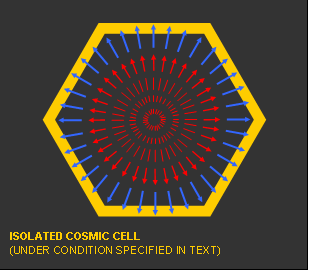
A LOOK AT THE COMOVING TRAJECTORIES IN THE CELLULAR UNIVERSE. The scale of importance in the DSSU is the scale of its bubble-like cosmic cells which have a nominal diameter of 300 million lightyears. I have used hexagons as the schematic representation of such cells. The actual cosmic structures, in general, have a non-Platonic dodecahedral shape. We may think of the flat hexagon as being the cross-section view of a polyhedron (dodecahedron). The space medium within the cell is dynamic and when we imagine sprinkling galaxies into this region —like sprinkling bread crumbs onto the surface of a lazy stream or like blowing bubbles into a gentle breeze— they will comove with the medium into which we have placed them. The motions of the “sprinkled galaxies” become comoving trajectories. The trajectories coincide with the Λ and gravity vectors/flowlines in the diagrams.
Consider, for the moment, the situation in which all the matter in the universe was somehow evenly distributed around the perimeter of each cosmic cell. Then the Λ-effect and gravitation effect and the resulting trajectories would be represented with a simple radial pattern as shown in Figure 2.
 |
||
|
Figure 2. Opposites in harmony. The arrows represent the direction of the Lambda “force” (in red) and the gravitation “force” (in blue) under the unrealistic condition in which matter is uniformly distributed within the cell walls (yellow). The arrows also serve to indicate the direction of movement of "space" itself and the comovement of contained objects. |
Matter, however, is not evenly distributed. Like a beehive
honeycomb the cell ‘walls’ at midpoints have very little material, while
the cell nodes are substantially reinforced. Matter, mainly in the form of
galaxies, tends to clump together at the cosmic-cell nodes —as astronomical
observations confirm. These accumulations are naturally called galaxy clusters. Away from
the nodes we have the cell walls, or cell interfaces, which contain
considerably fewer galaxies. And these galaxies are in transit towards the
nearest node. In fact, it is the law of cosmic motion that all
galaxies obey regardless of where they originate or where we may place them
in our diagram: all follow a trajectory towards the nearest node (allowing
for the occasional momentary detour and the possibility of galactic
cannibalism).
Once again, we are able to underscore just how strongly
divergent the two cosmologies really are. In the DSSU the Lambda effect actually reinforces gravity!
No mathematical proof is required; simply look at the drawing (Figure 3)
and visualize force vectors (or simply acceleration vectors) along the
curved paths. The Λ-effect vectors are in the same general direction as the
nearest vectors representing the gravitational effect. In the DSSU, objects
subjected to either Λ or gravity will move in the same general direction.
On the cosmic-cell scale, the Λ vectors are directed towards
mass-concentration regions, as are the gravity vectors.
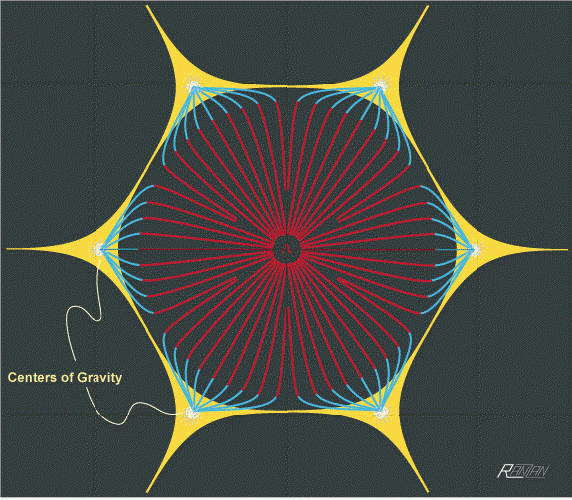 |
||
|
Figure 3. Opposites in harmony in a dynamic cosmic cell. The curves are the trajectories of the movement of "space" itself and the idealized comovement of contained objects. There is a perpetual flow; first through the Lambda region (along the red paths); then through the gravitating region (along the blue paths) and into the very cores of the nodal galaxy clusters. (The hexagon is a schematic cross-section of a single cell of the DSSU.) |
The DSSU picture reveals the beauty and symmetry of the harmony of
opposites. Lambda “pushes” galaxies, and any other comoving objects,
towards the cell’s interfaces where basic gravity takes over and “pulls” them in.
The direction of the vectors confirms that Lambda does indeed amplify
gravity. When it comes to holding galaxy clusters together ordinary gravity
will not do it on its own; Lambda —not dark matter— partakes in the
effort. By grasping the underlying principle, known as the harmony of
opposites, we have gained crucial insight. Heraclitus of Ephesus
(530-470 BC), the Ancient Greek originator of the theory of the
harmony of opposites and a participant in the first revolution in
cosmology, had paved the way
|
Heraclitus develop[ed] a new theory ... and this is his signal discovery: and contribution to philosophy: the real world consists in a balanced adjustment of opposing tendencies. Behind the strife between opposites, according to measures, there lies a hidden harmony or attunement which is the world. –Bertrand Russell, Wisdom of the West (p24) |
If Heraclitus could have foreseen the future he probably would have
wondered what took us so long to apply his famous principle. And the
novelist and social critic George Orwell would have understood the human
factor in resolving the gravity-Lambda mystery: Orwell was keenly aware of
the danger of intellectual pacifism when he exhorted, “To see what is in
front of one’s nose requires a constant struggle.”
|
If Heraclitus could have foreseen the future he probably would have wondered what took us so long to apply his famous principle. And the novelist and social critic George Orwell would have understood the human factor in resolving the gravity-Lambda mystery: Orwell was keenly aware of the danger of intellectual pacifism when he exhorted, “To see what is in front of one’s nose requires a constant struggle.” |
“[T]here is one way in which wisdom can be achieved, and that is by
grasping the underlying principle of things. This formula is the
harmony of opposites, but men do not recognize it, though it
manifests itself everywhere. ... If we do not recognize the formula
then no amount of learning is going to be of any use."
|
5. IMPLICATIONS OF GRAVITY AND LAMBDA IN HARMONY
Einstein was correct in principle when in 1917 he envisioned a universe in which Λ would exactly balance the effect of gravitation keeping the universe motionless (non-expanding, non-contracting). It was the pattern of the balancing dynamics that eluded him. I do not make the following claim lightly, but it seems that it never occurred to Einstein that he could have used Λ —even kept it positive— to assist gravity and still have achieved the realistic goal of a static universe.
His balanced static universe was not a success. The way Λ was used turned out to be a formula for instability. If Einstein, however, had fashioned Λ into a simple cellular pattern he would not only have modeled a truly stable and quasi-static universe, he would also have discovered the real universe —the Dynamic Steady State Universe.
As far as the quest for dark matter is concerned, it would be naïve to think that with the elucidation of the true nature of Λ —that in our cellular universe it acts in the same direction as gravity— the fruitless search for mysterious dark matter and dark energy would cease. It is not easy to argue that there simply is no dark matter; there is a dilemma in trying to prove a negative. One can only assert, as does Professor Reginald T. Cahill, of Flinders University, an expert in process physics:
|
There is no ‘dark matter’, merely an exotic self-interaction and annihilation process [i.e., a contraction process] of the quantum cellular structure that is space. –Space and Gravitation (Magister Botanicus, Vol.2, pp.13-22, 2004) |
The quest for dark matter will continue. It will continue mainly for two reasons. First, the unexpected discovery will be ignored and even suppressed. Secondly, research into dark matter is funded by government and quasi-government institutions; funding decisions are influenced by factors often far removed from truth and reality.
For the foreseeable future expect more of the same —more speculative mysterious-matter theories.
Nevertheless, there are profound and far-reaching implications in the discovery that gravity and Lambda act in harmony.
For instance, consider the unusual symmetry pattern (Figure 3) of the Λ-gravity field? ...Without going into detail in this short article, it simply means that the largest individual gravitational fields in our Universe are not spherical; which in turn means that the usual inverse-square law does not apply.
If we define the force of cosmic gravity at any point in space as the mass of a test particle multiplied by its comoving acceleration (realizing that the comoving acceleration is towards the cell interface in general and the nodal dominant galaxy in particular), then could we not simply combine expansionary Λ and contractile gravity into something called a unified-cosmic-gravitation? Any point we may wish to investigate in a typical cosmic cell is accelerating (meaning that the space medium is in motion) towards the interface and towards the nearest node! Indeed, all points “experience” gravitation as defined; all locations except for certain Lagrangian neutral sites. Lambda can simply be incorporated into a unified gravitation field. Each node with its galaxy cluster becomes the center of its own unified gravitation field. The implications are explored in greater detail in a related research paper.
The symmetry partly revealed by Figure 3 may be expressing another way: All centers of gravity are surrounded by Λ regions. Consequently, we conclude that the range of gravity is indeed limited (as claimed in the opening discussion). Furthermore, the universe is not random or chaotic. Gravity and Lambda manifest as the two dynamic processes that order the universe. The order of processes imposes the order of structure. The harmonious activity of expansion and contraction mold our ordered Universe —our cellular Cosmos.
6. REFLECTIONS
In the DSSU we see the ultimate in balance between gravity and Λ. We see this clearly in our minds because we grasp the underlying principle that Λ manifests as the expansion of "space" and gravity manifests as the contraction of "space." It is a balance that maintains our Universe’s observed structure. They are two sides of the same coin.
We see a harmony of opposites. What does institutionalized cosmology see? ... The view of the leaders of the Supernova research teams is representative:
|
What [Saul] Perlmutter and [Brian] Schmidt see, instead, is the ultimate in unbalance — a runaway universe, in which galaxies race ever faster away from one another. –Corey S. Powell, God in the Equation (p238) |
What academic cosmology sees must, of course,
conform to the established BB religion. As Corey Powell effectively argues,
its congregation deifies Lambda as the Angel of Dark Energy. First, the Big Bang
religion provided its followers with a creation story in the form of
an exploding egg (or singularity, if you prefer); the Angel of Dark Energy now provides followers
with a doomsday scenario —a prolonged demise in which Perlmutter and
Schmidt’s speculations of accelerated expansion leads their universe towards increasing
emptiness and death by dilution. Academic cosmologists envision a rather
gloomy future.
|
The [Λ dominated] accelerating
universe could create a spiritual crisis... |
All the while the practical crisis is very real, for
what has a beginning must also have an ending. The adherents of the
creationism cosmology, having failed in unraveling the mystery of their
creation event, now brood over the gloomy fate of their
universe.
What a blockbuster story gravity and Λ is turning out to be! The story is leading to what must surely be the death-blow crisis for creationism cosmology.
To the BB congregation and the non-believers, to the academics and the amateurs, I make the following prophecy in expressing one more implication associated with the discovery of the harmony of gravity and Λ. It is probably this feature of DSSU theory more than any of its other equally valid arguments that has the persuasiveness to trigger a paradigm shift in astrophysics and usher in the Fifth Revolution in cosmology. ...
7. SUMMARY
The following chart provides a convenient comparison-summary of the ideas herein covered.
.png) |
||
|
Figure 4. The role of Gravity and Lambda for two radically different cosmologies. |
In stating, in the Figure-4 flowchart, that Einstein’s gravitation lacks a cause I mean that there is no ‘mechanism’ (for lack of a better word) to explain how mass distorts, or curves, Einstein’s spacetime.
The conclusion that the 20th-Century Cosmology is a problem-plagued cosmology encompasses both the Big Bang class of models and the historic Steady State class.
According to general relativity theory, gravity and Lambda are the active dynamics of spacetime.
According to DSSU theory gravity and Lambda are the active dynamics of aether-permeated space. Both theories have gravity and Lambda as similar effects of their respective space. Both theories identify the dynamic effects with expansion and contraction. So, what’s the difference?
The heart of the difference —the profound difference— is relational:
Opposites in conflict versus opposites in harmony.
* * *
For the continuation of the story of Gravity and Λ, including its climactic finding and a more in-depth treatment of the ideas in the above article, please see the research paper:
The Story of Gravity and Lambda
–How the Theory of Heraclitus Solved the Dark Matter Mystery
–C. Ranzan
Reprinted by permission of Physics Essays Publication, from
Physics Essays, Vol.23, No.1, pp75-87 (2010).
* * *
This article is an open-access article distributed under the terms and conditions of the Creative Commons Attribution License (http://creativecommons.org/licenses/by/4.0/) which permits unrestricted use, distribution, and reproduction in any medium, provided the original work is properly cited.
Copyright © by Conrad Ranzan www.CellularUniverse.org
2007; rev2010-6
Selected Sources:
Cahill, R. T. Space and Gravitation.
Magister Botanicus, Vol.2, pp.13-22, January 2004
Posted at: http://www.mountainman.com.au/process_physics/index_of_papers.htm
Harrison, E. R. Cosmology, the Science of the Universe (Cambridge
University Press, Cambridge, UK, 1981)
Layzer, D. Constructing the Universe, Scientific American Library (W H
Freeman & Co. New York, 1984)
Powell, C. S. God in the Equation (The Free Press, New York,
2002)
Russell, B. Wisdom of the West, Editor Paul Foulkes (Crescent
Books, Inc., & Rathbone books Limited, London, reprinted 1977 & 1978)
|