|
|
ANNOUNCEMENTS &
NEW ITEMS:
(Most recent at top of column)
(2026 July 24): It often happens, the more powerful the logic of the
argument, the harder it is to pass through the review process. If your
airtight reasoning goes against the ‘official science’, it becomes extremely
difficult to get published. So it is with the DSSU OVERVIEW paper. After
many long months, it is still under review!
Meanwhile, the decline of Western Civilization
continues ...
According to a recent powerful address, a remarkable and highly
philosophical assessment, delivered by America’s Secretary-of-State Marco
Rubio:
"Radical Leftism may wear various slogans and ideologies across
place and time —anti-capitalist, anti-imperialist, communist, anarchist,
Marxist. But the fundamental character is always the same: a poisonous
resentment cloaked in the language of equality, justice, and liberation —an
overwhelming need to tear down what greater men have built. ... This is a
distinctive and unique evil, driven above all else by a deep hatred of
civilization itself. It is perpetrated by those who cannot build, cannot
create, cannot achieve great things, and take their revenge upon the world
for their own inadequacy by seeking to destroy those who can."
–Saving
America ... (Just Right #974 -
2026 July 22)
(2026 May): Addressed is the question:
How can a failed universe
model claim to be successful? All one has to do is ignore the key
evidence —highly-relevant observations.
(2026 February 13): Currently under review is a restructured
overview of DSSU Theory ... a presentation of the essential elements of
Natural Cosmology.
Meanwhile, we remember the Dresden Holocaust:
February 13-15 marks the 81st anniversary of the greatest evil in the
history of mankind. Historian Herbert L. Brown, in his recent book, calls it
“The Dresden Massacre—the worst war crime in history” ...
The Devil’s Handiwork ...
(2025 December 5): An overview of the essentials of DSSU Cosmology is
currently being prepared.
Meanwhile. The persecution of the productive
class intensifies. Collectivism, Communism, and Socialism deepen their grip
on the Western World.
“In practice, socialism is the political application of the philosophy
of egalitarianism. Socialist 'equality' does not mean 'equality before and
under the law' —it means equity: the 'equality' of results. It means that
those who work hard, take risks, and produce the goods, services, and
products upon which a society's survival depends, must be punished to the
degree of their success, while those who do not fit into the productive
class (for whatever reason) are to be rewarded by sharing in the products
they had no part in creating.” –Just Right #939
(2025-11-19)
(2025 August 22): Announcing a positive development for the Fifth
Cosmology revolution: A new Web
Domain has been acquired for the promotion of the Dynamic
Steady State Universe: www.DSSU.info
Meanwhile. Amazing but not surprising,
for this is how Communism works. A citizen is fined $28,870.50 merely for
walking into a forested area —for strolling through a piece of property of
which he is the owner! Under Communism you might think you’re the owner, but
in reality you own nothing! The full story is posted at: Just Right #926 August
20 (with link to podcast).
(2025 August 15): Recent problem with sending email to ... @CellularUniverse.org
has been corrected.
(2025 August 8): A high-quality HTM version of "Mainspring of the
Universe –The Mechanism Sustaining the Universe’s Steady State" is
now available. File:
Mainspring(ijcaa-R)-Ranzan.htm
(2025 August 1): The latest research article, "Nature’s Maximal Mass
Density and the Mechanism Keeping It Constant," has been
PUBLISHED in the
International Journal of Astrophysics and Space Science, (Vol.13,
No.3). For an overview and background details, see the current
Press Release.
(2025 June 6): Another triumph for DSSU theory. Two baffling
aspects of neutron stars have been resolved: ● The long-standing
question of maximal density. ● And the question relating to total mass, Why
are almost all neutron stars the same mass-size?
The relevant research paper is currently undergoing editorial peer-review.
Meanwhile, mankind’s enslavement continues. It
works like this: In order to get people to accept a fully-surveilled, open
prison, cashless society, social credit system, ... a gradual wearing down
process is implemented. “First you wear people down. Poison them with drugs,
vaccines, fluoride, and chemical assaults so they become fat and dumb. Put
addictive devices in their hands and bombard them with propagandized movies,
TV, and Masonically-controlled actors and musicians. Destroy the food
supply, poison the water and the air, manufacture fake climate change while
blaming it all on the people, and tax them to death for it.” Push
‘sustainability’ according to the UN-2030 Agenda and the
World-Economic-Forum Cult. Work towards the implementation of “15-minute
SMART-city enslavement camps.” At the same time “give them all sorts of
distractions, from the two-party political charade (with the illusion of
choice when it is a totally rigged game), manufacture social disharmony, and
grow up controlled opposition to divide and conquer any truth movement that
appears to be gaining any momentum.”
“Then fill them with rage from all the injustices, making
everyone broke and struggling so they have no time to research and figure
out the con. Slowly erase [censor] the internet so nothing of worth comes up
in searches anymore and you successfully have a dumbed-down, ignorant, slave
population.”
The Globalists are succeeding at this game —for “they have
mastered understanding human psychology.”
–per Article by Amandha Dawn Vollmer, as in Druthers, Issue #42 (May 2024)
(2025 May 2): Dynamic Aether Theory of Gravity has now been published in the
SCIREA
Journal of Physics (Vol.10, Issue 2, April 2025 | pp.39-62)
● LINK to the Journal
version.
Abstract.
● LINK to the high-resolution
Reprint
Version.
Meanwhile: We stand at a crisis—the
supreme crisis of the ages. For unnumbered millenniums man has toiled
upward from the dank jungles of savagery toward glorious heights which his
mental and spiritual potentialities give promise that he shall attain. His
path has been slow and wavering. Time and again he has lost his way and
plunged into deep valleys. Man’s trail is littered with the wrecks of dead
civilizations and dotted with the graves of promising peoples stricken by an
untimely end. –Lothrop Stoddard’s dire warning of the dangers of the
practice of dysgenics (1921 !)
(2025 March 1): Currently under review, research article updating the
DSSU aether theory of gravity.
Meanwhile author Joe Martino comments on “Humanity’s
Crisis”. He rhetorically asks “What are we missing? Who’s the
enemy?” His answer to Humanity’s Crisis is for individuals to apply his
Four Principles: Break the Illusion (awareness and self-awareness); Awaken
Neutrality (curiosity); Awaken Possibility; and Live Aligned.
However, the deeper, more meaningful, answer to What are we
missing? Who’s the enemy? may be found in the classic book:
The World
Conquerors, The Real War Criminals by Louis Marschalko
(2025 February 12): New research paper is nearing completion ... It
details a major advancement in DSSU gravity theory.
Meanwhile, we remember Dresden: February 13-15
marks the 80th anniversary of the greatest evil in the history of mankind.
Time, once again, to reflect on the
Hellstorm Destruction of Dresden and mourn the over half-million
victims. We need perspective, Russia kills a few people in a drone
attack one night and the news dominates the ‘News’ networks; Palestinians
kill 1,200 Israelis in a raid and the Jewish lobby flies into hysteria. Yet,
Allied mass fire-bombing of Dresden in 1945 killed over 300,000 civilians
and its perpetrators were hailed as war heroes! Details.
Dare to know the truth. On
Dresden 80th Anniversary --Genocide of Europeans.
(2024 July 12): Press Release:
Remarkable convergence of gravity theory and empirical evidence has revealed
the cosmic-scale geometry of the Universe.
The DSSU research article "Natural
Cosmic-Scale Geometry of Our Universe" has now been published. Links
are posted here. □
Meanwhile, the war on civilization escalates:
● See the reports at Big Sky Free Press –Beyond the Headlines
(http://www.bsfreepress.net/)
● Assassination attempt on President Donald Trump (https://www.youtube.com/watch?v=ozCQwPyVKlE).
(2024 June 21): After some now-familiar rounds of fake reviews and
rejections, the latest DSSU research article —entitled Natural
Cosmic-Scale Geometry of Our Universe— has been accepted for
publication. It is an outstanding work, outstanding in the sense that
the underlying theory agrees wonderfully with the empirical evidence —the
abundant and incontrovertible astronomical observations. This is science of
the highest standard. And yet, one reviewer flatly asserted, “It is
completely unscientific,” and recommended rejecting the article
(prompting the editor of the Journal of High Energy Physics, Gravitation
and Cosmology to decline its publication). What!? Thirty-eight
supporting references is not science!? And what about the text and
diagrammatic content being as clear as a cloudless day? … Yes, that
journal, and two others, recognized a serious threat to their sacred
Worldview. □
Meanwhile the decline of civilization and the loss of freedom
continues.
There is an ongoing reinstitution of the ancient practice of
slavery. "During this revival of servitude and oppression, the systems of
enslavement have been greatly upgraded and enhanced, for the purpose of
effectively enslaving the entire human race."
"One of the true motivations behind the DNA altering vaccines, that
are being imposed on all of humanity, is to genetically engineer mankind
with a view to create a new model of human that will perfectly obey
their modern masters."
–Dr. Reiner Fuellmich, Corona Investigative Committee, Grand
Jury Summary (
www.StopWorldControl.com )
(2024 March 8): The Cosmic Geometry paper is currently being
peer-reviewed.
Meanwhile: “The disintegration of Western civilization is
proceeding so rapidly that I cannot keep up with it even as a full time job.
… It is happening right in front of our eyes.” –PaulCraigRoberts.org
(2024 February): New research paper, focusing on the large-scale geometry
of the Cosmos, is currently being readied for publication. It details
the arrangement of gravity cells and how the rhombic dodecahedron is
embedded within a superoctahedron.
Meanwhile: Reflect on the mega-crime of the last century —Dresden
Hellstorm (February 13-15, 1945). It is appalling to think its
perpetrators were actually hailed as war heroes!
● The
Blood of Dresden by Kurt Vonnegut
●
Dresden 1945: The Devil’s Tinderbox by Charles Lutton
(2023 October): The
Gerhard Herzberg Award, 2023: Canada's most prestigious prize for
science and engineering went to Yoshua Bengio, a scientist who
helped make the AI revolution possible. As the scientific director of the
Montreal Institute for Learning Algorithms and professor at the University
of Montreal, he is both excited and cautious about the future of the
technology he helped create. Congratulations.
(2023 October 12): George Orwell Free Speech Award, 2023:
Congratulations to Jurgen Neumann who was presented with the award
“For outstanding courage in challenging censorship and defending freedom in
pursuit of the truth and for outstanding talent as a freedom communicator &
videographer …”
(2023 September): Newly posted:
Question regarding The Fermi Paradox.
Where are other advanced civilizations?
Meanwhile, history continues to repeat itself and teach essential
lessons:
“As is becoming increasingly more obvious, even to historical novices,
mainstream academia, mass media and what passes for journalism these days is
agenda driven, not truth driven. Certain narratives and ideas that
advance particular agendas are elevated and promoted, while dissenting or
alternative perspectives and viewpoints are hysterically dismissed or
censored.” –The Barnes
Review Vol.29, No.5 (Sept/Oct 2023, p69)
(2023 August):
Important UPDATE to the so-call discovery/detection of gravity
waves (the ones predicted by Einstein’s geometric gravity theory). Turns
out no gravity waves were detected! Just as I had suspected and reported
years ago. … What the LIGO and VIRGO teams actually found was a match-up
between measured signal noise and preprogrammed idealized wave
patterns (i.e., computer stored preexisting general-relativity gravity
waves). It was simply the result of a computerized search to obtain a very
approximate and partial fit between measured signal and simulated “chirps.”
…What was presented to the ever-credulous public was not the actual recorded
waves, but rather the pre-stored-in-computer-memory idealized wave patterns!
Such are the findings of a collaboration of four researchers. [Abstract
& link to full article in the International Astronomy and
Astrophysics Research Journal]
Meanwhile, the collapse continues:
“The United States is falling apart in real time.” –The Barnes Review (July/Aug 2023,
p30)
Suppressed is the essence of the spirit needed to resist the accompanying
enslavement: “That traditional suspicion and disdain of an overreaching
centralized government; that ambitious, fearless, risk-taking outlook; that
love of individual liberty and personal freedom; that hardworking,
productive, can-do attitude —these and similar characteristics are the
essence of the true American spirit.” –The Barnes Review (July/Aug 2023,
p22)
(2023 July 28):
Author’s Curriculum Vitae has been updated to include the discovery
of meta-thermodynamics processes.
(2023 July 21): The revolution in cosmology continues. The first
documentation of Nature’s entropy-lowering mechanism —involving a
structure encompassing two separate and independent processes— has been
published. The latest DSSU article presents a discussion of how cosmic-scale
entropy neutrality is maintained —how two processes prevent the Universe
from ever running down. Press
Release.
Meanwhile: The Great Enslavement continues. The ongoing
implementation measures and events —including real and imagined crises— are
too numerous for the average person to keep track of, let alone deal with.
Sometimes too covert to recognize. Oftentimes seemingly benevolent, like the
pending implementation of digital currency. And always propagandized.
(2023 July 1): The report on Nature’s Entropy-Lowering
Processes has been accepted for publication. Five of five
journal-appointed Reviewers deemed the research article to be
"scientifically correct." ... Details to follow.
(2023 March 24 ... April 15): Latest research paper Nature’s Entropy-Lowering
Processes is currently under review.
Meanwhile: Tyranny in Canada! The persecution of Pastor Artur
Pawlowski. Listen to the incredible first-hand account: Just Right Program
#802 (2023-3-16)
(2023 February): DSSU research article currently being prepared deals with
entropy ... with a focus on Nature's remarkable entropy-lowering
mechanism.
(2023 January 16): Who would believe it! An American official holiday for
communism and its foremost promoter. Clearly the lessons of history have
been ignored … all the while the repression, and enslavement, continues.
(2023 January): DSSU Cosmology is now into its 22nd year
on the Internet —the revolution continues.
ANNOUNCEMENTS & comments from
earlier years are available HERE.
|
|
(2022 December 28): Now PUBLISHED !
“Laws of Physics Twentieth-Century Scientists
Overlooked”
Available on AMAZON.com
and on
amazon.ca
The Nature of Gravitational Collapse
Subtitle: How the photon, the particle of light, is responsible for mass,
gravity, superneutron stars, and supermassive black holes
—Reveals the truth about stellar and supermassive black holes.
This work contains 311+ pages, 67 illustrations, references, and
index. …
Second printing details (2017 November)
First printing details (Lambert Academic
Publishing, 2017 July)
Guide to the Construction of the Natural Universe
Participate in a unique exploration of the Cosmos: venture into the
sub-atomic realm, even into the sub-quantum realm where the roots of reality
reside, and into the domain of cosmic-scale cell-structure and beyond to
infinity. Along the way, discover the cause of mass, the cause of
gravitation, and rediscover Einstein’s “nonponderable” aether and Heraclitus’
harmony-of-opposites principle. … The book represents the ultimate
vindication for all the skeptics who resisted the "preposterous" Big Bang
mythology and who refused to join the exploding-cosmos religion.
The book contains 317 pages, 61 illustrations, references, and
index …
Available from
C-FAR Books.
Or use this
mail-in Order Form.
(Also available at
Niagara Falls Public Library)
POPULAR RESEARCH PAPERS:
Mass-to-Energy Conversion,
the Astrophysical Mechanism –Published in Journal of High Energy
Physics, Gravitation and Cosmology, Vol.5, No.2 (2019).
HTML version.
Nature’s Supreme Mechanism
for Energy Extraction from Nonmaterial Aether –Published in
Infinite Energy
Magazine Vol.24,
Issue#144 (2019 March/April)
The Nature of Gravity –How One Factor Unifies Gravity’s Convergent,
Divergent, Vortex, and Wave Effects –Published in the International
Journal of Astrophysics and Space Science, Vol.6,
No.5, 2018.
-------------------------
Natural Mechanism for the Generation and Emission of Extreme
Energy Particles –Published in Physics Essays
Vol.31, No.3, p358 (2018). (Reprint)
-------------------------
Sachs-Wolfe Effect Disproof –Published in the International
Journal of Astrophysics and Space Science, Vol.6, No.1, 2018. (
Abstract & Links.)
"The Nature of Gravitational Collapse"
–Published in American Journal of Astronomy & Astrophysics. (
Abstract and Links.)
(Note, there is a typo in AJA&A posted version in the Fig-10
caption. It should read: … acceleration is proportional to 1/r2.)
|
|
Glossary of Terms
used in Cosmology and Astrophysics with particular emphasis on DSSU theory.
(Opens in separate Window or Tab)
|
|
GENERAL INTEREST ARTICLES:
Mysteries & Paradoxes that Plague Standard Cosmology
(Updated 2015-7)
Cosmology Crisis of 1998 (Revised 2015-5)
Critique of Conventional Cosmology ...
comments relating to the 'preposterous' expanding-universe paradigm.
Bafflement
—the remarkable admission of a physicist.
The Cosmology Debate That Never Happened
—During the 20th century there was a decades-long debate: The cataclysmic
expanding universe VS the stable expanding universe. But there has never
been a debate of the dynamic expanding universe VS the dynamic
non-expanding universe. (Posted
2011 Oct)
Models of the Universe
—Historical, Expanding, and Cellular universes. INCLUDES USEFUL TABLES FOR
COMPARING THEORIES.
The Universe Is Infinite
(Part 1)
—overcoming a "central" problem of cosmology theories.
The Universe Is Infinite
(Part 2)
—an explanation of how the universe can always have existed and will always
exist.
DSSU, The
Non-Expanding Universe: Structure, Redshift, Distance
—A long sought-after goal of astrophysicists has been a formulation of cosmic distance that is
independent of the speed of light. The goal has now been achieved. The
present Paper details the surprisingly simple distance expression and its
validating agreement with Supernova data.
Why Copernicus Did Not Need a Force of Gravity
—Explores the question of why no one, except Newton, invoked a force.
(Re-Posted February, 2014)
Gravity and Lambda —A Story of Opposites
(.htm) —A story of opposites in harmony. Key differences between the Conventional
Cosmology and the New Cosmology are presented.
Dynamic Cosmic Cell
—The Structural Component of the DSSU —Animated image and discussion
of the self-sustaining, self-balancing system.
Why
Einstein Did Not Receive the Nobel Prize for His Theory of Relativity
—“By 1922 Einstein had been nominated about fifty times —most were for his
relativity theories.”
Questions & Answers & Comments
|
|
COSMOLOGY ARTICLES, etc:
(2016 June) FREE DOWNLOAD details:
DSSU Validated by Redshift Theory and Structural Evidence,
Physics Essays, Vol.28, No.4, p455-473 (2015 Dec)
—Delivers the coup de grâce to the Big Bang.
Abstract & Links.
Both Reviewers enthusiastically endorsed this "well-written and incisive
article."
The Dynamic Steady State Universe.
This work brings together the main pieces of the cosmic
puzzle in a step-by-step construction of the Natural Universe.
Published in Physics
Essays Vol.27 No.2 (2014 June issue) (PDF download) "... the arguments
are well-made. The article is competent, enjoyable and readable." —Reviewer
for Physics Essays Journal
Revolutionary:
Olbers’
Paradox Resolved for the Infinite Non-Expanding Universe, American Journal of Astronomy & Astrophysics
Vol.4, No.1, (2016 January).
Abstract & links.
Reprint PDF.
Excerpts:
● “The man accredited with discovering universe expansion did not believe
that the universe was expanding. Hubble was convinced that the key evidence,
the cosmic redshift, was caused by some other factor, something more
fundamental than mere expansion.”
● “With the recent discovery of a new cosmic-redshift mechanism, and its
theoretical validation, it turns out that Hubble was right.”
● Explains how “an infinite, non-expanding, perpetually regenerating
universe" is able to predict a dark night sky.
Cosmic Redshift in the Nonexpanding Cellular Universe (
Journal links
) —details the actual causal mechanism. Published in the
American Journal of Astronomy & Astrophysics, Vol.2, No.5 (2014)
Abstract.
Local copy with quality images: (Reprint pdf).
HIGHLIGHTS:
• Entirely new concept for cosmic redshift mechanism;
• Retains the foundation premise of all modern cosmology;
• But does not require whole-universe expansion;
• A redshift based on the DSSU theory of unified gravity & cosmic cellular
structure;
• Remarkable agreement with independently established redshift distances.
The Cosmology Debate That Never Happened
What historians call "the greatest cosmological debate in
history” was between TWO expanding universes —two
hypothetical models that share the same, I repeat, the same
foundational property! If one is to claim some great clash of ideas (let
alone the "greatest") then surely there must exist some deep dividing
difference! (Posted 2011-10)
The Case for a Cellular Universe
—the Story of a Baffling Omission in Modern Cosmology (Rev2014)
Large-Scale Structure of the Dynamic Steady State Universe published in
the American Journal of Astronomy and Astrophysics, Vol.4, No.6,
2016, pp.65-77.
Astract and Links.
Highlights:
■ Presents the first 2 of the 4 main postulates that define the DSSU.
■ Space-medium expansion and contraction are perpetually held in balance,
thus ensuring a non-expanding universe.
■ Explains how the two dynamic processes of the DSSU’s space medium sustain
the cellular structure responsible for the pattern of matter distribution in
our Universe.
Galaxy Morphology:
Ellipticity, Its Origin & Progression in Comoving Galaxies, American Journal of Astronomy & Astrophysics,
AJAA, Vol.3, No.2, 2015.
Journal
Abstract and Links.
Local
high-resolution PDF.
HTML version available from AJAA here.
HIGHLIGHTS:
• Provides the first-ever natural explanation for the cause of the
elliptical shape of nonrotating galaxies
• Retains the foundation premise of all modern cosmology but rejects the
absurd concept of whole-universe expansion
• Takes full advantage of the universe’s cosmic cellular structure and
exploits the DSSU theory of unified gravity domains
• Amazingly, the mechanism that stretches galaxies turns out to be the very
same mechanism that causes the cosmic spectral redshift!
Cosmic-Redshift Distance Law Without c
Without H –Comments &
Links– Simplifying the redshift-distance formula by removing the
speed-of-light constant and the Hubble parameter —while maintaining
agreement with observational evidence.
|
|
DSSU Theory:
DSSU Validated by Redshift Theory and Structural Evidence,
Physics Essays, Vol.28, No.4, p455-473 (2015 Dec)
—Delivers the coup de grâce to the Big Bang.
Abstract & Links.
Both Reviewers enthusiastically endorsed this "well-written and incisive
article."
A historical tour of
universes culminating with the Natural Universe —This
essay gives a thematic tour of historical and modern universes. ... While the Universe
is endlessly speaking, forever sending signals; philosophers and scientists
listen and interpret.
Currently undergoing revision and updating: Theoretical Foundation and Pillars of the Dynamic Steady State Universe —The first complete presentation of all four
postulates of DSSU theory. A powerful paper that resolves the
cause-of-causes paradox, explains the non-independent nature of time, and
reveals the 'supreme advantage'. It includes a concise comparison with
standard cosmology focusing on real-world viability.
The Fundamental Process of Energy —A Qualitative Unification of
Energy, Mass, and Gravity. (Abstract
& Reviews & Links) … This article reveals
the secret behind photon confinement. (Contains only a bare minimum of mathematics
and mainly in one of the 14 sections.)
PART 1 published in
Infinite Energy Magazine Issue #113 (Jan/Feb 2014)
PART 2 published in
Infinite Energy Magazine Issue
#114 (Mar/Apr 2014)
Headlined as:
A "Conceptual Unification of Energy, Mass and Gravity"

Dynamic Cosmic Cell
—The Structural Component of the DSSU —Animated image and discussion
of the self-sustaining, self-balancing system.
Unified Gravitation Cells
of the DSSU —Constructing the Universe with Cosmic Gravity Cells
Aether Flow
Equations and Expansion-Contraction Rates (pdf) —This paper
explores the mathematical aspects of the two space-medium postulates of DSSU
theory —and uncovers some profound consequences.
|
|
ARTICLES on AETHER:
Documentary
movie footage in which Einstein states, "There exists an aether"
—High
resolution .mpg video.
—Low
resolution .wmv video.
The
Aether Experiments and the Impact on Cosmology
—Aether was detected first in 1887 and then several more times during the
20th century. Its 21st–century "rediscovery" (in 2001) led to the long-sought causal mechanism of
gravity —a discovery which has revolutionizing cosmology.
Michelson-Morley and the
Story of the Aether Theory —Richard Milton's analysis of the
historical details involving the misrepresentation, bias, and cover-up that
hampered the Aether theory.
The History of the Aether Theory
—The historic development of the
aether as a scientific theory of the universal space medium. What started as the "fifth
element" of Antiquity becomes molded by theoretical constraints and
experimental evidence into the dual-dynamic sub-quantum medium —the Essence of the Universe.
(Updated
2019-12)
Relativity of
Time in the Aether-Space of the DSSU —How intrinsic time and relative time are related.
DSSU Relativity –The Lorentz Transformations Applied to Aether-Space —Ranzan
Reprinted by permission of Physics Essays Publication,
Physics Essays Vol.23, No.3, p520. (2010).
ABSTRACT
Physical Nature of Length Contraction
—the DSSU Theory of Length Contraction Induced by Absolute Motion.
An easy to follow examination of how the mode by which matter is “conducted”
through luminiferous aether causes the matter to contract. A simple
derivation of the mathematical expression for this physical phenomenon is
presented. There is also a brief discussion of relevant historical aspects
and of nonphysical length contraction.
Reviewer's comments:
“This is amazing …” “The paper is interesting …” –Applied Physics
Research reviewer. Published in
Applied Physics Research journal
Vol.5, No.1
(2013
Feb).
Contradiction Divides Two Aether Theories
—An exploration into the three parts of the speed-of-light postulate.
Reprinted by permission of PEP, from
Physics Essays Journal
(Vol 24, No.3, Sept, 2011)
...
ABSTRACT
Basic-level mathematical and graphical exploration of dynamic aether flow:
PDF
Here is an external webpage with an extensive list of
research papers on the aether-drift experiments, and the larger question of energy in space.
|
|
DSSU RESEARCH PAPERS:
Sachs-Wolfe Effect Disproof (published in in the International
Journal of Astrophysics and Space Science Vol.6, No.1, 2018.)
Abstract & links.
DSSU Cosmic Redshift-Distance Relation (htm)
—Converting the cosmic redshift into distance for our Cellular Universe using
a simple and elegant equation.
Large Scale Structure of the Dynamic Steady State Universe (pdf)
How a dual-dynamic space medium sustains the cellular structure (published in AJAA in 2016).
—Presents the postulates and implications of regional space-medium expansion and contraction.
Cosmic-Scale Structural Features Explained (pdf)
(Chapter 2 of original DSSU Manuscript)
—The Spacing of Clusters
—Sheets of Galaxies
—Supernodes
—Right-angled Walls of Galaxies.
The Cosmic Background Radiation in the DSSU
—The natural explanation of the microwave background radiation applicable to
the natural Cellular Universe.
Ellipticity, Its Origin & Progression in Comoving Galaxies,
American Journal of Astronomy & Astrophysics, AJAA, Vol.3, No.2, 2015.
Journal
Abstract and Links
Local
high-resolution PDF.
HTML version available from AJAA here.
HIGHLIGHTS:
• Provides the first-ever natural explanation for the cause of the
elliptical shape of nonrotating galaxies
• Retains the foundation premise of all modern cosmology but rejects the
absurd concept of whole-universe expansion
• Takes full advantage of the universe’s cosmic cellular structure and
exploits the DSSU theory of unified gravity domains
• Amazingly, the mechanism that stretches galaxies turns out to be the very
same mechanism that causes the cosmic spectral redshift!
|
|
GRAVITY:
The Nature of
Gravity –How One Factor Unifies Gravity’s Convergent, Divergent, Vortex, and
Wave Effects
–Published in International Journal of Astrophysics and Space Science
(IJASS),
Vol.6, No.5, 2018, pp.73-92. (Abstract and Links.)
"Revolutionary"
The Nature of Gravitational Collapse
–Published in American Journal of Astronomy & Astrophysics Vol.4,
No.2, 2016, pp.15-33. (Abstract and Links.)
(Note, there is a typo in AJA&A posted version in the Fig-10
caption. It should read: … acceleration is proportional to 1/r2.)
Gravity and Dark Energy (How they
Shape the Universe) –An Introduction. Provides a preamble and overview
for a couple of earlier DSSU articles.
The Processes of Gravitation –The Cause and Mechanism of Gravitation
by C. Ranzan –A revolutionary paper on gravity published in J. Mod. Phys.
Appl. Vol.2014:3 (2014).
(Abstract & Reviews & Links.
Includes link to hi-resolution PDF)
Why Copernicus Did Not Need a Force of Gravity
—Explores the question of why no one, except Newton, invoked a force. (Rev 2011-9)
First ever, journal-published paper featuring the DSSU:
The Story of Gravity and Lambda –How the Theory of Heraclitus Solved the Dark Matter Mystery
–Ranzan
Reprinted by permission of
PEP, from
Physics Essays, Vol 23, No1, p75-87 (2010 Mar).
ABSTRACT
This is the cure for the fallacious belief in cosmic-scale Dark Matter.
The Story of Gravity and Lambda –How the Theory of Heraclitus Solved the Dark Matter Mystery
(Color version) –Ranzan
Considered "an excellent contribution to the [PE journal]" --professional reviewer
(2010).
Unified Gravitation Cells of the DSSU
—Constructing the Universe with Cosmic Gravity Cells
|
|
RELATIVITY ARTICLES:
Why
Einstein Did Not Receive the Nobel Prize for His Theory of Relativity
(●Abstract ●Links ●Excerpts ●Extras)
—“By 1922 Einstein had been nominated about fifty times —most were for his
relativity theories.”
Einstein’s Simple Mathematical Trick –and the Illusion of a Constant Speed
of Light
(Abridged version with links to Journal-published version. Posted 2013)
Extended Relativity –Exploiting the Loopholes in Einstein's Relativity.
A Logical extension of special relativity. Reprinted by permission of
PEP,
from
Physics Essays Vol.25, No.3 (2012).
— Abstract & Links & Reviews —
The Three Components of the Speed-of-Light Postulate.
Published in Physics Essays journal Vol.26,No.1 (2013)
Local copy:
The
Three Components of the Speed-of-Light Postulate (pdf):
Absolute vs relative. Variance vs invariance. Another instance of the Heraclitian
"Harmony of Opposites." (Reprinted by permission of PEP, from
Physics Essays, Vol.26, No.1,
2013).
Relativity of Time in the Aether
Medium of the DSSU
—Absolute Motion and Intrinsic Time
Resolving a Paradox in Special Relativity –Absolute Motion and the Unified Doppler Equation.
(Posted 2011, July). Reprinted by permission of
PEP, from
Physics Essays Vol.23, No.4, p594 (2010).
ABSTRACT
How DSSU Relativity Resolves the Speed Paradox (Introductory Discussion)
—Absolute Motion Resolves a (speed) Paradox in Einstein’s Special Relativity.
(Supplementary Discussion)
DSSU Relativity –The Lorentz Transformations Applied to Aether-Space
(Posted 2011). Reprinted by permission of Physics Essays Publication,
Physics Essays Vol.23, No.3, p520. (2010).
ABSTRACT
The Key that Extends Einstein’s Relativity (Part 1)
—Response to a reviewer critical of DSSU aether-based relativity
The Key that Extends Einstein’s Relativity (Part 2)
—How to convert abstract-space equations into aether-based equations
Restoring the Physical Meaning of Energy
Published in
Applied Physics Research journal
Vol.5, No.2
(2013).
LOCAL COPY:
Restoring the Physical Meaning of Energy —distinguishing
between the apparent energy and the real energy of moving mass.
|
|
An Open Letter to the Scientific Community
(Published in New Scientist, May 22, 2004)
"The big bang today relies on a growing number of
hypothetical entities, things that we have never observed-- inflation, dark
matter and dark energy are the most prominent examples. Without them, there
would be a fatal contradiction between the observations made by astronomers
and the predictions of the big bang theory. In no other field of physics
would this continual recourse to new hypothetical objects be accepted as a
way of bridging the gap between theory and observation. It would, at the
least, raise serious questions about the validity of the underlying theory.
..."
continues
...
A devastating Declaration of opposition to Big Bang cosmology
signed by more than 400 Researchers.
Full text:
CosmologyStatement.org
or alternate
site.
|
|
INTELLECTUAL FREEDOM:
This website is mainly concerned with revisionism in cosmology. Those of us
involved in replacing the unnatural expanding-universe paradigm are aware of
the difficulties involved.
However,
other revisionists have unimaginable difficulties. Consider the ongoing
persecution of revisionists in other fields of intellectual pursuit:
"It makes you wonder —about the immense effort being made
by State and State-sponsored organizations with budgets of tens of millions
of dollars and thousands of employees and associates to smother and punish
these few men and women. Every punishing instrument imaginable is used,
every vicious slander conceivable, every flagrant and pervasive form of
censorship that law allows, including the imprisonment of simple writers for
thought crimes against the State. ... Makes you wonder." —Bradley R. Smith (2011-1)
●
"Discussing truth is so controversial, so dangerous … In most of the world it is simply illegal.”
–
Gordon Duff, Senior Editor, Veterans Today (2011)
●
"The further a society drifts from truth the more it will hate those who
speak it." –George Orwell
● Why the suppression of free speech is so deadly dangerous:
“When you silence the man of the pen, you
must deal with the man of the sword.” –proverb
● "Free speech is the
essence of Civilization."
–Stephen Molyneux, Address at the EU Parliament (2019-1-21).
|
DEDICATION: This website is solemnly dedicated to those
individuals who have conducted research in their chosen field and have
informed others of their inquiries and suffered the consequences when
subpoenaed by the Inquisition or some variant thereof. The dedication
extends to those individuals currently imprisoned, and those facing
trial and persecution simply for exercising their basic human right of
freedom of expression supposedly granted to them under the UN Charter of
Human Rights.
"Every
year, hundreds of writers and other literary professionals around the world
are imprisoned, prosecuted, persecuted, attacked, threatened, forced into
exile or even murdered as a result of their work."
ALSO: Be aware of the continuing threat to our precious freedom of expression on the
Internet. The threat is serious and relentless. It is described as “… the formal effort to mimic Communist China’s
system of Internet censorship.” –
www.InfoWars.com
More information on threats to internet freedom: https://battleforthenet.com/
End of free speech in Britain:
A publisher of history books in Britain has reported that “due to new laws
in the UK all their books will have to be censored moving forward” to avoid
criminal penalties for “inciting racial hatred.” –The Barnes Review (2020 March/April)
p77
A hostile jury, by a hasty unanimous
verdict, decided that British Nationalist Leader Jez Turner deserves to be sent to
jail for his critical views! Report (2018-5-15).
British Maverick Psychologist
jailed for publishing his research. … “The ambivalence of librarians
getting writers imprisoned quite defies comprehension.” –Simon Sheppard
(2013)
In repressive Germany:
Ursula Haverbeck,
89, Sentenced to 14 Months in Jail for Heresy! –2017 November
This amazing 89-year-old woman continues advocating under the dictum: "Only
the truth will set you free”.
Mrs. Haverbeck, along with her late husband, founded the education facility
Collegium Humanum in 1963, but which was banned by the Marxist thought police in
2008.
Update (2018-5-16): Ursula Haverbeck will celebrate her 90th birthday in a
German prison
cell. The sprightly grandmother is now serving a
two-year prison term without parole merely for stating a sincerely
held opinion that is supported by acclaimed academics worldwide!!
“Frau Haverbeck is now sentenced to two years in prison, merely for her
peaceful historical research” –The Barnes Review Vol.24, No.5
(Sept/Oct 2018) p71
UPDATE (2019-11):
On November 9th (2019), the very day of Ursula Haverbeck’s 91st. birthday,
hundreds of German nationalists, patriots and friends, well-wishers and
admirers rallied in her support. Report on the Rally to Celebrate
Political Prisoner Ursula Haverbeck.
Update (2020-12): This 92-year-old peaceful woman has just
been released from jail, having spent 2&1/2 years behind bars, and less than
2 weeks later was in court in Berlin for more charges ... was
again sentenced to prison!!!
George Orwell Free Speech Awards:
The 2022 George
Orwell Free Speech Award was presented to Alfred and Monika Schaefer,
July 30, 2022 in Vancouver.
The George Orwell
Free Speech Award for 2024 went to former political prisoner Brad
Love: ● Citizen journalist ● Suffered the longest jail sentence under
Canada’s notorious anti-free-speech “hate law” ● An inquisitive free-thinker
who asks the press & politicians questions they don’t want to answer ●
Presented by the Canadian Association for Free Expression.
The George Orwell
Free Speech Award for 2025 was presented (in Toronto) to William
Whatcott:
“For
Outstanding Courage In Challenging Censorship / and Defending Freedom In
Pursuit of the Truth / And for enduring prison and state and private
prosecutions and job loss / in order to witness to the rights of the unborn
and to oppose the death culture of the LGBTQ agenda, / and all done with
Christian love, creative humour and a good heart.”
The Supreme Irony:
Fellow freedom-lovers and truth-seekers, please pay
close attention. ... Chemist, historian, and author, Germar Rudolf
sums up the persecution in Germany as follows:
“Now I will summarize here the pseudo-logic hiding behind this absurd and
criminal nonsense of persecuting dissidents. This logic of those in power in
[Germany] really amounts to this:
Because in the past minorities have been persecuted, dissidents imprisoned
and books burned, one feels obliged to do everything in order to prevent a
repetition —even if that entails having to persecute minorities, imprison
dissidents and burn books. [Italics as in the original.]
Because that is exactly what is happening today! Absolutely nothing has been
learned from the past. The table is merely turned around, and for a change a
different group is now being persecuted.”
–Germar Rudolf, Resistance is Obligatory 2nd edition (Castle Hill
Publishers, Box 243, Uckfield, UK, 2016) p213
□
The Continuing Struggle for Freedom
A ray of hope in the ongoing struggle for freedom. Populist and nationalist
movements around the world are gaining ascendancy over the New World Order’s
effort to establish global governance and impose tyrannical control over
every last square meter of the Earth’s surface. –The Barnes Review
Vol.23 No.1 (2017 Jan p70)
"This
Is Very Serious" –S. Molyneux, 2018-7
(7-minute
video on the importance of freedom of speech)
The ongoing fight for freedom and truth. –Just
Right Media (2020, Sept 18, program)
● Pro-Freedom NEWS:
Vanguard News
● InfoWars NEWS: InfoWars
| AlexJones
● Freedom Force
Red Pill University
for truth-seekers.
For more on Freedom (and Objectivism),
visit:
Freedomain Radio (www.freedomainradio.com)
presented by Stefan Molyneux.
Just Right Media (www.justrightmedia.org)
|
|
... about the author ...
Curriculum Vitae
.jpg)
© Copyright 2005-2026 by
Conrad Ranzan & DSSU Research
CONTACT:
D S S U Research,
Niagara Falls, Canada
25 years on the Internet.
Most recent update:
2026 July 24
Visits since mid-2010 :

2026-7-24
|
| |
Dynamic Cosmic Cell --The Structural
Component of the DSSU
Conrad Ranzan
Published on the Cellular Universe website (
www.CellularUniverse.org ) 2008 rev2011
URL: http://www.CellularUniverse.org/S3DynamicCosmicCell.htm
|
| |
Nature
presents us with a host of phenomena which appear mostly as chaotic
randomness until we select some significant events, and abstract from
their particular, irrelevant circumstances so that they become
idealized. Only then can they exhibit their true structure in full
splendor. –J. M. Jauch
[1]
|
|
The foundation principle of modern cosmology is
the expansion of space, or more properly, the vacuum.
This is true in Big Bang cosmology and it
is true in DSSU cosmology. It is
true regardless of how 'space' is defined —whether continuous, or
quantized, or geometric, or aether-like. (Since aether permeates all
space, it is the preferred term within the context of the DSSU. However,
the terms space, vacuum, and aether are often used
synonymously.)
But on this common foundation rest two radically different types of
universe: The expanding universe and the non-expanding
universe. Examples of the
expanding type include the mytho-religious Big Bang model[2]
and the historical Steady State model. An example of the non-expanding type is a cellular universe known as the Dynamic Steady State
Universe (the DSSU).
Let me explain the essential difference. In the
expanding universe
model space expands universally. While in the
non-expanding
universe
space expands but regionally. In our cellular universe the space
medium expands
within giant three-dimensional cells. Global expansion versus regional
expansion —that is the essential difference.
But there is more. Our cellular universe also has
space contraction —space contracts regionally. Space expansion is balanced by space
contraction, thereby making it possible to sustain the cosmic cellular structure of the Universe.
It is these three factors, the expansion, the contraction, and the balance,
that shape the universe. It is these three requisites that determine the
ongoing large-scale distribution of matter. The dynamic
flow between the regions is, in some ways, analogous to thermal convection
cells.
So, a quantitative balance of expansion and contraction
means that the Universe is intrinsically (as opposed to phenomenologically)
cellularly structured. Remarkably, but not unexpectedly, it also means that
the Universe does not expand! ... Furthermore, it means we are
dealing with a radically new (as of 2002) cosmology, one that directly
challenges the establishment Worldview.
Let us focus on the cell structure. The obvious question is, is the
universe really cellular?
Astronomers have for several decades recorded the bubble-like nature of
the structure of the observable universe. They note that galaxies are
distributed in sheets and filaments surrounding large empty voids. Galaxy
concentrations are particularly great at the nodes between bubbles.
The galaxy plotters know the cell structure is real, even though it appears rather chaotic.
But a
chaotic appearance is not unexpected. A popular on-line encyclopedia warns:
| |
"Some caution is
required in describing structures on a cosmic scale because things are
not always as they appear to be. Bending of light by gravitation
(gravitational lensing) can result in images which appear to originate
in a different direction from their real source. This is caused by
foreground objects (such as galaxies) curving the space around
themselves (as predicted by general relativity), deflecting light rays
that pass nearby. ... Weak lensing (gravitational shear) by the
intervening universe in general also subtly changes the observed
large-scale structure." –Wikipedia: Large-scale structure of the
cosmos (2009/4) |
|
Now please re-read my opening quote.
"Nature presents us with phenomena which appear mostly as chaotic
randomness" until, as J.M. Jauch suggests, we select and idealize
the significant underlying action. In this spirit, we idealize the regional
space dynamics (the vacuum expansion and vacuum contraction).
"Only then can they exhibit their true structure in full splendor."
The following composite image represents this idealization.
| |
|
|
| |

|
|
| |
|
|
| |
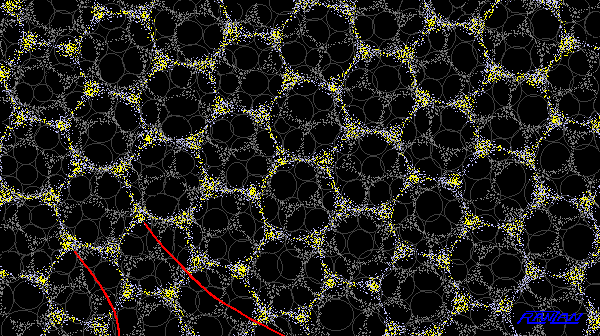
Idealized dynamic cosmic cell.
The animation shows the bulk flow of space (or aether). Space flows from
the expanding region (known as a Void) and flows into the contracting
regions (known as
galaxy clusters). But note, the Void does not grow bigger and the galaxy clusters
do not become
smaller! (This image explains the balanced flow of aether; the
equally important balanced flow of matter is explained later in the text.)
Understand this image and know
the reason why our universe does NOT expand.
The idealized Cosmoscape at the top
reveals the cellular nature of the universe normally unrecognizable in
the vast tangle of interwoven superclusters of galaxies.
Images are not to
scale. The galaxies, particularly the supergalaxies at each node, are
exaggerated. |
|
The Cell Mechanism: Space Expansion and Contraction
The motion in the animation above represents the bulk flow of
aether. Since space expansion is an exponential growth process, the
associated motion involves radial acceleration. The
acceleration and
outward increase in speed are, of course, greatly exaggerated.
The comoving drift of a test particle starting
near the center of an actual cosmic cell takes a very long time —a mind-boggling
150 billion
years. The flow is caused by the ongoing emergence of new aether. The
rate of this growth, in terms of expansion, is known. Astronomers have measured it to be in
the range of 18 to 20 kilometers per second per million lightyears of distance. In
easily understood terms, it means one kilometer of aether grows by about
6.2 centimeters every million Earth years of time. In terms of volume it
means one cubic kilometer of the space medium grows by
about 186,000 cubic meters
every million Earth-years.
The radial flow is caused by the expansion occurring in the
Void region
(and only in the Void
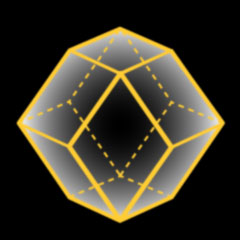
region). The Void is surrounded by a dodecahedral-shaped shell of
galaxies.
This "shell of galaxies" is, of course, what gives the Cosmic Cell its
visible shape.[3]
The dodecahedral form corresponds to the hexagonal representation used for
the above two-dimensional image. The flow proceeds into the interface
region of adjoining cells and into the galaxy cluster regions —the
structural nodes of the structural 'shell.'
And there, in the interface, in the galaxy clusters,
space expansion
ceases. In fact, it undergoes contraction. The galaxy cluster regions
are major dissipaters (consumers or absorbers) of aether.
There is a very real harmony here. Space expansion is balanced by space
contraction. Which means, as noted above, the cosmic cell does not grow
bigger.
Yes, but what about the galaxy clusters? ... What prevents them from
collapsing into the central dominant galaxy (the yellow 'elliptical' shown at
the heart of each node)?
To answer this we need to consider another kind of flow.
The Cell Mechanism:
Matter Flow
The above section deals with the flows that result from the balanced
processes of aether, its expansion and its contraction.
This is the flow shown in the animation.
There is, however, another pair of balanced processes. There exists a
harmony
between primitive matter formation (an emergence from the aether
itself) occurring in the void region and the negation of a
balancing quantity of gravitating matter within the interface (between
cosmic cells) and within galaxy clusters. More specifically, the negation
of matter takes place within the cores of excessive matter concentrations
such as active superneutron stars.
This other aspect of the cosmic cell's equilibrium —the matter-formation
and matter-negation— is described here only in brief outline. Considerably
more detail may be found in other research
papers on the CellularUniverse.org website.
In a nutshell, the other aspect of the cell's
equilibrium is between (1) primitive matter formation occurring in the Void
(some believe it is derived from the release of energy due to space
expansion), and (2) the negation
of quantities of gravitating matter within the cores of sufficiently large
matter concentrations, most often massive superneutron stars. (Superneutron
stars are, in some ways, similar to black holes. But understand, they
never collapse inward through their Schwarzschild radius and, therefore,
can never become black-hole singularities of infinite density.) Matter
accumulation has a limit. Exceed the limit and matter/mass/energy become
unsustainable —as happens in these special cores. In blunt terms, the matter,
flowing into these cores, vanishes from the universe. It then, literally,
no long exists. The descriptive term for this process, the term used in
DSSU theory, is terminal annihilation. (Be assured there is no
violation of the law governing energy conservation nor of the law governing
entropy.) The two processes lead to a simple self-balancing mechanism.
There is a continuous material flow entering the galaxy clusters
(astronomers refer to the process as streaming) and a continuous
destruction (terminal-annihilation) of material within the galaxy clusters.
Thus, when the matter formation-and-negation pair is combined with the
space expansion-and-contraction pair, the cosmic cell becomes a
complete, self-sustaining, self-balancing system.
In practical terms it means the Void does not grow bigger and the
surrounding galaxy clusters do not become smaller. The size of the cosmic
cell, for the most part, is stable. An average diameter is about 300
million lightyears.
Notice how Nature hides its true nature.
The Universe's cellularity is 'hidden' in the tangle
of strands and clumps of galaxy clusters and the even greater
tangle of interwoven superclusters of galaxies: Lost in the
cosmic web; expansion and contraction almost unrecognizable.
While large-scale structure is hidden in the apparent "chaotic randomness,"
the matter formation and annihilation processes are hidden by something
else entirely.
Matter formation is
hidden in the unimaginable smallness-of-scale of discretized aether.
Lost to all our senses. And matter annihilation (terminal annihilation) is hidden in the ultimate density of
the cores of active superneutron stars.
Lost in the blackness.
Continuous Beginning, Continuous Ending
Contrary to conventional cosmology, our Universe did not have a
beginning and it will not have an ending. However, everything in
and of the universe has a beginning and an ending. But
what is most amazing is that the Universe embodies continuous "beginning"
and continuous "ending". The dynamic cosmic cell has no starting and
stopping mechanism. So it runs perpetually. In this way
the animation, above, also captures the feature of continuous beginning and
continuous ending.
We may think of this
continuous beginning as primitive matter being formed from the
aether —from vacuum energy in conventional terminology and theory.
Conceptualizing continuous ending is easy. It takes place in the
cores
of active superneutron stars. They are the sink holes of the universe (and
conventionally called black holes).
The full-term process from beginning
to ending can be expressed in the following radically simplified sequence:
Consider a newly formed sub-sub-atomic particle —a freshly precipitated precursor particle—
somewhere, anywhere, in the
universe. Regardless of the quantity and quality and time duration of
processes in which it partakes, its ultimate destination is the core at the
bottom of a deep gravity well where the
terminal annihilation takes place. This event is literally the end
of the original particle —or whatever it has evolved or transformed into.
It is an 'ending' event. A tiny entity of the universe goes out of
existence.
Should the 'particle', or object, somehow, by some great fortune,
miss all the gravitating bodies harboring terminal cores, all the countless
ones stalking conventional galaxies
(especially the massive ones at the nuclei of galaxies) then its ultimate
ending will occur at the core of a nodal supergalaxy —known to astronomers
as cluster-dominating cD galaxies. Representations of these supergiants are located at the six nodes of the idealized cosmic cell,
above. And I repeat, whatever flows into the core is fated for the
final annihilation
process and ceases to exist.
Before presenting the conclusion, is there anything that has been
overlooked? Any dynamic force or effect? ...
Of course! Gravity. ... And what about the
anti-gravity effect —the
enigmatically termed cosmological constant made famous by Einstein?
Yes, yes. I should have clarified this earlier. I
confess, I am so used to thinking of these two effects in the terms of
their true nature (of their fundamental dynamic "true splendor") that I forgot to link
them to the more common terminology, to the terms ‘gravity’ and
‘cosmological constant.’ (Both of which, in conventional physics, are
missing a cause.)
Gravity is simply the effect produced by the contraction of space (the
inhomogeneous contraction of aether). As for the
cosmological constant, it is the effect produced by the expansion of
space (the exponential expansion of
aether). Both are caused by the dynamic action of aether.
(But unless this is your first visit to the Cellular Universe website
then you would have known this anyway.)
Conclusion
When two fundamental process-pairs are combined:
When the space expansion-and-contraction pair
is combined with
the matter formation-and-negation pair, then the cosmic cell becomes a complete, self-sustaining, self-balancing
system.
And we say that the cosmic cell of the Dynamic Steady State
Universe is a perpetual dynamic system —always has been, always will
be.
One final question. A
question I asked myself some months after uncovering the four-process
system in the year 2001: If the system involves perpetual motion, does it
necessarily violate the fundamental laws of Nature? Does it violate the
dictum most people are familiar with —the one that asserts that there is no
such thing as a perpetual motion machine?
To fully appreciate the answer there are three things to consider.
(1) It turns out that there are three kinds of perpetual motion
machines or systems: The first kind violates the principle of conservation
of energy; the second kind violates the 2nd law of thermodynamics (the
entropy law); the third kind, however, violates no known laws.[4]
It is entirely possible
to have a perpetual motion system without violating known laws. Thus we could, if we wanted, say that,
yes, the DSSU is a perpetual motion "system"; however,
being of the ‘third kind’ no physical laws are violated. Aether is
the component that moves forever —a perpetual flow into existence and out
of existence.
(2) Astrophysicists concede that one law in particular, the conservation
of energy law, does not apply to the universe itself. In the words of
Edward
Harrison,
“The conclusion, whether we like it or not, is obvious: Energy in the
universe is not conserved.”
[5]
(3) And finally, there is the checkmate argument.
There is an airtight philosophical reason why this must be so —why there
must be a perpetual process. See:
Guide to the Construction of the Natural Universe
and Section 3 in
The Dynamic Steady State Universe.
The considered answer to the perpetual-nature
question is, in the light of the foregoing:
| |
Thus, the Dynamic Steady State Universe is a cosmos of perpetual formation and perpetual
balancing destruction.
The Dynamic Cosmic Cell embodies the processes involved. |
|
* * * *
Copyright © by Conrad Ranzan
This work is an open access article distributed
under the Creative Commons Attribution License (http://creativecommons.org/licenses/by/4.0/)
which permits unrestricted use, distribution, and reproduction in any
medium, provided the original work is properly cited.
For more on DSSU structure
see: Large-Scale Structure of the DSSU |
Abstract & Links.
|
Notes and References
- ^ J. M. Jauch, Are Quanta Real?
(Indiana University Press, Bloomington, Ind., 1973) p64
(As in Douglas R. Hofstadter, Gödel, Escher, Bach: an Eternal Golden Braid
(Basic Books, Inc., New York, 1979) p408
- ^ C. S. Powell, God in the Equation (The
Free Press, New York, 2002)
-
^
But note, the dodecahedral "shell of galaxies"
is not shaped as the familiar pentagonal-sided dodecahedron; rather it is
shaped as the rhombic dodecahedron (and sometimes as the closely related
rhombic-trapezoidal dodecahedron. The significance of the rhombic type of
dodecahedron is that a collection of them can be closely packed together
—with no gaps in between. This is not true of the familiar Platonic
version.
-
^
McGraw-Hill Dictionary of Scientific and Technical Terms, 3rd Ed. Editor Sybil P. Parker
(McGraw-Hill Book Co. New York) p1190
-
^
E. R. Harrison, Cosmology, the Science of the Universe (Cambridge University Press, 1981) p276
(2008; rev2011)
|
|
|
Top of page
Back to DSSU Home Page
|
|

.jpg)