|
| |||
|
ANNOUNCEMENTS &
NEW ITEMS:
Meanwhile, mankind’s enslavement continues. It
works like this: In order to get people to accept a fully-surveilled, open
prison, cashless society, social credit system, ... a gradual wearing down
process is implemented. “First you wear people down. Poison them with drugs,
vaccines, fluoride, and chemical assaults so they become fat and dumb. Put
addictive devices in their hands and bombard them with propagandized movies,
TV, and Masonically-controlled actors and musicians. Destroy the food
supply, poison the water and the air, manufacture fake climate change while
blaming it all on the people, and tax them to death for it.” Push
‘sustainability’ according to the UN-2030 Agenda and the
World-Economic-Forum Cult. Work towards the implementation of “15-minute
SMART-city enslavement camps.” At the same time “give them all sorts of
distractions, from the two-party political charade (with the illusion of
choice when it is a totally rigged game), manufacture social disharmony, and
grow up controlled opposition to divide and conquer any truth movement that
appears to be gaining any momentum.”
Meanwhile: We stand at a crisis—the supreme crisis of the ages. For unnumbered millenniums man has toiled upward from the dank jungles of savagery toward glorious heights which his mental and spiritual potentialities give promise that he shall attain. His path has been slow and wavering. Time and again he has lost his way and plunged into deep valleys. Man’s trail is littered with the wrecks of dead civilizations and dotted with the graves of promising peoples stricken by an untimely end. –Lothrop Stoddard’s dire warning of the dangers of the practice of dysgenics (1921 !)
The World Conquerors, The Real War Criminals by Louis Marschalko
Meanwhile: Reflect on the mega-crime of the last century —Dresden
Hellstorm (February 13-15, 1945). It is appalling to think its
perpetrators were actually hailed as war heroes!
| |||
|
“Laws of Physics Twentieth-Century Scientists
Overlooked”
Available on AMAZON.com
The Nature of Gravitational Collapse
Guide to the Construction of the Natural Universe
Participate in a unique exploration of the Cosmos: venture into the
sub-atomic realm, even into the sub-quantum realm where the roots of reality
reside, and into the domain of cosmic-scale cell-structure and beyond to
infinity. Along the way, discover the cause of mass, the cause of
gravitation, and rediscover Einstein’s “nonponderable” aether and Heraclitus’
harmony-of-opposites principle. … The book represents the ultimate
vindication for all the skeptics who resisted the "preposterous" Big Bang
mythology and who refused to join the exploding-cosmos religion. POPULAR RESEARCH PAPERS:
| |||
|
Glossary of Terms
used in Cosmology and Astrophysics with particular emphasis on DSSU theory. |
|||
|
GENERAL INTEREST ARTICLES: | |||
|
COSMOLOGY ARTICLES, etc:
Large-Scale Structure of the Dynamic Steady State Universe published in
the American Journal of Astronomy and Astrophysics, Vol.4, No.6,
2016, pp.65-77.
Astract and Links. Galaxy Morphology:
Ellipticity, Its Origin & Progression in Comoving Galaxies, American Journal of Astronomy & Astrophysics,
AJAA, Vol.3, No.2, 2015.
EXTERNAL LINKS:
| |||
|
DSSU Theory:
The Fundamental Process of Energy —A Qualitative Unification of
Energy, Mass, and Gravity. (Abstract
& Reviews & Links) … This article reveals
the secret behind photon confinement. (Contains only a bare minimum of mathematics
and mainly in one of the 14 sections.)
Headlined as:
| |||
|
ARTICLES on AETHER: |
|||
|
DSSU RESEARCH PAPERS: |
|||
|
GRAVITY:
|
|||
|
RELATIVITY ARTICLES: |
|||
|
An Open Letter to the Scientific Community "The big bang today relies on a growing number of hypothetical entities, things that we have never observed-- inflation, dark matter and dark energy are the most prominent examples. Without them, there would be a fatal contradiction between the observations made by astronomers and the predictions of the big bang theory. In no other field of physics would this continual recourse to new hypothetical objects be accepted as a way of bridging the gap between theory and observation. It would, at the least, raise serious questions about the validity of the underlying theory. ..." continues ... A devastating Declaration of opposition to Big Bang cosmology signed by more than 400 Researchers.
|
|||
|
INTELLECTUAL FREEDOM:
|
|||
|
DEDICATION: This website is solemnly dedicated to those
individuals who have conducted research in their chosen field and have
informed others of their inquiries and suffered the consequences when
subpoenaed by the Inquisition or some variant thereof. The dedication
extends to those individuals currently imprisoned, and those facing
trial and persecution simply for exercising their basic human right of
freedom of expression supposedly granted to them under the UN Charter of
Human Rights. "Every year, hundreds of writers and other literary professionals around the world are imprisoned, prosecuted, persecuted, attacked, threatened, forced into exile or even murdered as a result of their work." ALSO: Be aware of the continuing threat to our precious freedom of expression on the Internet. The threat is serious and relentless. It is described as “… the formal effort to mimic Communist China’s system of Internet censorship.” – www.InfoWars.com More information on threats to internet freedom: https://battleforthenet.com/ End of free speech in Britain:
A publisher of history books in Britain has reported that “due to new laws
in the UK all their books will have to be censored moving forward” to avoid
criminal penalties for “inciting racial hatred.” –The Barnes Review (2020 March/April)
p77 In repressive Germany:
Ursula Haverbeck,
89, Sentenced to 14 Months in Jail for Heresy! –2017 November George Orwell Free Speech Awards:
The Supreme Irony:
□ The Continuing Struggle for Freedom A ray of hope in the ongoing struggle for freedom. Populist and nationalist movements around the world are gaining ascendancy over the New World Order’s effort to establish global governance and impose tyrannical control over every last square meter of the Earth’s surface. –The Barnes Review Vol.23 No.1 (2017 Jan p70)
The ongoing fight for freedom and truth. –Just Right Media (2020, Sept 18, program)
● Pro-Freedom NEWS:
Vanguard News
For more on Freedom (and Objectivism), |
|||
|
... about the author ...
D S S U Research,
Niagara Falls, Canada Visits since mid-2010 :
2026-7-24 |

.jpg)

.jpg)
Unified Gravitation Cells of the DSSU
|
|
"The world is various. But many processes
in nature are more or less alike; amidst the differences in the world,
there are similarities, strong patterns, strange resemblances, ..."
|
1. Introduction
My purpose in this exploration is to show how the Universe —specifically the Dynamic Steady State Universe— is ‘constructed’ of unified gravity cells and discuss some of their features.
In order to place the new cosmology into perspective I will first draw attention to the ‘construction project’ of cosmology that has failed.
In conventional cosmology the universe is assumed to be a single cell. As such, it has a definable finite diameter —sort of a visibility-limit diameter. This diameter depends on the Hubble-expansion parameter and the evolutionary age of the universe. In some versions of the Big Bang theory the cell was the size of a primordial atom —much smaller than a speck of dust. ... Now when gravity theory is applied to the conventional universe it is applied to the universe as a whole —as if it were a single cell. The gravity of the cell is determined by the contained mass-and-energy. Considerable effort has gone into measuring and calculating the total matter content to determine whether the expanding-cell universe is closed or open —whether it will eventually collapse in on itself or expand outward forever. This single-cell view of the universe is the view held by the vast majority of academics and promoted by the media and embraced by popular culture. It leads to what astrophysicists describe as an unnatural universe; and some have gone so far as to call it a preposterous universe. [2]
In the new cosmology known as the Dynamic Steady State Universe (DSSU) the universe is structured into a multi-cellular natural arrangement. The cellularity is not a theory premise, not an assumption. The cellularity is the logical outcome of the theory’s two pairs of postulates. The four postulates specify the four processes that act to form a self-regulating mechanism —a mechanism that sustains the cosmic cell structure. [3]
There are two levels of cells —the structural cell level and the gravitational cell level. They are intimately connected to each other —essentially they overlap (but they do not coincide). The entire universe is divided into structural cells —cosmic in scale and closely packed. Similarly the entire universe is divided into gravitational cells —also cosmic in scale and closely packed.
Let us deal with the structural-cell level first. The structural units will then guide us to the gravitational units.
2. The Cosmic Structural Cell
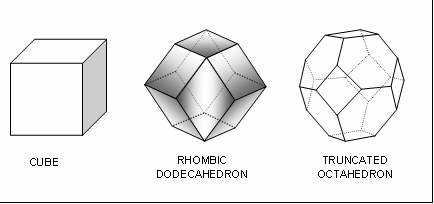
The theoretical shape of the structural cells is surprisingly simple to determine. There are actually only three ways by which a volume can be divided into ordered polyhedral cells (identical units with no gaps between adjacent cells). One could use hexahedra (cubes), truncated octahedra, or rhombic dodecahedra. These are the three candidates for cosmic structural units available for space-filling packing.[4] We immediately eliminate the cube ---it is unstable when subjected to the forces involved. That leaves the truncated octahedron and the rhombic dodecahedron.
 |
||
|
Fig. 1. The three polyhedral cells capable of being ‘close’ packed, capable of dividing space —capable of orderly cellularizing a volume. |
The choice of of a suitableshape depends entirely on the type of force involved: When the forces of surface-tension are involved then the cell tries to minimize the surface area. When the force involved is that of "negative pressure" then the tendency is to maximize the surface area. The truncated octahedron has a surface-to-volume ratio of 5.315; the rhombic dodecahedron has a surface-to-volume ratio of 5.345 (both expressed in terms of the geometrical invariant: ratio = S/V2/3). The difference is subtle —so small that it only appears in the 3rd significant digit. Nevertheless, this difference means that for equal volumes the truncated octahedron has less surface area than does the rhombic dodecahedron.
Thus, surface tension cells, striving to minimize their surface area, take the shape of truncated octahedra. While negative pressure cells, striving to maximize their surface area, take the shape of rhombic dodecahedra. Soap bubbles are considered surface tension cells; thus they tend to be shaped as truncated octahedra when packed together (although gravity causes considerable distortion).
The cosmic cells of the DSSU are negative pressure cells. The negative pressure is the manifestation of the process of space expansion (according to Postulate #1 of DSSU theory). Space expansion is the Primary process of the universe. Thus the cosmic cells of the DSSU tend to be shaped as rhombic dodecahedra (and not as truncated octahedra).[5]
A word about soap bubbles. It should be
pointed out that soap bubbles are not regular in shape even when
experiments strive for constant volume. They tend to be highly irregular
tetrakaidecahedra.[6]
The reason is that gravity induces film thickness distortion. However, it
is predicted that under weightless conditions soap bubbles will be shaped
as truncated octahedra (if equal volume bubbles are produced). The
truncated octahedron is, of course, a tetrakaidecahedron.
Back to the cosmic structural cells. Space expansion sustains a central void region. Why this process is equated with negative pressure is not easy to explain. It certainly seems counterintuitive but such is the nature of dynamic space. It may be of help to think of the region as being under tension (space is being ‘pulled’ apart, as it were). There is a tension across the cell (along any diameter). In a moment we will see what is aiding this ‘pull’ action.
Each cell, with its void, interfaces with twelve others as each cell tries to maximize its volume and surface area. The result is a twelve-faced structure —the rhombic dodecahedron. The result is a cosmic cell with fourteen nodes.
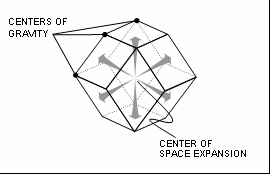
Each node of this cell is a center of gravity —the center of gravity of a galaxy cluster. The fourteen galaxy clusters are linked by 24 filamentous arms. These arms are simply the extensions of the various galaxy clusters. The entire network surrounds the central cosmic void. (See Fig. 2.)
 |
||
|
Fig. 2. Schematic view of an isolated structural cosmic cell. |
Now, mentally draw lines through the structural cell
and join opposite centers of gravity; the tension mentioned earlier should
immediately become self evident. The tension is always present since the
nodal galaxy clusters never come together. Always keep in mind that the
overall cell-size has a certain degree of stability. And speaking of cell
size: Although the cells are discussed in rather casual terms, one should
not lose sight of the enormity of the scale involved. All cosmic cells have
dimensions in the range of 300 million lightyears.
The cell nodes are logically the centers of
gravitational cosmic cells.
3. The Cosmic Gravitational Cells
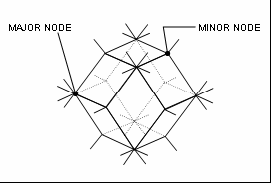
A striking feature of the structural cell is that there are two distinctive types of nodes —distinguished by the number of arms joined at a node. There are Major nodes and Minor nodes; six of one and eight of the other. Now here is the amazing part: When one relates the nodes to respective galaxy structures, one finds a four-branch galaxy cluster at Minor nodes and an eight-branch galaxy cluster at Major nodes! We have here the underlying reason for variation in size and density of galaxy clusters. (The Platonic dodecahedron, of course, has all its nodes identical; and for other reasons is unsuitable for modeling the universe.)
Real cosmic cells are never isolated; nodes are always shared. The geometry of "closest" packing requires that these shared nodes must have either four branches or eight branches, as shown in Fig. 3.
 |
||
|
Fig. 3. Major nodes and Minor nodes of the externally-linked structural cosmic-cell. Nodes are linked outward to the surrounding dodecahedra so that Minor nodes actually have four arms and Major nodes actually have eight arms. |
Obviously, there must be two types of gravitational cells. The geometry demands there be a distinct shape for each of the two types of nodes. The four-armed node requires a tetrahedron. The eight-armed node calls for an octahedron. These two shapes, when combined, will totally fill 3-dimensional space (as they must). But unlike the cosmic structural cells, the gravitation cells have no visible boundaries!
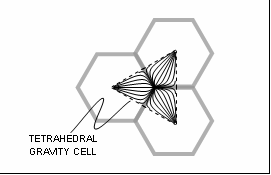
The tetrahedral gravitational cell. The center of gravity of a Minor-node galaxy cluster coincides with the geometric center of the tetrahedral cell. The four arms of the cluster pierce the four sides of the tetrahedron (the arms are more or less perpendicular to the tetrahedral faces). The vertices of the tetrahedron extend deep into the four surrounding voids. Fig. 4 attempts to show this arrangement; the fourth void (and fourth vertex) is hidden from view.
 |
||
|
Fig. 4. The vertices of the tetrahedron extend deep into the surrounding voids. |
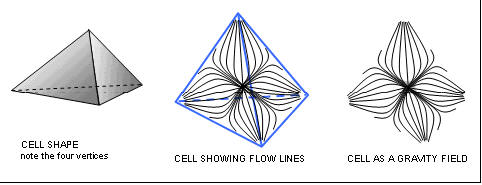
The next figure (Fig. 5) provides representations (in perspective view) of the tetrahedral gravity cell; its three images focus on: the cell’s geometry, the cell’s gravitation flow lines, and the cell as an isolated gravitational field. The flow lines represent the streaming of aether; they also represent the trajectories of comoving matter. The flow lines clearly reveal the cell’s four internal lobes. The four lobes act to funnel the space-and-matter flow towards the regional center of gravity.
 |
||
|
Fig. 5. Perspective views of an isolated tetrahedral gravity cell. The gravity cell is a dynamic structure. Space and comoving material flow along trajectories that form a four lobed three dimensional pattern (a symmetrical pattern under idealized conditions). |
An immediate question is, Why doesn’t the cell (or gravity field) collapse over time? The short answer is that the voids just keep on expanding. That is, the voids are forever supplying newly expanded aether to feed the flow. Furthermore, matter itself is continually precipitating from, and within, aether and in this way is further feeding the flow.
Shown below is an idealized dynamic image of an isolated tetrahedral gravity cell.
|
Fig. 6.
This animated image reveals the bulk
aether flow direction within a typical cosmic-scale gravitation cell.
It is an Idealized representation (in two dimensions) of a
3-dimensional tetrahedral unified-gravity cell.
The paths
diverge (red lines) where space expands; and paths converge (blue
lines) where space contracts. |
The octahedral gravitational cell.
Turning now to the octahedral gravity cell —the dynamic cell associated
with Major nodes (of the dodecahedral structural cell). What is the
associated pattern of lobes? Mentally place yourself at such a node. Use
Fig. 3 as a helpful reference. You are
surrounded by the eight arms of a Major galaxy cluster. But don’t be
misled. The lobes of gravity cells do not follow these structural arms.
The axes of the lobes are directed to void centers. Having
positioned yourself at the node it is possible to orient yourself in such a
way that (1) one void would be aligned above you and another below you, (2)
one void to your right and one to your left, and (3) one void in front and
another behind. You would be surrounded by six voids. And so, the
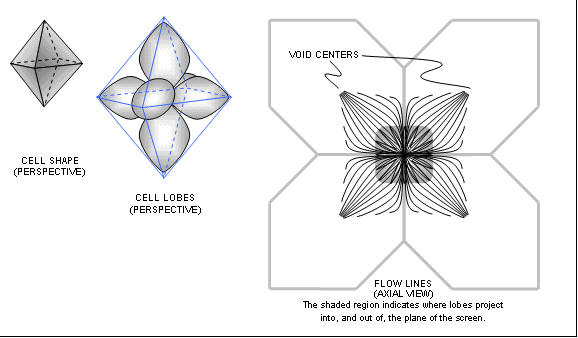
octahedral gravity cell has six lobes extending into six voids.
The following drawing (Fig. 7) shows, in succession, the shape, the lobes, and the trajectories of the octahedral gravitational cell.
 |
||
|
Fig. 7. Octahedral gravity cell is a dynamic structure in which aether and comoving material streams along trajectories that form a six-lobed three-dimensional pattern (a symmetrical pattern under idealized conditions). |
4. How the Gravity Cells Fit Together
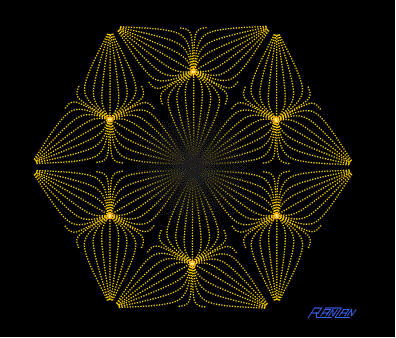
For a two-dimensional representation of how gravity cells fit together we could use the trefoil of Fig. 4 and proceed to tile a sample region. The resulting hexagonal shape is obvious, as shown in Fig. 8 below. The hexagon formed by joining the nodes (not the void centers) is, of course, the two-dimensional representation of the rhombic dodecahedral structural cell.
 |
||
|
Fig. 8. Group of unified gravity cells are 'close-packed' together and reveal a cosmic structural cell —the inner hexagon formed by the six nodes. (All cells are shown in two dimensions and idealized). |
Now what about the tetrahedral and octahedral volumes? Even though these volumes consist of the three types of dynamic space —expanding, flat, and contracting— standard theories alone fail utterly. The General Theory of Relativity struggles with the basic interaction and configuration of the very same expanding-, flat-, and contracting space. Meanwhile, Standard Cosmology is busy hypothesizing and adjusting a growing number of parameters of its single-cell universe. Multicellularity has not yet been recognized!
General relativity measures the geometry, or curvature, of each volume of space —whether that volume is expanding, flat, or contracting. But ...
|
Neither relativity nor standard cosmological observations say anything about how those volumes fit together to give the universe its overall shape —its topology. ...Determining the topology requires some physical understanding beyond relativity. –Jean-Pierre Luminet (Scientific American, 2002) [7] |
You read that correctly. For the determination of the shape and topology of our Universe some physical understanding beyond standard cosmology, beyond relativity, is required! To say that relativity (a powerful mathematical theory) requires a physical something is a remarkable admission. Maybe what is required is the physical something missing from Einstein’s relativity theory; that essence substance often discussed on the Cellular Universe Website. Yes, understanding is within grasp. But what a long detour it has been. ... If only Einstein, those many many years ago, had not discarded the physical aether; discrediting it as a superfluous relic of a pre-relativistic age.
And this is why we turn to DSSU theory. It provides the vital pieces of the puzzle for just such a physical understanding. It tells us precisely how the three types of space fit together, how the “volumes fit together” to form the characteristic pattern of each type of gravity cell. And further, DSSU theory then tells us how those gravity cells “fit together to give the universe its overall shape —its topology.”
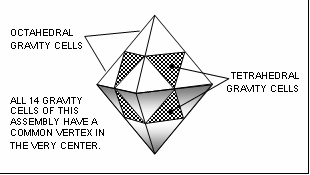
Here is a guide on how the tetrahedral and octahedral volumes fit together. Think of the center of a void as a reference point. This void, because of the geometry of the structural cell, is surrounded by 8 Minor nodes and 6 Major nodes. This, in turn, means that a void is surrounded by 8 tetrahedral and 6 octahedral cells. In fact a total of 14 gravity cells meet at the reference point at the center of a void.
And the tetrahedral and octahedral cells do fit together. The tetrahedron and octahedron comprise what is called a dual space-filling system.[8]
In assembling the gravity cells it helps to realize, firstly, that they all have faces consisting of identical equilateral triangles; secondly, that an octahedron ‘touches’ another octahedron edge-to-edge; thirdly, that an octahedron ‘touches’ a neighboring tetrahedron face-to-face, and finally, that a tetrahedron ‘touches’ a neighboring tetrahedron edge-to-edge. These rules, along with a bit of cerebral effort, permit one to visualize an assembly of all 14 fields. Use Figure 9 as a guide.
 |
||
|
Fig. 9. Assembly of the 14 unified gravitational fields that penetrate and subdivide one structural cell. Each vertex (13 are shown, 5 are hidden behind) gives the location of a void center. The number of vertices agrees with the number of voids (18) that surround one dodecahedral structural cell. |
We normally think of the dodecahedral cell as being
surrounded by twelve others. The reason is that we associate each of the
twelve faces of one cell interfacing with a corresponding number of neighbors.
Actually our structural unit is linked to a total of eighteen others.
The gravity cells do the linking; they provide the dynamic bonding.
We have established that there are 14 gravity cells
associated with a structural cell. Let us sum the vertices of all 14 cells.
Each Minor unified field (tetrahedron) has 4 vertices that extend into 4
different void centers. Each Major unified field (octahedron) has 6
vertices that extend into 6 voids. Total vertices is (8x4) + (6x6) or 68.
Each of these vertices, of course, must terminate at a void center. We know
that 14 of these vertices meet at the center of the dodecahedron leaving
the remaining 54 vertices free to extend into the 12 surrounding units (the
12 units with which interfaces are shared). Each of these 12 dodecahedra
receives 4 of the field vertices. This should be self evident purely from
the fact that 4 nodal structures (of a rhombic face of a dodecahedron) are
shared between adjacent dodecahedra. But this allocation can account for
only 48 of the 54 external field vertices! Six of the field vertices
projecting from the subject cosmic-bubble still need to be allocated. It is
not at all obvious; it happens that there are 6 additional cosmic-bubbles
with which no interface surface is shared but with which one nodal
structure is shared, respectively. And so, the 14 fields of a dodecahedral
cell
join to a total of 18 surrounding others. Thus, the gravity cells of
a cosmic-bubble extend into the obvious 12 surrounding units and also into 6
other units —one at each of the 6 Major nodal clusters.
5. Discussion of Unified Gravity
Gravity alone might be driving everything ... –Nature 2003 July 3 [9]
Why are the cosmic gravitating regions referred to as unified gravity cells? There are several reasons.
The fundamental reason is that two kinds of gravity effects are actually being combined. In technical terms the positive energy field of L (the cosmological constant) is combined with the negative energy field of conventional gravity (contractile gravity). When I say “combined” I mean they are separate regions of a single field. A gravity cell represents one gravity domain encompassing both normal gravity and ‘antigravity’ regions.
The logical reason is that a single definition of gravity serves to describe all regions of the cell. All regions of the cell are accelerating towards a common core —the heart of the gravity cell. The key word is acceleration. In a gravity field there must be acceleration. Aether is accelerating along the trajectories (we visualize them as flow lines) and likewise all the comoving matter.
Another way of looking at the unifying definition is this way: Imagine placing a test object anywhere in the gravity cell. It will, over the long term, tend towards the nucleus of the cell. Sprinkle lots of test objects all over a vast region and notice the gradual delineation of boundaries of relative emptiness. The boundaries of almost emptiness separate the individual cells, as shown in Fig. 8 above.
The isolation reason. Except for the exchange and flow of radiation a gravity cell is totally isolated from the rest of the universe. (In DSSU theory gravity is not considered to be a form of radiation.) No object, no massive galaxy, no matter how supermassive it may be, has any gravitational influence beyond its home cosmic gravity cell.
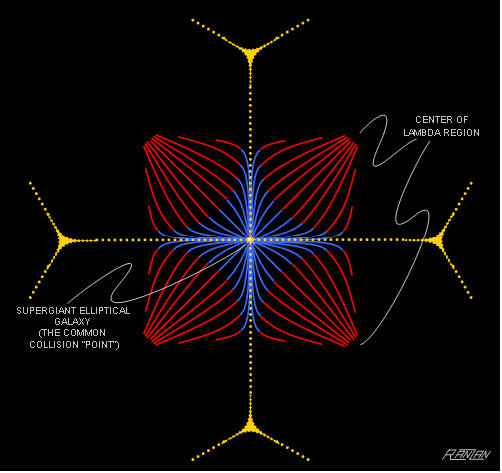
There is a simple and dramatic way to describe the unifying feature of a gravity cell. A unified gravity cell defines that region of space (a more or less symmetrical region) in which any and all comoving bodies are on a common collision course. (See Fig. 10.) The field lines are the trajectories, the comoving paths —diverging in the Lambda portion of the gravity field and then converging in the contractile portion of the field. The nodal supergalaxy —the focus of the trajectories— is the common collision point. Bodies may temporarily deviate from the purely comoving paths, as in the case of interface interactions and collisions. But ultimately —always keeping in mind the enormous multi-gigayear time scale— the fateful paths resume and the final freefall collisions occur.
 |
||
|
Fig. 10. The unified gravity cell is the ultimate collision pattern. The pattern consists of the large-scale trajectories of space-and-comoving-matter through regions dominated by Lambda (Λ) and the central region dominated by normal gravity. The paths, as they course inward, diverge (red lines) where space expands; and converge (blue lines) where space contracts. The drawing reveals three crucially important properties: (1) The central galaxy cluster has no gravitational
influence on anything outside this clearly defined gravity-and-Λ cell.
|
6. Implications of Unified Gravity and Cosmic Cellularization
There can be no doubt of the profound and far-reaching implications in the discovery that gravity and Lambda (G & Λ) act in harmony and, through that harmony, help sustain cosmic cell structure. Obviously, the discovery spells disaster for the conventional worldview. The concept of G & Λ in harmony is the key to a Pandora's Box of devastating consequences for all universe models based on general relativity. The naive notion that our universe can be coded in a pair of equations as if the universe is a single monolithic gravitational field is doomed. The space-time ontology of general relativity, used to model various monolithic universes, will return to its obscure role as a mathematical oddity. Gravity fields that extend to infinite, as the old theories claim, are doomed. Doomed by quantized gravity ---gravity quantized into natural gravity cells. With G & Λ working in harmony to bring about cluster cohesion there is absolutely no need for mysterious dark matter. It means the demise of dark theories. We may finally witness the end of over 30 years of long fruitless searching; the end of speculations masquerading as science. Then there is the implication for the central dogma of twentieth-century cosmology: The expansion of the universe will seem pointless. If the cosmic cells don’t expand then surely there is no reason for the universe to expand. G & Λ are in harmony. This is the key. Lambda and gravity in their easily understood manifestations —space expansion and space contraction— are in equilibrium.
The treatment of G & Λ as harmonious effects leads to finite gravity fields. These lead to steady-state cell structure which leads to a nonexpanding universe ... which leads us to a further implication. And this one will exact a heavy toll. If, as we have seen, the universe does not expand then neither does it evolve. Although processes and systems (and countless subsystems) within the cells are perpetually evolving, the universe itself is not evolving. The Universe simply is. Theories that say otherwise will, in the light of reality, become untenable and will not survive.
The evolving universe, in all its theoretical variations, is not supported by logic and not supported by observations; it is untenable. All Big Bang universe models are scenarios of evolving universes. In fact, all expanding universe models are classed as evolving universes. Thus, all are affected.
Academic cosmology is a grand collection of theories, hypotheses, and speculations —all based on a common theme. Each member of the collection represents one or another aspect of the evolving-and-expanding universe. The focus is on fine-tuning the abundant parameters of their exploding-and-changing universe. Almost never are the fundamentals questioned. Theories and research papers are endlessly cross-referenced and stand in support of each other and the official theme. What we have then is a vast collection of inbred theories nurtured by Academic Cosmology. A most unnatural situation. No wonder outspoken physicist and cosmologist Sean M. Carroll questions the naturalness of the current Big Bang model[10] and refers to it as the preposterous universe. In fact he sums up his extensive paper[11] with a section heading in boldface lettering: "Conclusions: the preposterous universe". Now the meaning of preposterous is, according to my Webster dictionary, quite clear: "Contrary to nature, reason, or common sense; utterly foolish; absurd." And there it is, presented without any personal bias on my part, 20th-century cosmology is contrary to nature!
I can’t help but wonder. Who believes this absurd stuff —which I have collectively called Academic Cosmology!? (If I may digress for a moment.) It is easy enough to come up with two types of believers: There are the true believers, the ones who believe anything official or authoritative or promoted by the mass-media; and there are those who are paid to believe. But still I wonder. Maybe the Big Bang really is more religion than science. Maybe author Wendy Kaminer is right when she warns of “the Rise of Irrationalism” and a new dark age undercutting reality in America. For the new-dark-age believers, “The truth lies in what you feel, not in what you know.” ... It is a worrying, even dangerous, trend. It will be incredibly fascinating to witness how the implications will run their course (assuming objectivism prevails). Particularly interesting will be the abandonment of theories when the flawed foundation gives way. Expanding-and-evolving universe theories, interdependent as they are, will fall like dominoes. At some point the vast twentieth-century experiment with the single monolithic cell will come to an end. A new revolution in cosmology will be upon us. It will become known as the 5th revolution in the history of cosmology.
|
Revolutions in the History of Cosmology At the pre-dawn of civilization mankind conceived of
a revolutionary Worldview in which gods created order from chaos
and conjured all things into being. For countless ages of man, the
Universe was ruled, and misruled, by equally countless gods |
After the devastation, what remains of the old cosmology? ... One pillar remains. The pillar that supports all modern cosmology —space expansion. The process of the physical expansion of space, that essential process first detected and interpreted in the pioneering work of V.M. Slipher, Carl Wirtz, Howard Robertson, and Edwin Hubble, will remain and continue to play a leading role. The great pillar of expanding space will stand; and alongside will stand the new pillar of space-contraction in equal and harmonious stature.
The seeds of the new cosmology have been planted. The revolutionary concept of the intrinsically cellular cosmos is growing. Meanwhile, the breeches in the old cosmology grow ever wider; its claims undefendable; its flaws unrepairable. The overthrow of the “preposterous” expanding universe by the natural cellular cosmos is the 5th revolution of cosmology.
* * * *
2009-8 rev2012-6 Copyright © by Conrad Ranzan E-mail:
Ranzan@CellularUniverse.org
www.CellularUniverse.org
Notes and References
- ^ David Berlinski, A Tour of the Calculus (Pantheon Books, New York, 1995) p208
- ^
Sean M.
Carroll, The Cosmological Constant (astro-ph/0004075
EFI-2000-13 Available at http://relativity.livingreviews.org/Articles/lrr-2001-1)
Physicist Sean Carroll’s website: http://preposterousuniverse.com/ - ^ C. Ranzan. 2009. The Story of Gravity and Lambda —How the Theory of Heraclitus Solved the Dark Matter Mystery, Physics Essays Vol.23, No.1, p75-87 (2010 Mar) (www.CellularUniverse.org/G2GravityLambda.pdf)
- ^ Peter Pearce, Structure in Nature Is a Strategy for Design (The MIT Press, Cambridge, Massachusetts, 1990) p41
- ^ It should be noted that the rhombic dodecahedron has a twin. All the main features are the same except half of the 12 faces are trapezoids. As a result, there are some extra-long arms and some extra-short arms. The structure is called the rhombic-trapezoid dodecahedron. And amazingly these two structures still fit together totally (when packed together according to a basic geometric asymmetry, there are no gaps in between). And the Major and Minor nodes are still the same (6 of one and 8 of the other).
- ^ Peter Pearce, Structure in Nature Is a Strategy for Design, p6
- ^ Jean-Pierre Luminet, et al., Is Space Finite? (Scientific American Special Edition 2002: The Once and Future Cosmos) p60
- ^ Peter Pearce, Structure in Nature Is a Strategy for Design, p45
- ^ Nature News Service (Macmillan Magazines Ltd) 2003 July 3, reporting on the work of S.M. Carroll, V. Duvvuri, M. Trodden, and M.S. Turner, Is Cosmic Speed-up due to New Gravitational Physics? (http://xxx.lanl.gov/abs/astro-ph/0306438)
- ^ S. M. Carroll. 2005. Is Our Universe Natural? (Paper: arXiv:hep-th/0512148v1 13 Dec 2005)
- ^ S. M. Carroll. 2001. The Cosmological Constant (astro-ph/0004075 EFI-2000-13 Available at http://relativity.livingreviews.org/Articles/lrr-2001-1)
2009-8 (2012-6)
|