|
| |||
|
ANNOUNCEMENTS &
NEW ITEMS:
Meanwhile, mankind’s enslavement continues. It
works like this: In order to get people to accept a fully-surveilled, open
prison, cashless society, social credit system, ... a gradual wearing down
process is implemented. “First you wear people down. Poison them with drugs,
vaccines, fluoride, and chemical assaults so they become fat and dumb. Put
addictive devices in their hands and bombard them with propagandized movies,
TV, and Masonically-controlled actors and musicians. Destroy the food
supply, poison the water and the air, manufacture fake climate change while
blaming it all on the people, and tax them to death for it.” Push
‘sustainability’ according to the UN-2030 Agenda and the
World-Economic-Forum Cult. Work towards the implementation of “15-minute
SMART-city enslavement camps.” At the same time “give them all sorts of
distractions, from the two-party political charade (with the illusion of
choice when it is a totally rigged game), manufacture social disharmony, and
grow up controlled opposition to divide and conquer any truth movement that
appears to be gaining any momentum.”
Meanwhile: We stand at a crisis—the supreme crisis of the ages. For unnumbered millenniums man has toiled upward from the dank jungles of savagery toward glorious heights which his mental and spiritual potentialities give promise that he shall attain. His path has been slow and wavering. Time and again he has lost his way and plunged into deep valleys. Man’s trail is littered with the wrecks of dead civilizations and dotted with the graves of promising peoples stricken by an untimely end. –Lothrop Stoddard’s dire warning of the dangers of the practice of dysgenics (1921 !)
The World Conquerors, The Real War Criminals by Louis Marschalko
Meanwhile: Reflect on the mega-crime of the last century —Dresden
Hellstorm (February 13-15, 1945). It is appalling to think its
perpetrators were actually hailed as war heroes!
| |||
|
“Laws of Physics Twentieth-Century Scientists
Overlooked”
Available on AMAZON.com
The Nature of Gravitational Collapse
Guide to the Construction of the Natural Universe
Participate in a unique exploration of the Cosmos: venture into the
sub-atomic realm, even into the sub-quantum realm where the roots of reality
reside, and into the domain of cosmic-scale cell-structure and beyond to
infinity. Along the way, discover the cause of mass, the cause of
gravitation, and rediscover Einstein’s “nonponderable” aether and Heraclitus’
harmony-of-opposites principle. … The book represents the ultimate
vindication for all the skeptics who resisted the "preposterous" Big Bang
mythology and who refused to join the exploding-cosmos religion. POPULAR RESEARCH PAPERS:
| |||
|
Glossary of Terms
used in Cosmology and Astrophysics with particular emphasis on DSSU theory. |
|||
|
GENERAL INTEREST ARTICLES: | |||
|
COSMOLOGY ARTICLES, etc:
Large-Scale Structure of the Dynamic Steady State Universe published in
the American Journal of Astronomy and Astrophysics, Vol.4, No.6,
2016, pp.65-77.
Astract and Links. Galaxy Morphology:
Ellipticity, Its Origin & Progression in Comoving Galaxies, American Journal of Astronomy & Astrophysics,
AJAA, Vol.3, No.2, 2015.
EXTERNAL LINKS:
| |||
|
DSSU Theory:
The Fundamental Process of Energy —A Qualitative Unification of
Energy, Mass, and Gravity. (Abstract
& Reviews & Links) … This article reveals
the secret behind photon confinement. (Contains only a bare minimum of mathematics
and mainly in one of the 14 sections.)
Headlined as:
| |||
|
ARTICLES on AETHER: |
|||
|
DSSU RESEARCH PAPERS: |
|||
|
GRAVITY:
|
|||
|
RELATIVITY ARTICLES: |
|||
|
An Open Letter to the Scientific Community "The big bang today relies on a growing number of hypothetical entities, things that we have never observed-- inflation, dark matter and dark energy are the most prominent examples. Without them, there would be a fatal contradiction between the observations made by astronomers and the predictions of the big bang theory. In no other field of physics would this continual recourse to new hypothetical objects be accepted as a way of bridging the gap between theory and observation. It would, at the least, raise serious questions about the validity of the underlying theory. ..." continues ... A devastating Declaration of opposition to Big Bang cosmology signed by more than 400 Researchers.
|
|||
|
INTELLECTUAL FREEDOM:
|
|||
|
DEDICATION: This website is solemnly dedicated to those
individuals who have conducted research in their chosen field and have
informed others of their inquiries and suffered the consequences when
subpoenaed by the Inquisition or some variant thereof. The dedication
extends to those individuals currently imprisoned, and those facing
trial and persecution simply for exercising their basic human right of
freedom of expression supposedly granted to them under the UN Charter of
Human Rights. "Every year, hundreds of writers and other literary professionals around the world are imprisoned, prosecuted, persecuted, attacked, threatened, forced into exile or even murdered as a result of their work." ALSO: Be aware of the continuing threat to our precious freedom of expression on the Internet. The threat is serious and relentless. It is described as “… the formal effort to mimic Communist China’s system of Internet censorship.” – www.InfoWars.com More information on threats to internet freedom: https://battleforthenet.com/ End of free speech in Britain:
A publisher of history books in Britain has reported that “due to new laws
in the UK all their books will have to be censored moving forward” to avoid
criminal penalties for “inciting racial hatred.” –The Barnes Review (2020 March/April)
p77 In repressive Germany:
Ursula Haverbeck,
89, Sentenced to 14 Months in Jail for Heresy! –2017 November George Orwell Free Speech Awards:
The Supreme Irony:
□ The Continuing Struggle for Freedom A ray of hope in the ongoing struggle for freedom. Populist and nationalist movements around the world are gaining ascendancy over the New World Order’s effort to establish global governance and impose tyrannical control over every last square meter of the Earth’s surface. –The Barnes Review Vol.23 No.1 (2017 Jan p70)
The ongoing fight for freedom and truth. –Just Right Media (2020, Sept 18, program)
● Pro-Freedom NEWS:
Vanguard News
For more on Freedom (and Objectivism), |
|||
|
... about the author ...
D S S U Research,
Niagara Falls, Canada Visits since mid-2010 :
2026-7-24 |

.jpg)

.jpg)
Models of the Universe
|
|||||||||||||||||||||||||||||||||||||||||||||||||||||||||||||||||||||||||||||||||||||||||||||||||||||||||||||||||||||||||||||||||||||||||||||||||||||||||||||||||||||||||||||||||||||||||||||||||||||||||||||||||||||||||||||||||||||||||||
|
“…the universe itself acts on us as
a random, inefficient, and yet in the long run effective, teaching
machine. …our way of looking at the universe has gradually evolved through
a natural selection of ideas.” |
At one time almost all the science professors were
Aristotelians —the
establishment supporters of the Earth-centered universe. The heretical
revisionists were Copernicans —the
revolutionary proponents of the Sun-centered universe.
Today, almost all the science professors are Big-Bangers —the establishment
supporters of the exploding universe. The modern revisionists know them to
be wrong —profoundly
wrong. And the revisionists, armed with a new cosmology, can prove it.
The stage is set for the next revolution in cosmology.
The present article
traces, in summary form, how our way of looking at the universe gradually
evolved through a natural selection of ideas. It presents summary charts
of various models of the Universe including the sub-categories for the
Historical-, the Expanding-, and the Cellular- Universes. There is
also a summary of Miscellaneous Models. Some commonly accepted ideas are examined and found to be seriously
flawed. The primary emphasis is on that class of model neglected by
mainstream cosmology: The class of the Cellular Universe.
Included in this article's collection of Universe Models is a
precedent-setting entry with awesome predictive powers.
CONTENTS
1.
Historical Models of the Universe
2.
Expanding Universe Models
3.
Cellular Universe Models
4.
Two Conflicting World Views
5.
The Cellular DSSU Combines the Two Conflicting World Views
6. Miscellaneous Universe Models
1. Historical Models of the Universe
The
following table outlines the significant historical models in
chronological order.
Notice that all the historic models possess one or more of the
attributes of expansion, contraction, and stability. Each universe can be
said to expand, oscillate between expansion and contraction, or do neither
and just sit there maintaining a static or equilibrium state. None can be
classified as cellularly structured. It seems that throughout history the
cellular universe was never seriously considered.
|
Table 1: Historical Models of the Universe |
|||
| NAME | Author & Date | Classification |
REMARKS |
| Brahmanda (Earliest known model) | Ancient Hindu Rig-Veda treatise on cosmology | Cyclical or oscillating. Infinite in time. |
The universe is a cosmic egg that cycles between expansion and total collapse. It expanded from a concentrated form —a point called a Bindu. The universe, as a living entity, is bound to the perpetual cycle of birth, death, and rebirth ... |
| Pythagorean cosmology | Ancient Greek “Pythagoreans” 600-400 B.C. |
Heliocentric | The followers of Pythagoras believed that Earth (and the planets) moved, along with the Sun, around a “central fire” at the center of the universe, a central fire which was visible only indirectly from its reflected light. The Earth rotated daily on its own axis. The motions of the planets were supposedly related to numerical harmonics like those of musical notes. |
| Atomist universe | Anaxagoras (500-428 B.C.) & later Epicurus | Infinite in extent | The universe contains only two things: an infinite number of tiny seeds, or atoms, and the void of infinite extent. All atoms are made of the same substance, but differ in size and shape. Objects are formed from atom aggregations and decay back into atoms. Incorporates Leucippus’ principle of causality: ”nothing happens at random; everything happens out of reason and necessity.” The universe was not ruled by gods. |
| Stoic universe | Stoics 3rd & 4th c. B.C. | Island universe | The cosmos is finite and surrounded by an infinite void. It is in a state of flux, as it pulsates in size and periodically passes through upheavals and conflagrations --reminiscent of some 20th-century models. |
| Aristotelian universe (based on the model of Plato’s student Eudoxus) | Aristotle (384-322 B.C.) | Geocentric Static, steady state, finite |
A
spherical and spatially-infinite cosmos. Spherical earth is surrounded by concentric
celestial spheres. Universe exists unchanged throughout
eternity. Emphasis on Plato’s geometric ideal of perfectly circular
orbits. Motions are caused and controlled by intelligent agents
("souls"). Contains a 5th element called
ether (also known as
quintessence). The ideas of a beginning of the cosmos and of a beginning of time are rejected. Aristotle’s cosmology is considered to be the first “steady-state” universe. |
| Aristarchean universe | Aristarchus of Samos (circa 280 B.C.) | Heliocentric | Earth rotates daily on its axis and revolves annually about the sun in a circular orbit. Sphere of fixed stars is centered about the sun. Aristarchus beat Copernicus to this realization by 1800 years. |
| Ptolemaic model (based on the Aristotelian universe) | Claudius Ptolemaeus (2nd century A.D.) |
Geocentric |
Universe orbits about a stationary Earth. Planets move in circular
epicycles, each having a center that moved in a larger circular orbit
(called an eccentric or a deferent) around a center-point near the
Earth. The use of equants added another level of complexity.
The most successful universe model of all time, using the criterion of
longevity. Almagest (the Great System). The System
allowed astronomers to predict the positions of the planets reasonably
well. Its fatal flaw was its inability to account for the observable changes in the phases of Venus, revealed after the invention of the optical telescope just prior to 1608. |
| Copernican universe | Nicolaus Copernicus, 1543 | Heliocentric | The ancient Aristarchean universe rediscovered. The
Copernican universe was essentially a remapping of the Ptolemaic
scheme to make the Sun the center of the system rather than the
Earth. It retained ideal circular orbits and still needed epicycles.
But it captured the revolutionary idea that the Earth moves! "Revolutions of the Celestial Spheres." Condemned by the Catholic Church in 1616. |
| Static Newtonian | Sir Isaac Newton (1642-1727) | Static (evolving), steady state, infinite | Every particle in the universe attracts every other particle. Matter on the large scale is uniformly distributed. Gravitationally balanced but UNSTABLE. |
| Hierarchical universe (Fractal universe) |
Immanuel Kant, Johann Lambert, 1700s | Static (evolving), steady state, infinite | Matter is clustered on ever larger scales of
hierarchy; forming a fractal universe. Matter is endlessly being
recycled. Fatal flaw: It has a cosmic center. |
|
' ' |
Carl Charlier, early 20th century Swedish astronomer | Charlier pointed out that "In a hierarchical universe the density of matter becomes progressively less when averaged over larger and larger regions." In theory, the hierarchy may be arranged so that in the limit, on the cosmic scale, the average density of the universe approaches zero. The larger the scale the weaker gravity becomes. On the largest scale gravity vanishes. | |
| Einstein 'Equilibrium' universe | Albert Einstein, 1917 | Static (nominally). Bounded (finite) | “Matter without motion.” Contains uniformly distributed matter. Has a constant radius of RE= 1/Λ2. Has uniformly curved spherical space; space is said to curve in on itself. It is based on Riemann’s hypersphere. Curvature is set equal to Λ. In effect Λ is equivalent to a repulsive force which counteracts gravity. UNSTABLE. |
| MacMillan | William MacMillan, 1920s | Static & steady state |
New matter is created from radiation. Starlight is perpetually recycled into new matter particles. |
| Dirac universe | Paul Dirac, 1930s | Expanding | Demands a large variation in G, which decreases with time. Gravity weakens as universe evolves. |
| Note: the term “static” simply means not expanding and not contracting. Symbol G represents Newton’s gravitational constant; Λ (Lambda) is the cosmological constant. | |||
The Ptolemaic model was the Western world’s most
popular and successful cosmology of all time, and represented the orthodox
view for almost 1500 years. It was so firmly established that only a
revolution could lead to dethronement. And as it happened the Copernican
revolution took hold. An Ancient idea gained new life as Copernicus
revived Aristarchus’ Heliocentric model and became
wide-spread throughout Europe and beyond. The Ptolemaic cosmology was doomed. Nothing could
save the long-established theory of the heavens: Not the vast power of the
Church; not the Papal edicts; not the threats of the Inquisitors; not the
torture of heretics; and not the burning of books.
If the succession of the Ptolemaic universe by the Copernican universe
represents the third cosmology revolution; then the overthrow of the
Copernican world by the Big Bang universe (discussed in the next section) represents the fourth
cosmology revolution. For the student of cosmology, what is worth noting
is the strange artificiality underlying both the most popular model of the
past and the most popular model of the 20th century:
The Ptolemaic model placed the Earth at its center and used geometric
elaborations involving circles within circles. It was a mechanically
intricate complexity that actually managed to replicate the apparent
orbital motions of the planets and make reasonably accurate positional
predictions. The Ptolemaic model, however, seems almost simple when
compared to the Big Bang model (BB). The BB uses geometric curvature, hot and cold
dark matter, dark energy (expansion), inflation (hyper-expansion), acceleration (when not using
deceleration), re-inflation (more expansion), and something called "open inflation."
[Scientific
American Jan 1999, p66] In the Archaic system, eccentrics,
epicycles, and equants, served as the model’s mechanical adjustments that permitted its
defenders to say, with a straight face, "See, the celestial objects are
precisely where they should be." In the modern BB system, there
exists a similar
situation. Such unreal things as space-curvature, dark matter, virtual
particles, inflation, acceleration, and even 9-dimensional strings, have all
been proposed to justify the similar claim, "See, the universe evolves
precisely as our revised model says that it should."
Ptolemy’s "eccentrics,
epicycles, and equants" were found to have no basis in reality and were
cast aside. Curvature, dark matter, virtual-particle energy, inflation, acceleration, and
strings, (as used in BB cosmology) are equally devoid of reality and, in
the fifth cosmological revolution, suffer the same fate.
Another popular historic model was the Hierarchical universe. With its
endless progression of systems of increasing size filling infinite space,
it seemed an elegant and simple construction. Unfortunately it could not
survive an important finding of modern cosmology.
Although the organization of matter into spherical and near
spherical systems is the rule over virtually the entire astronomical
hierarchy, the rule breaks down suddenly and dramatically when applied to
the top level —the largest structures in the astronomical Universe.
Witness the size progression: Gravitating bodies are spherical; planetary
and binary systems are spherical; solar systems are spherical; star
systems (globular clusters) are spherical; galaxies are, to varying
degrees, spherical; and finally rich galaxy clusters are spherical. But
there the rule ends. The clusters of galaxies are not grouped into
anything resembling spheres. “Instead, they are strung out in filaments,
which lie on the surfaces of huge bubblelike regions within which there are no
clusters and few or no bright galaxies.” Instead, the clusters surround
giant voids of empty space. [–David Layzer, 1991. Cosmogenesis, the
Growth of Order in the Universe, p166]
2. Expanding Universe Models
The 20th century was the golden age of the expanding
type of universe. The philosophical and theological motivation for birth-and-rebirth
cosmology had, throughout the ages, favored universes that grow and
expand. But in the early years of the last century it was discovered
(thanks to Vesto Slipher’s surprising redshift measurements) that the distant galaxies
all appeared to be receding. Two interpretations emerged. The obvious idea
was that the galaxies are actually in Doppler motion and moving away
radially in all directions. The other view posited that space in general
---and the space between us and the “receding” galaxy in particular--- was
somehow expanding. Both views turned out to be wrong, but this
realization did not occur until many decades later. (Needless to say, there was also a minority view
in which the apparent recession was believed to be just that ---an
apparent recession.)
Then, as it happened during those heady days of model building, a simple but fateful extrapolation
was made: If galaxies appear to be receding, then the whole universe is
probably expanding. If the evidence shows that space expands, then the
whole universe must be expanding. Cosmology took a major turn. What had
for the most part been a stable universe was deemed, by the scientific
community, henceforth to be an expanding universe. The fourth revolution in
cosmology was a swift one. With the opposing sides coming to the same
conclusion, in spite of their differences over the interpretation of the
cosmic redshift, it is small wonder the revolution towards the
expanding-universe concept became unstoppable.
And so the 20th century became the age of discovery of the
seemingly endless ways in which the universe could expand ---at least on
paper, at least
mathematically. Table 2 describes the most
popular constructions and those with some special significance. Notice that Big
Bang cosmology is the main subclass of expanding-universe cosmology.
|
Table 2: Expanding Universe Models |
|||
| NAME | Author & Date | Classification |
REMARKS |
| Brahmanda | Ancient Hindu Rig-Veda treatise on cosmology | Expanding and contracting
in cycles. Infinite in time. |
Models the Hindu belief that the Universe has no absolute beginning or end, but follows a perpetual cosmic creation and dissolution. See Table 1 for more details. |
| DeSitter universe | Willem de Sitter, 1917 (Dutch astronomer) |
Expanding flat space. Steady state. Λ > 0 |
“Motion without matter.” Only apparently static. Based on Einstein’s General Relativity. Scaling factor (radius of a region of infinite universe) increases exponentially. |
| Friedmann universe of spherical space | Alexander Friedmann, 1922 (Russian mathematician) | Spherical expanding space. k = +1; no Λ |
Space geometry is similar to Einstein’s
Equilibrium model, but in addition to the positive curvature of space
there is also a curvature of time. In Friedmann’s version of the
closed universe there is a beginning and an end to time when material
expands from and recollapses to infinite densities. Curvature constant
k = +1. Expands then recollapses. Matter dominated. Spatially closed (finite). |
| Friedmann universe of hyperbolic space | Alexander Friedmann, 1924 | Hyperbolic expanding space. k = −1; no Λ |
Negative curvature. Said to be spatially and materially infinite (but ambiguous). Unbounded. Begins with expansion from a big bang of infinite density. Expands forever (The question you’re not supposed to ask is, What does it expand into?). |
| Friedmann zero-curvature, aka the Einstein-DeSitter universe | Einstein & DeSitter, 1932 | Expanding flat space. k = 0; Λ = 0 Critical density |
Space-curvature constant k is zero; space
pressure is zero; cosmological constant Λ is zero.
Said to be infinite (but ambiguous). "Unbounded cosmos of limited extent."
Begins with a big bang and expands forever.
Specifically, the expanding distance between widely separated
galaxies varies as time to the 2/3 power. "Simplest"
of all known universes. Named after but not considered by Friedmann.
Has a deceleration term q =½, which means that its expansion
rate slows down. (Einstein published his new model in a paper, coauthored with Willem de Sitter, entitled “On the relation between the expansion and the mean density of the universe” and presented at the 1932 proceedings of the National Academy of Sciences.) |
| Georges Lemaître the original Big Bang. Aka the Friedmann-Lemaître Model |
Georges Lemaître (Belgian priest & mathematician) 1927 & 1929 & 1933 | Expansion Λ > 0 Λ > |Gravity| |
In 1927 Lemaître rediscovered the Friedmann 1922 model; and in subsequent years he added a positive Λ with a magnitude greater than Gravity. Universe has initial high density state ("primeval atom"). Followed by a two-stage expansion. Λ is used to destabilize the universe. (Lemaître is considered to be the father of the big-bang model.) |
| Oscillating universe (aka the Friedmann-Einstein; was latter’s 1st choice after rejecting his 1917 model) | Favored by Friedmann, 1920s & 1930s |
Expanding and contracting in cycles | Time is endless and beginningless; thus
avoids the beginning-of-time paradox. Perpetual cycles of big
explosion followed by big implosion. Each cycle is slightly larger and
longer than the preceding cycle owing to the growth of entropy.
However, back extrapolation revealed that the beginning paradox
could not in fact be resolved! Philosophically- and theologically- motivated forms of the Oscillating, or more picturesquely, the “Phoenix” universe are among the oldest known cosmologies. In Greek and Roman antiquity, for instance, each eternally repeating cycle was called “a Great Year.” |
| Eddington eternal universe | Arthur Eddington, 1930 | first Static then Expands |
Static Einstein 1917 universe with its instability disturbed into expansion mode; with relentless matter dilution, it becomes a DeSitter universe. Λ dominates gravity. |
| Milne universe of kinematic relativity |
Edward A. Milne,1933,
1935. William H. McCrea, 1930s |
Kinematic expansion with NO space expansion |
Rejects general
relativity and the expanding space paradigm. Gravity not
included as initial assumption. Obeys cosmological principle & rules
of special relativity. The Milne expanding universe consists of a
finite spherical cloud of particles (or galaxies) that expands WITHIN
flat space which is infinite and otherwise empty. It has a center and
a cosmic edge (the 'surface' of the particle cloud) which expands at
light speed. Milne's explanation of gravity was elaborate and
unconvincing. For instance, his universe has an infinite number of
particles, with a non-constant G, hence infinite mass, within a finite cosmic volume!! It also has two separate time scales! |
| Dirac universe | Paul Dirac, 1930s | Expanding | Demands a large variation in G, which decreases with time. Gravity weakens as universe evolves. |
| Brans-Dicke | Carl H. Brans Robert H. Dicke | Expanding | Based on Mach’s principle and general relativity. G varies with time (G falls as the universe ages; G is proportional to 1/t), and therefore mass also varies with time, as universe expands. “But nobody is quite sure what Mach’s principle actually means.” |
| Robertson-Walker universe |
Howard Robertson,
Arthur Walker, 1935 |
Uniformly expanding | Uses the most general form of the general relativity metric for a spacetime satisfying the cosmological principle (homogeneity and isotropy). Spacetime separates into uniformly curved space and cosmic time common to all comoving observers. The formulation system is now known as the Robertson-Walker metrics of cosmic time and curved space. |
| Steady-state expanding (Bondi & Gold) | Herman Bondi, Thomas Gold, 1948 | Expanding, steady state, infinite | Matter creation rate maintains constant
density. Continuous creation out of nothing from nowhere. (Presumably,
like the Hoyle model below, the energy released by space expansion is
used in the process of matter creation.) Exponential
expansion. Deceleration term q = −1. No mechanism for terminating matter; and therefore, arguably, violates conservation of matter. |
| Steady-state expanding (Hoyle) | Fred Hoyle 1948 | Expanding, steady state; but unstable | Matter creation rate maintains constant density. Energy released by space expansion is used in the process of matter creation. But critics have argued that since matter creation rate must be exactly balanced with the space expansion rate, the system is unstable. No mechanism for terminating matter; and therefore, arguably, violates conservation of matter. |
| Negative pressure universe | William McCrea, 1951 (British cosmologist) |
Expanding, steady state | A universe in tension: McCrea proposed that a negative pressure (equivalent to a state of cosmic tension) may be present in the universe. It can be detected only in the way it affects the dynamics of the universe. As the universe expands energy is released, and this energy could take the form of newly created matter. |
| Steady-state (Shrinking atom model) | Fred Hoyle, Narlikar, 1975 |
Static. Expansion is only apparent | Instead of an expanding universe with atoms of constant mass this model has a STATIC universe of SHRINKING atoms making the universe appear to be expanding. When atoms grow in size, universe appears to collapse. Avoids creation mystery. |
| Cyclic Model | Paul Steinhardt (Princeton); Neil Turok (Cambridge) 2002 | Expanding and contracting in cycles |
A controversial revival of Oscillating universe (above) based on brane and string theories. Two parallel planes known as M-branes, one of which represents our visible universe, collide periodically in a higher dimensional space (up to 10-dimensional space in some versions). Each collision corresponds to a reversal from contraction to expansion. Fails largely because the collision mechanism is highly speculative and poorly understood. Details on Cyclic universe can be found at arxiv.org |
| Symbol G represents Newton’s
gravitational constant; Λ (Lambda) is the cosmological
constant. A table similar to this one appears in Wikipedia, the on-line encyclopedia, as Models of the Universe and was originally created by the author. |
|||
SOME CLASSIFICATION NOTES
LAMBDA.
Lambda, Λ, when positive, is a force or effect that opposes
gravity. Lambda is an intrinsic property of space, or the space medium, itself.
AMBIGUITY OF INFINITY.
There is a certain ambiguity of the "infinite" designation
with respect to some models: If a universe has a
point-like beginning and then progressively expands as it ages, how can it
be infinite? Arguably, not in age! and certainly not in size!
A universe that is said to have a true beginning precludes
infinity of age. A universe that is said to expand precludes
infinity of size. The reason is simply that only finite entities can
logically be said to expand. To say that something of infinite size is
itself expanding is unnecessary as well as meaningless, for that which is
infinite is already fully expanded. That which is infinite in its spatial
dimensions cannot become more infinite. To say the universe becomes more
infinite in extent is to deny that it was infinite in the first place.
Furthermore, whatever is finite, no matter how much it grows, will always
remain finite; it can never become infinite.
TYPES OF EXPANSION.
Physicists have several methods for driving the expansion.
(1) Expansion may be caused by curvature of space. This is the
mathematical method. The great advantage is that it allows the confinement
of that which is infinite.
(2) Expansion caused by the physical growth of the space medium.
This is a plain-and-simple method. It allows theorist to give the space
medium various essential or fundamental properties —theory-specific
properties.
(3) Expansion caused by something called inflation. This
is the ‘save-the-appearance-by-any-means’ method.
(4) Expansion caused by something called dark energy. This
is the ‘murky-and-mysterious’ method.
(5) There are other methods such as Kinematic expansion, Quintessence,
Space tension, etc.
TYPES OF UNIVERSE THAT MAINTAIN EQUILIBRIUM:
Static Universe:
No expansion, no contraction —motionless.
A static universe is one that is constant in size.
Any contained objects can have peculiar motions
and can evolve.
Therefore, its appearance may change.
Steady State Universe: May have expansion or contraction, or a
harmonious balance of both.
Any activity that occurs must be
perpetual and unalterable.
Static Steady State: No expansion or contraction.
Its appearance, on average, must never
change.
Later, it will be shown that a cellular universe is another type that has the
ability to maintain equilibrium.
COMMENTARY ON CRUCIAL ASPECTS OF THE EXPANSION PARADIGM
THE GRAVITY PROBLEM. Einstein, during his
early years, denied the existence of absolute
space, but this did not stop him from giving non-existent space some
suspiciously real properties such as geometric curvature and the dynamic
ability to expand and contract. His unreal space even acquired the
ability to order the very real motions of the planets, the stars
and the galaxies.
Edward Milne, at least, was more consistent. (See
Table 2 entry.) He
denied, just as Einstein had, the existence of absolute space, but then
went further. Having made it clear that space “by itself has no existence”
he refused to attribute to space any properties whatsoever
—no curvature, no
expansion, no contraction, no space-vacuum energy (no Λ). He rejected
general relativity and the expanding space paradigm of which he said,
|
This concept though
mathematically significant has by itself no physical content; it is
merely the choice of a particular mathematical apparatus for
describing and analyzing phenomena. An alternate procedure is to
choose a static space, as in ordinary physics, and analyze the
expansion phenomena as actual motions in this space. |
Unfortunately Milne’s purist rejection of all properties of space,
in favor of a Euclidean space, leads to the conclusion that his universe
possesses a center and a cosmic edge —attributes which no
realistic model may have. The other models in Table 2 do not fare any better. It turns out that almost all of
them share this problem.
Cosmic center and cosmic edge are imperfect features
a model-maker strives to expunge from his creation. And yet, they
persist, they demand inclusion. If gravity is to be a part of the grand
construction, which is almost always the case, then center and edge are
unavoidable.
David Layzer at Harvard in 1954 updated the notion that gravity is
impotent in a universe without center and edge. [–D. Layzer, On the
Significance of Newtonian Cosmology, Astronomical Journal 59, p268-270
(1954)] The finding had profound significance for conventional
cosmology. Categorically, the gravitational effect in expansion models is
definitively not impotent (the DeSitter model is an
exception). Gravity is actually one of the two most powerful and potent
grand-scale effects in, and of, the Cosmos (Λ is the other). The
conclusion was unavoidable. Concordant with Layzer’s research, all such
models do have a center and a cosmic edge! And why is this so bad?
... It is nothing less than a gross violation of a fundamental principle
of cosmology.
The gravity problem may be stated this way:
For gravity to be potent
there must be some sort of cosmic center and some kind of cosmic boundary, but at the same time,
while affirming gravity’s potency, there must be absolutely no violation
of the cosmological principle! While gravity requires some
sort of preferred location(s), the cosmological principle prohibits
preferred locations for the Universe!
There is only one class of models with the potential of solving the
Layzer gravity problem. Only one class. It is the cellular class, and will
be described later.
THE FAILURE OF EXPANSION MODELS. All the expanding universe
models above (and others not listed) have one common flaw. They all
violate an important axiom of cosmology —known as the containment
principle (as well as the related cosmological principle). It demands that the universe includes or contains
everything that is physical (everything measurable) and nothing else. In
practical terms it means a universe can have no boundary that separates
itself from some outer region that is not a part of itself.
Any hypothesis that does not comply is burdened with a fatal flaw and
is precluded from rising to the status of a viable theory. A noncompliant model
carries a red flag; it labels itself as an implausible model.
Astrophysicist Henning Genz sums up the situation:
|
Let me stress that all these models of the development of the universe from nothing ... from some point [like the primordial atom of the Big Bang models]... have to be seen for what they are: models, devoid of compelling experimental verification. The scenarios we develop from them are possible, and they illustrate various features we can follow up on, but none is ultimately persuasive. –Nothingness: The Science of Empty Space, p296 |
As David Layzer argued, if gravity is to be a dominant
force/effect then a limiting boundary or cosmic edge must exist. We know
that gravity is the dominant player in our Universe. So let us ask the
question, the one the experts tell us we are not supposed to ask: As the Big Bang universe (or any expanding universe) expands,
what in the world (or whatever) is it expanding into? Furthermore, if it
is expanding into a nothingness-void (or whatever), why isn’t that
considered part of our universe? The "whatever" region is a forbidden
region beyond the cosmic edge.
Conversely we might ask, in the case of the contracting phase of the
oscillating models, what happens to the volume that the fully-expanded
universe had previously occupied? Is it still there ready to be revisited
during the next expansion phase? The answer: Unless we are willing to use
the magic of mathematics as our guide to reality, the only rational answer
is to admit that expanding models are but sub-universes of a full-status
Universe —one
that is infinite in extent and nonexpanding.
MATHEMATICAL MAGIC. True enough, mathematical hyper-dimensional space
can conform to the above principles. Here, one should try to
understand that (mathematically speaking) curved cosmic space can form a
four-dimensional sphere called a hypersphere. If your
imagination is good, think of ordinary three-dimensional space being
analogous to the two-dimensional surface of an ordinary sphere: Such a
universe is said to be finite and unbounded. Inside a
four-dimensional sphere (hypersphere) one can travel indefinitely in any
direction without reaching an edge; just as on the surface of a
three-dimensional sphere. A universe hypothesized as a geometric
hypersphere is a marvelous thing. It has no exterior to which we can point
and say, "Hey, this outer region is not contained in your universe!" No
exterior to which light can ever escape! Yes, there are equations that,
almost like magic, prove that light never leaves the confines of the hypersphere
universe, but instead, curves in its path to re-emerge from the opposite direction
(having circumnavigated the hypersphere). This means that
in a universe of positively curved space if you could see far
enough and wait long enough you would glimpse the back of your head
—the light beam having circled the universe to arrive at the front of your telescope
[–Timothy Ferris, The Whole Shebang, p320]. The equations dictate that
over the course of many billions of years light circumnavigates the
universe.
Welcome to the wonderful world of curved space. If you think the
foregoing defies all common sense, you are not alone. Something doesn’t
seem right; yet it would be pointless to argue with the logic of the
formulation. Mathematically the Friedmann universe of positively
curved space (and the Einstein 1917 universe,
Table 1), which is based on the
hypersphere, does not have a cosmic edge and does not violate
containment. The ‘something’ that does not seem right is the
connection with objective reality. We base our principles on reality
—and a real universe cannot have a cosmic edge. The question
is, “Is the hypersphere based on reality?"
The choice is simply this: Accept the truth of the statement:
If something is real (has a physical reality) then it can be
represented mathematically. Or accept the truth of the converse: If
something can be represented mathematically then it is real (has a
physical reality).
The validity of the first statement should immediately be
self-evident. Anything that is physically real can be measured (length,
width, height, time, speed, temperature, pressure, mass, force, energy,
... ). Measurements, of course, can be converted into numbers and numbers
can be manipulated with mathematics. Now what about the converse
statement, is it also true? ... It is not. It does not follow that if
something can be represented mathematically then it must possess a
physical reality. To make such a claim constitutes an error in logic
known as the fallacy of the converse. The choices offered above are not
logically equivalent.
Reality is the master that restrains the applicability of
mathematics. Mathematics does not dictate reality. It is physical
law that determines the mathematical constructions; mathematical
constructions do not necessarily determine the laws of physics.
|
All mathematics ... can be
interpreted as mapmaking. Pure mathematics constructs maps of abstract
space. A mathematician can map the contours of a four-dimensional
sphere or a ten-dimensional cube without worrying about whether any
such thing actually exists. [Some theories]
substitute mathematical symbols as the basis of science and deny that
any concrete experience underlies these symbols, thus replacing an
objective [universe] by a subjective universe. |
That the latter choice can lead to a dead-end is easily revealed. If
mathematics ruled reality then the various string theories that have
occupied theorists for decades would long ago have been verified. String
theory involves several branches of mathematics, elegant equations,
kaleidoscopic symmetries, unfathomable complexity, and little else.
Research into strings and membranes have so far shown that any and all
hypotheses that require more than the basic four dimensions (3 spatial and
1 temporal) do not represent anything that is real in a physical sense.
One must conclude that a 4-dimensional sphere is not something real. A
universe based on the 4-dimensional sphere —whether the hypersphere of positively curved space or of negatively
curved space—
is not a real universe. Furthermore, one must recognize that higher
dimensional geometry (and topology) when misapplied turns into a
mathematical trick to circumvent the cosmic edge and cosmological
principle.
UNIVERSAL EXPANSION AND INFINITE SIZE ARE MUTUALLY EXCLUSIVE. All the
expansion models (Table 2), although
meticulously crafted, are speculative. Each uses its own mathematical
construction in an attempt to dictate reality. Each fails a crucial
reality check. The models of Table 2 all
represent universes that expand and are, explicitly or implicitly, of
finite size. These two properties are not coincidental. One cannot
construct a universe predicated on universe-wide expansion, then expect to
have unrestricted freedom of choice with respect to size —finite or
infinite. If one claims that an entire universe expands, then it must
necessarily be a finite universe. By that very activity of growing, it
defines itself as a universe of limited extent.
And what is so faulty with finite constructions? ... Well,
there‘s that cosmic-edge-and-forbidden-region problem once again. A
universe of finite size has an uncontained exterior into which it is
expanding. Each expansion model fails because it neglects the reality that the
Universe we live in has always been fully expanded. This universe is
infinite and cannot expand!
However, this does not mean that no expansion takes place in our universe. Let it be stated categorically: The space medium (the vacuum) is expanding in the universe. The vacuum expands as part of a “harmony of opposites” as the Ancient Greeks would say. The vacuum expands in a patterned equilibrium with opposing contraction. Note the distinction: Expansion is in the universe, not of the universe.
The historic Steady State models are classified as "infinite" (Table 2); but as already explained, this cannot be. One cannot claim that a universe is infinite in extent and simultaneously expanding (no matter how good one's imagination). The two concepts are mutually exclusive.
FEAR OF INFINITY. If it is so easy to expose the failings of the
expansion models, how then does one explain their persistent popularity?
Think, for a moment, of mankind’s fallible ways of selecting and promoting ideas. Everything else being
equal, which hypothesis will grab more headlines, generate more
excitement, motivate more recruits, elicit more government and corporate
funding: on the one hand, a scenario of universal expansion with a fire-and-brimstone genesis, or on the other hand, a scenario in which
nothing extraordinary happened (there was no beginning and the
universe simply exists in some state of steady processes)? ... Exactly. The flashy
award-winning Block-Buster theory will upstage the staid and steady
presentation. Throw in the support that occurred during the 20th century) of
the Western World’s dominant religion with its affinity for cataclysmic
events and, behold, the Expansion model becomes enshrined in reverence. It
becomes a popular religiocultural icon. And to suggest that the sanctioned
view-of-the-world is wrong is risky. Any alternative view becomes ungodly.
If someone wanted to proffer a deeper reason
for the popularity of expansion models, then the fear of the infinite would be
a likely choice. All the models, arguably, avoid the dreaded concept of
infinite size. Although the Bondi-Gold steady-state model claims to
be infinite, the argument that was used above reveals otherwise. If one is
willing to delve deeper, the fear of infinity can be found in
diverse fields and throughout
history ---in philosophy, in religion (let none forget why Giordano Bruno
was tortured to death), in mathematics, in science, and in modern
cosmology.
THE MOST CRITICAL DEFECT. The most critical defect of all Expansion models is their inability, utterly hopeless inability, to account for what is known as the Abell-85 anomaly —a major inexplicable configuration of galaxy clusters in the direction of the A85 rich cluster.
THE LAWS OF PHYSICS ALLOW BOTH
SPACE EXPANSION AND CONTRACTION. So far, the
discussion has focused on expansion —expansion of space (the vacuum), expansion of the
universe. There is, however, another side to the story. Einstein wrote,
|
Cosmic expansion may be simply a temporary condition which will be followed at some future epoch of cosmic time by a period of contraction. The universe in this picture is a pulsating balloon in which cycles of expansion and contraction succeed each other through eternity. |
The significance of the dual expanding and contracting models is that
astrophysicists acknowledge that if the vacuum can expand then it can also
contract. The postulating of oscillating and cyclic models
represents tacit admission that if space can expand then it can also
contract. This is important to the DSSU model which takes the unique and
perfectly legitimate step of using both expansion and contraction. Moreover,
it uses them simultaneously.
3. Cellular Universe Models
This section deals with that class of models neglected by mainstream cosmology: The class
of the Cellular Universe.
It is rather surprising that during the 20th century the cellular concept
was never
seriously applied to the universe. Consider what is obvious: so much of the
natural world divides itself into repetitive subunits. Prominent in this
tendency is the organic realm; all organisms are structurally divided into
living cells. Entities such as viruses, classified as somewhere between
living and non-living, are structured as cells. The inorganic realm as
well, structures itself as cells: Ice under certain natural conditions
becomes cellular and is referred to as candled ice; crystalline
minerals are composed of unit cells of the fourteen Bravis Lattices. One
of the most remarkable examples of molecular-scale formation of cells is
the buckyball structure of molecular carbon C60
found in the rare coal-like mineral known as shungite. In their
geometric perfection they are indeed remarkable. On a larger scale:
sun-baked and dehydrated mudflats crack into polygonal cells; the tundra
of the Canadian north, in response to the expansion-and-contraction effect
of the freeze-thaw cycle, is shaped into large flat cells. Even the sun’s
surface is divided into cells (called thermal convection cells). If one
considers individual atoms and molecules as being cell-like, then all
solids, liquids and gases are likewise cellular. ... Then why not the
entire universe?
It seems a reasonable proposal, being as it is nature's
preferred arrangement. The only necessary ingredients for cellularizing
the universe are the processes of space-medium expansion and
contraction —known processes, known to take place. Matter itself is
ancillary. In this simplification, matter in the form of luminous stars
and galaxies serves only to highlight the boundaries of the cells formed
by the dynamics of space itself.
Yet the concept, as applied to the universe, has been almost
totally neglected (as the brevity of Table 3
reveals)! The table has only three entries: an antiquated one, an
observational one, and a theoretical one.
A search of the literature will find no true cellular models —only quasi-cellular ones. The construction of René Descartes (the Cartesian Vortex universe, Table 3) is more of a historical model than anything else; it is probably the first attempt at a cellular design. The Descartes model uses a vortex hypothesis in an effort to explain the formation of astronomical structures such as stars, planets, comets, and planetary systems. With its aether-like space in dynamic motion it was definitely on the right track.
|
Table 3: Cellular Universe Models |
|||
| NAME (or Type) | Author & Date | Classification |
REMARKS |
| Cartesian Vortex universe | René Descartes 17th century |
Quasi-cellular INFINITE |
A system of huge swirling whirlpools of aethereal or fine matter produces what we would call gravitational effects. His vacuum was not empty. All space was filled with matter that swirled around in large and small vortices. The universe was a system of interlocking vortices called “tourbillons.” |
| Observational | Jaan Einasto 1977 | Quasi-cellular | Structure of the universe has a preferred cellular scale of 100 mega parsec. However, this structure exists within a universe believed to be expanding. |
| Dynamic Steady State Universe (D S S U) (consisting of cosmic cells) |
Conrad Ranzan 2002 | Cellular, quasi-static in structure; steady state in terms of processes; infinite |
The DSSU infinite universe is a stable lattice-like
structure of cosmic cells. Categorically a nonexpanding
universe. Spatially distinct regions of expanding and contracting aether are maintained by the equilibrium expressed in: |contractile gravity| = |expansionary Λ|. Cosmic cells are self-regulating in size and are in a perpetual steady state of simultaneous medium-expansion and medium-contraction. In other words, the "space" constituting a cell is continuously dynamic. The cell boundaries constitute a stable (almost static) Euclidean structure that exists within the nonexpanding universe. DSSU complies with both the Copernican principle and the perfect cosmological principle (time-independent homogeneity and isotropy on the large scale). Founded on an aether theory of gravity. |
The cellular class is defined by the compartmentation of the one-and-only real Universe. The cellular type of universe should not be confused with what are popularly known as bubble universes. Bubble universes belong to the class of multiverses (a speculative class which also includes parallel worlds and multiple domains); some of the better known are described in Table 4 Miscellaneous Universe Models.
The Bubble model of Alan Guth and the
Chaotic-Inflation (bubble) model of Andreï Linde, as
Table 4 makes obvious, are highly
speculative. With names suggestive of instability (think bursting bubbles)
and chaotic randomness, they are far removed from stable cellular
organization and it comes as no surprise that they make no meaningful
predictions. They are completely unable to explain the Universe and its phenomena.
There are many additional bubble models; practically all are based
on the concept of inflationary space. The list includes extended inflation,
natural inflation,
hybrid inflation and many others. The description Andreï Linde applies to
one of his favorite, the self-reproducing inflationary universe,
gives the impression that his universe is diseased with a chronic cosmic
cancer: There are scalar fields that evolve to produce arrays of inflating
bubbles, some of which mature to make more bubbles, and so on ... ad infinitum. “In
essence, one inflationary universe sprouts other inflationary bubbles,
which in turn produce other inflationary bubbles.” [The
Self-Reproducing Inflationary Universe, Scientific American Nov 1994,
p38] Models of this nature never achieve equilibrium, and cannot be
truly cellular.
Coming back to
Table 3, the quasi-cellular universe
attributed to Jaan Einasto is strictly an
observational entry. By Einasto’s own admission it has no theoretical
backing.
The Dynamic Steady State Universe (DSSU) stands alone
and professes to be the first true cellular universe. It is
supported by the observations of veteran astronomer, Jaan Einasto. As a
comprehensive model it incorporates the very cause, as well as the effect,
of gravitation. No other model in mainstream cosmology makes such a claim.
The
Dynamic Steady State Universe has the distinction of being the first
universe model in the history of cosmology to incorporate the concept of a
fully-dynamic aether medium, which means, first and foremost, that
the space medium expands and contracts. In the DSSU model,
space-medium expansion is a primary dynamic activity. But note carefully,
aether expands regionally. Simultaneously, aether contracts elsewhere —again,
regionally. Hence, there is cellular order inherent in this universe.
The space medium expands as part of a “harmony of opposites” as the Ancient Greeks would say. The space
medium expands in a patterned equilibrium with opposing contraction.
The patterned equilibrium is shown in the schematic of Fig. 1.
The model represents dynamic stability: Expansion is in
the universe, not of the universe.
The DSSU, being infinite, has no cosmic center and no cosmic edge
(and no forbidden external regions). And yet,
remarkably, gravity retains its potency!
Gravity asserts its power regionally.
This cellular model of the universe solves the Layzer gravity problem.
It manages to maintain gravity’s potency by ordering the Universe into
gravity regions (cells) each with its own cosmic center and
boundaries. See the popular article
Gravity and Lambda --a Story of Opposite.
The details of the
gravity resolution and other aspects of DSSU theory are explored in
several research papers by the author and are available at
www.CellularUniverse.org .
4. Two Conflicting World Views
An overview of World models
WORLD VIEWS. It is possible to argue that the major world views, past and present, can be grouped into the perpetual, unchanging, universe on the one hand and the dynamic, tumultuous, even cyclical and plural, on the other —or simply, the steady-state view and the dynamic-state view.
The early Chinese believed in a steady state "celestial sphere" theory which was later (3rd century AD) displaced by a weak dynamic system, conceived as an infinite empty-space universe in which astronomical bodies floated freely subjected only to a mysterious "hard wind" force.
The dynamic system (the Brahmanda, Table 1 & 2) of the Buddhists, in addition to having a plurality of universes, used lengthy time cycles of destruction and rebirth of the universe. The Cartesians (Table 3), in contrast, had their steady state universe which was filled with matter and in which the same amount of matter and motion is always conserved. Since we cannot think of any limit to the extent of space, it was argued, the Cartesian universe must be infinite.
WORLD VIEWS IN CONFLICT. The scientific debate (using a rather
broad meaning) between proponents of the unchanging universe and the
defenders of a dynamic universe has existed for the most part of three
millennia. Aristotle and Eudoxus’ crystalline celestial spheres were in
opposition to Heraclitus and Anaximander’s perpetual change where nothing
ever stays still and all things are processes. "All things are in
flux," the dynamic side claimed. The ancient steady-staters came out on top, the
dynamic-movers had to bide their time.
In another age, Copernicus (1473-1543) still believed in a rigid sphere
of stars when he shifted the center of the universe. Thomas Digges
(1543-95) probably felt that the system was too unchanging and opted for a
theory in which stars extended infinitely into space, not fixed to a celestial
sphere as Copernicus had believed. However, the church decreed that the
heavens, once created, embody unchanging perfection; Giordano Bruno
(1548-1600) did not entirely agree and suffered the Christian consequences
of heresy.
In the last century, Einstein’s delicately-crafted steady state
universe of 1917 (Table 1) was overturned
by Lemaître’s violent primordial bomb (Table 2).
In 1939, in the United States, George Gamow, Ralph Alpher and Hans Bethe
developed a version of the Big Bang that involved cataclysmic creation a ‘hot’ nuclear explosion.
Within a
decade it was countered by the Bondi-Gold continuous creation, constant
density,
steady state (SS) universe (Table 2);
and by the very similar steady state model of Fred Hoyle (Table 2).
Then in 1952 the world’s dominant Church decided to proclaim
the revised infallible truth. The universe was no longer in a perpetual steady state
of perfection, but rather a dynamic state of perfection; in
the new version the universe had a primeval fireball genesis and has
undergone explosive expansion ever since. It may expand forever, and yes, even to infinity —Giordano,
your sin, your insight into infinity, has been forgiven. The sad and
tragic irony: Given enough time, heresy becomes orthodoxy.
With the discovery of the cosmic background radiation (CBR) and
its misinterpretation as the creationists’ smoking gun, the Lemaître side
claimed victory over the Steady State. Thereafter, the SS
model declined in popularity as Mainstream researchers turned their
attention to the development of a bewildering variety of dynamic
expansion models (overwhelmingly, variations of the big-bang theme).
... Although greatly weakened, the
steady-state side never accepted defeat. The steady state
concept was too beautiful to discard; it had the ingredients most
desirable in any fundamental and valid theory: simplicity and
inevitability. Work continued on the model. Hoyle, Burbidge, and Narlikar
introduced the Quasi-Steady State Cosmology in an attempt to allow
for the evolution of the CBR temperature in a universe that is always the
same over the very long term. A sinusoidal cycle is superimposed over the
exponential growth of the scaling factor (a measure of expansion analogous
to the radius of the universe). It is a universe with alternating cosmic
periods of expansion and contraction. See Edward Wright's
summary. (Just think, if they had used
simultaneous expansion and contraction they could have called it the
Dynamic Steady State.)
Sometimes one side or the other runs out of scientific arguments. The
English physicist C. J. Isham argued in favor of the BB by questioning the
atheism and psychological motivation of the advocates of the opposing Steady State.
While on the SS side, John Maddox, the editor of Nature, in 1989 argued against the BB
and judged its cosmogony “philosophically unacceptable.” [–Adolf Grünbaum.
Creation in Cosmology, Encyclopedia of Cosmology, p126]
The mass-media and mass-culture of today interpret and present
"space
science" in the frame of the BB model. Any unexpected observations or
inconsistencies that arise bring another adjustment to the BB model. This
involves a Ptolemaic-like modification designed to “save appearances” and
retain the model. The official establishment model is not allowed
to fail. The formal scientific community feeds the media the
establishment model, and the media then amplify the message, while the
Steady State is largely ignored. And worse, it is sometimes treated as
though it had never existed. “It is telling that when Allan Guth, the
young elementary particle physicist who first proposed the inflationary
universe model in 1980, was asked about its relationship to the steady
state model, his answer was ‘What is the steady state theory?’ ”
[–Helge Kragh.
Steady State Theory, Encyclopedia of Cosmology, p635 ]
The BB model gives all appearance of a solid and secure theory. Writers
and spokespeople are relentless in emphasizing just how indubitably secure
it seems with its observational successes and scientifically sound
hypotheses. The 2006 Nobel Prize in physics was awarded for research into
CBR, the phenomenon that is still interpreted as the remnant flash of a
genesis event, affirming the establishment’s patronization of the
dynamic world view —the
BB model. It seems unassailable. And yet ...
|
One of
the obvious lessons to be learned from the history of scientific
achievement is that no theory survives forever, and that often when things
seem most settled new observations and fresh ideas replace them with new
concepts. But, then, this is part of the adventure that is science, part
of the slow conquest of the puzzle that is the natural world, part of what
Alfred Noyes so elegantly termed the ‘long battle for the light’ in which
man has engaged since the first days of his earliest civilization. |
Attacks on the BB
model can be found in popular books such as: The Big Bang Never
Happened, by Eric J. Lerner, which advocates Hannes Alfvén's Plasma
Cosmology instead of the Big Bang theory. Astronomy On Trial: A
Devastating and Complete Repudiation of the Big Bang Fiasco (1999) by
Roy C. Martin. Another book, Seeing Red: Redshifts, Cosmology and
Academic Science, by the legendary astronomer Halton Arp, is described
as “a frontal assault on the standard model of the universe.”
But the main arena in which the conflict of the World views
takes place is that of science journals and magazine. There, one may find
a wealth of articles critical of the Big Bang and many more published in
its defense.
5. The Cellular DSSU Combines the Two Conflicting World Views
The DSSU theory manages to
accomplish the seemingly impossible: it combines the world view of
perpetual change with the other world view embracing the absence of
change. It brings together both sides of the contentious issue that
has divided cosmologists and philosophers for millennia. The cellular DSSU
is both dynamic and static. It is static in the sense
that the universe neither expands nor contracts. And it is dynamic
in the sense that the universe is permeated by an immaterial medium that
is dynamic (it induces motion). And most importantly, this universe is
both dynamic and static simultaneously and perpetually —not
sequentially. [–C. Ranzan, "The Dynamic Steady State Universe"
Physics Essays Vol.27, No.2, p286-315 (2014)]
The dynamic flow pattern of the space medium sustains
cosmic-scale cells, as shown in Fig. 1.
 |
||
|
Fig. 1. Flow pattern of the dynamic space medium sustains cosmic-scale cells. The hexagon is a highly-schematic 2-dimensional representation of a single cell of the DSSU. The red arrows represent the effect of Lambda. The blue arrows represent the effect of Gravity. |
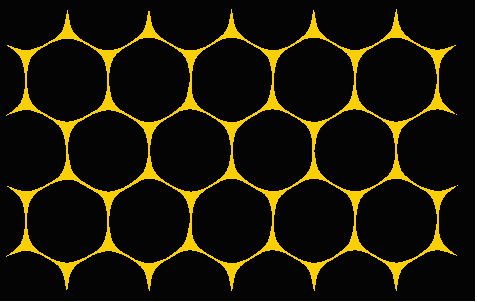
The Universe, on the grandest scale, is mainly static. See Fig. 2.
 |
||
|
Fig. 2. Static Cellular Universe. Each hexagon represents a dodecahedral cell (about 300 million lightyears across) within an infinite and static (nonexpanding, noncontracting) universe. (Again, highly schematic) |
UNIFICATION OF MODELS. It is rather ironic but all the
evidence indicates that the kinematic and dynamic expansion of the big
bang and contraction of the big crunch and the perpetual
uniformity of the steady state, when brought together, comprise a
comprehensive cosmic theory. The research conducted over many years in the
preparation of numerous DSSU articles found no evidence to the contrary.
Our world is both an ever-changing dynamic universe and an unchanging
steady-state universe. The DSSU is the triple amalgam of dynamic
"space", steady state processes, and static structure. And like
the structure of a living organism there is an ongoing renewal and
cell-scaffolding replacement.
It has happened before. In the history of science there are
found two notable
rival theories that claimed to describe the nature of light.
One was known as the wave theory, the other the corpuscular theory (or
stream-of-particles theory). After several contentious centuries there
emerged a wave-particle duality theory of electromagnetic radiation. In other words, the explanation of light
required both wave and particle theories. Remarkably, conflicting
explanations became united to form a superior single theory.
A functionally superior theory of the Universe requires features from
the two conflicting world views. The explanation of our Universe
requires dynamic vacuum, steady state processes, and quasi-static structure.
THE DSSU IN THE COMPETITION OF SCIENTIFIC THEORIES. The system for the selection of scientific truth involves lots of random scattered ideas and theories competing for survival. There follows the selection of the idea that seems to work best. One idea dominates, and this is followed by its amplification. [–Heinz Pagels, The Dreams of Reason, p138] ... But no theory, no matter how orthodox, is ever safe from competition.
|
Scientific
knowledge, like the evolution of life, is a selective system. |
Now if a superior idea is omitted from the initial selection system, then an inferior idea may take hold —then reasonable people may be led astray. The superior idea —the cellular-universe idea with its dual nature (or triple nature)— has never been put forward. It has never been in the competition (and therefore has never been rejected). While the standard Steady State and others were rightfully rejected, the BB became dominant (by default), became amplified, and now rules under the sponsorship of the Academic Establishment. The only "debate" has been among different versions of the BB model. None of these versions is persuasive.
The future of cosmology lies not with a simplistic
single-cell Big Bang but with a multi-cell, dynamic,
Steady State.
6. Miscellaneous Universe Models
|
Table 4: Miscellaneous Universe Model |
|||
| NAME (Type) | Author & Date | Classification |
REMARKS |
| Plasma Universe | Hannes Alfvén (Nobelist), 1965 | not classified |
Infinite in time; the universe has always
existed. Infinite in size. The "big bang" is merely a local
explosion. Not based on general relativity. Galaxies and clusters of
galaxies are shaped not only by gravity, but by vast electrical and
magnetic fields. Based on the observed fact that the matter of the
universe is 99% plasma —ionized
gas that can conduct electricity. The universe is sculpted by
titanic electric currents and associated magnetic fields that flow
through the plasma. (–Eric J. Lerner, The Big Bang Never Happened,
Discover 1988, June) |
| Multiverse (or meta-universe) | Hugh Everett (originator) Max Tegmark (main proponent) |
multiverse (Generally an infinite universe with fractal structure at all scales.) |
A multiverse (or meta-universe) is the hypothetical
set of multiple possible universes (including our universe). The
different universes within a multiverse are called parallel universes
or "parallel worlds." The narrow meaning of "multiverse" applies to a set of disconnected space-times. The broad meaning includes virtually any kind of multiple-domain and multiple-parallel universes. Multiverse models in general lack the empirical connection with reality that comes with hard physical evidence; they arguably fall outside the methodology of scientific investigation. They cannot be confirmed or disproved; and therefore are more mathematically theoretical and metaphysical than scientific in nature. The multiverse represents more of a classification than it does a theory. As a theory it is weak since it allows for far too many possibilities ---evident in the 4 hierarchical levels of classification of possible meta-universes. |
| Bubble Universe | see below | complex expanding universe | Bubble Universe concept involves an infinite number of "bubbles" or open multiverses; each may have different effective physical constants, dimensionality, and particle content. Both large and small bubbles are created from the quantum foam energy fluctuations of a "parent universe." A small energy fluctuation leads to the formation of a tiny bubble universe which may experience some expansion like an inflating balloon, and then contract and disappear from existence. However, an energy fluctuation greater than a particular critical value, leads to the formation of a bubble universe which experiences long-term expansion, and the possible formation of matter and large-scale galactic structures. This Bubble universe concept fits well with the widely employed hypothesis of cosmic inflation as well as chaotic inflation. |
| Inflation (Bubbles) model | Alan Guth 1981 |
complex expanding universe | An evolving universe based on the speculative concept of
hot inflation. (In the original model the bubbles were way
too small, while in a later version they were too big.) As the early
hot universe cooled, a supercooled vacuum-state developed which
eventually led to a process of bubble nucleation ---bubbles of
true vacuum spontaneously form in the sea of false vacuum
and begin a rapid lightspeed expansion. While bubbles are expanding
at the speed of light, the bubbles themselves are spaced far enough
apart so that the expansion of inter-bubble space made any bubble
interaction exceedingly rare. The problem: there was a
knife-edge balance involving the rate of bubble formation. If the
rate is not finely tuned, the scenario fails. Since each bubble represents a separate universe, Guth’s model should also be classified as a multiverse. |
| Inflation (Bubbles) models | Andreï Linde, Andreas Albrecht, Paul Steinhardt 1982 |
complex expanding universes | A grab bag of
evolving universes of the multiverse type; based on the
speculative concept of cold inflation (in contrast to Guth’s hot
inflation). And again, bubbles nucleate in a spacetime foam. Inflation
models violate the cosmological principle. Inflation theory, in
Linde’s words, “predicts that on the extremely large scale the
Universe becomes entirely inhomgeneous ...” Andreï Linde’s 1983 version, called Chaotic Inflation, has "little bangs" inflating themselves, at random, all over the place. Each with independent initial conditions; some expand into bubble universes supposedly like our entire cosmos. |
| The QSSU | Fred Hoyle, Geoffrey Burbidge, Jayant V. Narlikar 1993 |
cyclical expansion and contraction | The whole universe steadily expands and contracts (yet is not considered to be a finite universe). The universe undergoes cyclic oscillations between periods of compression and rarefaction involving enormous time scales. A notable characteristic is that new matter formation takes place in regions of intense gravitation, primarily in active galactic nuclei. Uses a Machian theory of gravity. Space and time are geometrized (as in general relativity theory). |
The Plasma Universe has a serious down side; it does not make sufficiently concrete predictions that would allow one to test and to judge the validity of the theory. A point of interest is that it postulates the existence of vast magnetic vortices which are reminiscent of René Descartes' 17th-century Vortex universe with its system of huge swirling whirlpools of fine matter.
The originator of the multiverse concept is generally considered to be Hugh Everett whose 1957 Princeton doctoral thesis first presented what has come to be called the "many worlds" interpretation of quantum mechanics. But the concept is more a flight of fantasy than science —a mathematical fantasy spawned in “the century of mathematical universes.” Cosmologist Edward Harrison sums up this category nicely: "When postulating other universes [multiverses] we quit the solid ground of empirical knowledge for the airy heights of unfalsifiable speculation." [–E. R. Harrison, Masks of the Universe, p288]
The Quasi-Steady-State Universe (QSSU)
is an infinite universe that is steadily expanding and contracting on a
time scale of about 1000 giga-years (1012 years). In a later version the time scale of the
expanding and contracting cycles is 40-50 giga-years. The cyclic oscillations
"involve maximum and minimum periods of compression and rarefaction" with
creation activity in galactic nuclei being greatest in the periods of
compression. It is a universe based on a modified version of Einstein's
geometrized space and time.
New matter formation takes place at active galactic nuclei where
astronomers observe energy in the form of hot gas, relativistic particles,
and coherent objects being ejected (comparable to H. Arp’s view) but nothing falling in. The traditional
view of the black hole as representing the crushing collapse of matter is
rejected. Ejection, not mass inflow, is the dominant mode of a black hole;
and this is how new matter and energy, sometimes in the form of compact
objects such as galaxies and quasi-stellar objects, is born. This is the
cosmogony of small "big bangs" in which energy is created in regions of
very strong gravitational fields in already existing systems.
[–G. Burbidge, An Alternative Approach to Cosmogony and Cosmology, J. Astrophys. Astr.
(1997) 18, p349-351] Continuous matter-creation events occur in regions of
very strong gravitational fields in the centers of galaxies in a process
supported by the Hoyle-Narlikar C-field theory ("C" for creation) which contains a
modification of Einstein’s theory. Matter creation is balanced by negative
kinetic energy (whatever that is!). Unlike Einstein's cosmological
constant, which has a positive value, the QSSU's Λ is negative; and
"does not represent the [vacuum] energy density of the quantum fields."
The model uses a Machian notion of gravity in which mass and
inertia arise from the interaction of a body or particle with all the
other bodies in the universe. But like all Machian models it lacks a
causal mechanism for gravitation.
The QSSU can explain the abundances of the light elements and their
isotopes. All elements are the product of stellar-based nuclear processes.
Microwave background radiation is a local effect caused by space
borne iron whiskers having favorable characteristics.
Like all other models of the universe, except the cellular class,
the QSSU does not give a cause for the rotation of galaxies.
Although it claims to be an alternative to the discredited BB
model, the QSSU, amazingly, supports the expanding universe paradigm. The
QSSU embraces the very same pillar that makes the BB model untenable! As
has been shown so often in the comparative study of universe models, the
unscientific extrapolation of the fundamental process of the Universe
—space expansion— always leads to irresolvable problems.
* * *
2005 rev2015-1 Copyright © by Conrad Ranzan Email: Ranzan@CellularUniverse.org
|
SELECTED SOURCES OF HISTORICAL DETAILS: Encyclopedia of Cosmology, Norriss S. Hetherington, Editor (Garland Publishing, Inc. NY & London, 1993) Cosmology, the Science of the Universe, E. R. Harrison (Cambridge University Press, 1981) The Atlas of Scientific Discovery, Colin Ronan (Crescent Books, 1983) Science: its History and Development Among the World Cultures, Colin Ronan (The Hamlyn Publishing Group Ltd, New York, 1982) Lonely Hearts of the Cosmos, Dennis Overbye (Little, Brown and Company, 1999) PARTIAL BIBLIOGRAPHY: Arp, Halton. 1998. Seeing Red: Redshifts, Cosmology and Academic Science |
This is an open-access article distributed under the terms and conditions of the Creative Commons Attribution License (http://creativecommons.org/licenses/by/4.0/) which permits unrestricted use, distribution, and reproduction in any medium, provided the original work is properly cited.
Link to PRINT VERSION of this article.
|